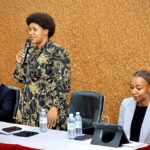






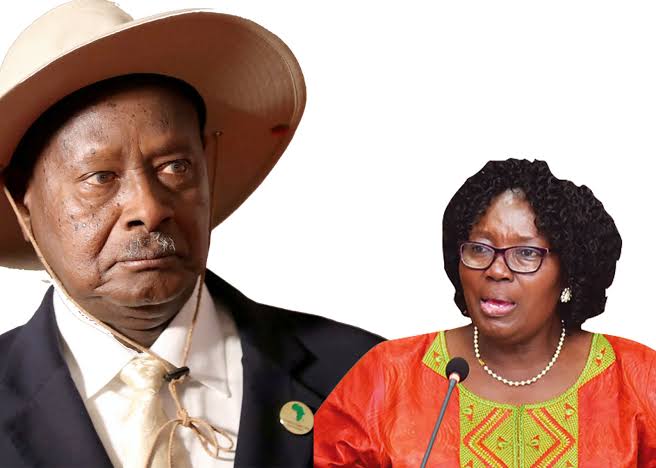

Rebecca Alitwala Kadaga, born on 24 May 1956 in Kamuli District in Uganda’s Busoga region, rose from a private legal practice in the 1980s to become the first woman elected Speaker of the Parliament of Uganda, serving from 19 May 2011 until May 2021.
A trained lawyer with an LLB from Makerere University (1978) and further qualifications in women’s law from the University of Zimbabwe, she entered politics in 1989 as Woman MP for Kamuli and held the post continuously thereafter. She served as Deputy Speaker from 2001 before ascending to the speakership.
After leaving the Speaker’s chair in 2021 (losing a contest to Jacob Oulanyah), she became First Deputy Prime Minister and Minister for East African Community Affairs, a position she continued to hold into 2026 while remaining an influential NRM figure and Kamuli representative.
The two measures associated with her speakership—the “Presidential age limit” and a “Covid-19 State of Emergency”—as bills that “would stop the over stay of President Museveni in power.” Historical records show a more complex and, in key respects, opposite reality for the age-limit measure, while the COVID discussion involved advice that was not enacted as a formal emergency declaration capable of altering term structures.

Background: Museveni’s Long Rule and Earlier Constitutional Changes.

Yoweri Museveni took power in 1986 after a five-year guerrilla war. In writings from that period he identified “leaders who want to overstay in power” as a core African problem. The 1995 Constitution introduced a presidential age ceiling of 75 (alongside a minimum of 35) and, initially, term limits. In 2005 Parliament removed the two-term limit, enabling Museveni’s continued candidacies. By 2017 he was in his early seventies; without further change he would have been constitutionally barred from the 2021 election.

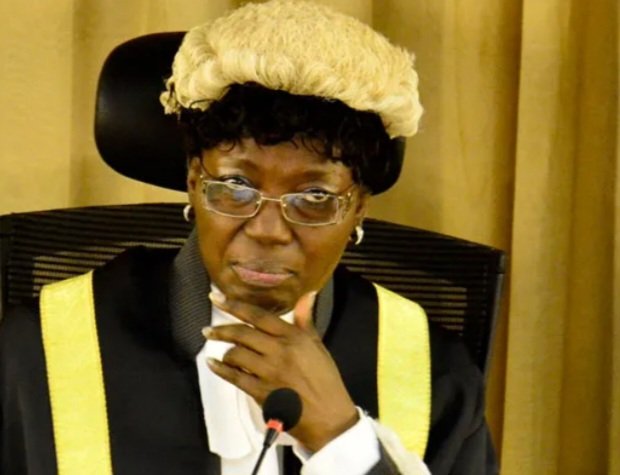
The 2017 Constitutional Amendment Removing the Age Limit.In 2017 a private member’s bill, primarily associated with Igara West MP Raphael Magyezi, sought to amend Article 102(b) of the Constitution to remove both the upper and lower age limits for presidential candidates. Speaker Kadaga allowed debate after adjusting the order paper. The process was highly contentious.
Opposition MPs, many wearing red as a symbol of protest, filibustered, walked out, and engaged in physical confrontations. Special Forces personnel entered the chamber at points, leading to suspensions of several opposition legislators (including Ibrahim Ssemujju Nganda and others) and reports of injuries, notably to MP Betty Nambooze. Chairs were thrown; sessions were chaotic across multiple days.
On 20 December 2017 the House voted. Kadaga announced the result: 317 in favour, 97 against, with two abstentions. The amendment also restored a two-term limit (to take effect after the subsequent election) and extended parliamentary and local government terms from five to seven years. Museveni signed the bill into law later that month or early the following year. The Constitutional Court later upheld the core age-limit removal.
Kadaga herself later stated publicly that without her role facilitating the process Museveni would not have been on the 2021 ballot. Ruling-party supporters celebrated the change as ending age discrimination; critics described it as clearing the last major constitutional barrier to prolonged incumbency, especially after the earlier term-limit removal.
Public reaction included protests, some of which were dispersed by security forces. Several of the 317 MPs who voted yes faced local backlash. The measure enabled Museveni, then 73, to contest and win subsequent elections. By the January 2026 general election he secured a seventh term with approximately 71.65% of the vote (about 7.95 million votes) against Bobi Wine’s roughly 24.72%, according to the Electoral Commission. Turnout was around 52.5%.
Opposition figures alleged irregularities and internet restrictions; the official result stood. The 2020 COVID-19 Discussions on a State of Emergency.In early 2020, as COVID-19 reached Uganda, the government imposed lockdowns, movement restrictions, curfews, and business closures under presidential directives and the Public Health Act. Speaker Kadaga and then-Chief Justice Bart Katureebe advised Museveni, in a meeting of senior leaders, that a formal state of emergency under Article 110 of the Constitution would provide clearer legal footing for the extensive measures.
Article 110 allows the President, in consultation with Cabinet, to proclaim an emergency in cases of war, internal threat, natural disaster, or threats to public safety and essential services; Parliament must approve within 14 days, and the proclamation is limited in duration (initially up to 90 days, renewable under conditions).
Kadaga later told Parliament that a Cabinet minister had persuaded the President against the formal declaration. Attorney General William Byaruhanga explained that incremental measures under existing public-health powers were considered sufficient and that a full emergency risked more extreme steps (such as commandeering private property) that were not yet deemed necessary. MPs, including Asuman Basalirwa, pressed for a formal declaration or consolidated statutory instruments to reduce legal challenges.
No formal state of emergency was declared. The country operated under a series of presidential directives and regulations, with Parliament debating statutory instruments and supplementary budgets. Security forces enforced measures, drawing human-rights criticism over alleged excesses. Elections proceeded in 2021 under restricted conditions; some argued a formal emergency could have allowed term extensions, but that path was not taken.Kadaga’s Broader Record as Speaker and Afterward.
As Speaker, Kadaga presided over budget processes, loan approvals, and legislation aligned with the NRM programme while also managing opposition participation. She has emphasised women’s leadership in Parliament, recounting resistance when she rejected all-male committee chair lists early in her tenure. After 2021 she focused on East African Community affairs, advocating reduced trade barriers, regional health and economic initiatives, and Uganda’s interests in EAC institutions. She remained active in Busoga development issues and NRM structures into late 2026.Implications and Contemporary Context (as of late 2026).
The age-limit removal, more than any single COVID-related discussion, removed a concrete barrier to Museveni’s continued candidacy and reinforced a pattern of constitutional adjustment around the executive. Term limits had already been eliminated; the age ceiling was the remaining numerical constraint. Restoring term limits prospectively while extending other terms was viewed by some as a political trade-off.
Succession questions have persisted, with attention on figures such as Museveni’s son, Gen. Muhoozi Kainerugaba, amid the President’s advancing age (81 during the 2026 campaign).The characterisation of both measures as vehicles that would have halted overstay does not align with the documented outcome of the age-limit amendment, which facilitated continued eligibility.
The COVID emergency advice reflected institutional concern over the legal basis of extraordinary public-health powers but did not produce a formal proclamation or any term-related consequence. These episodes illustrate the interplay between parliamentary procedure, executive preference, party majorities, and public contestation in Uganda’s politics over the past decade.Rebecca Kadaga’s tenure as Speaker placed her at the centre of one of the most consequential constitutional votes of the Museveni era.
Whether viewed as procedural management of a majority will, facilitation of continuity, or contribution to the erosion of limits, the record is public, contested, and consequential for Uganda’s institutional trajectory into the present.