








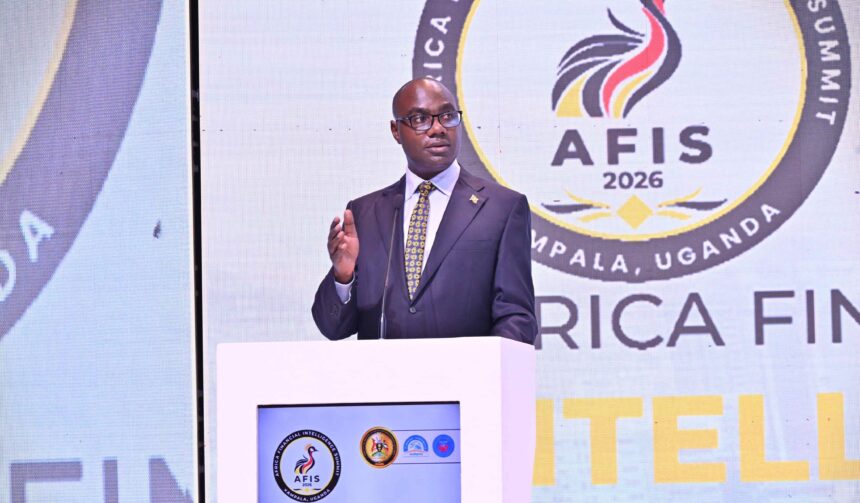

The Minister of Finance, Planning and Economic Development, Henry Musasizi, has called on African countries to strengthen the integrity of their financial systems to combat financial crime, protect national resources and accelerate economic transformation.
Minister Musasizi made the remarks on Monday while officially opening the second Africa Financial Intelligence Summit (AFRIS 2026) at Speke Resort Munyonyo Convention Centre in Kampala.
The summit brought together delegates from 36 countries, including financial intelligence authorities, law enforcement agencies, regulators, forensic investigators and international partners to discuss emerging financial crimes and strengthen cooperation in combating illicit financial activities.
Minister Musasizi said Africa was at a defining moment as financial crimes continued to evolve in scale, speed and sophistication, driven by the rapid growth of digital finance, financial technology, virtual assets and cross-border transactions.
He said African countries needed to strengthen their financial intelligence systems and institutions to respond effectively to emerging threats and safeguard their economies.

Minister Musasizi highlighted Uganda’s progress in strengthening its Anti-Money Laundering and Countering the Financing of Terrorism (AML/CFT) framework, which contributed to the country’s removal from the Financial Action Task Force (FATF) grey list.

He also commended the Financial Intelligence Authority (FIA) for becoming the first Financial Intelligence Unit in Africa to attain the ISO/IEC 27001:2022 certification, an internationally recognised standard for information security management.
According to Musasizi, the certification demonstrates Uganda’s commitment to protecting sensitive financial intelligence and strengthening public confidence in its financial systems.

However, he cautioned that the country must remain vigilant against emerging financial risks, particularly as it prepares for its 2028 Mutual Evaluation.
He identified virtual assets, weaknesses in beneficial ownership transparency, digital financial crimes and gaps in asset recovery as some of the areas requiring increased attention.
Musasizi urged African countries to prioritise stronger cooperation among Financial Intelligence Units, noting that financial crimes increasingly transcend national borders and require coordinated responses.
He also called for investment in technology and cyber resilience, including the adoption of artificial intelligence, blockchain analytics, cyber investigations and digital forensic capabilities to improve the detection and prevention of financial crimes.
On asset recovery, the minister emphasised the need for countries to strengthen mechanisms for tracing, freezing, seizing and recovering proceeds of crime so that stolen resources can be returned to benefit economies and citizens.
He said Africa must move beyond meeting technical compliance requirements and focus on building effective, secure and trusted financial systems that protect national resources, attract investment and support sustainable economic development.
“Let this Summit strengthen our institutions, sharpen our intelligence, deepen our cooperation and ensure that Africa’s financial systems increasingly work for Africa’s development,” Musasizi said.
He challenged delegates to translate discussions and recommendations from the summit into practical actions, stronger partnerships and lasting institutional capacity to address financial crimes across the continent.
Minister Musasizi commended the Institute of Forensics for selecting Uganda to host the summit, saying the gathering provides an opportunity to strengthen professional capacity and cooperation in financial intelligence across Africa.