
Summary:
- They raised concerns about the significant disparity between the hospital’s annual revenue of only Shs7 billion and its annual budget of approximately Shs31 billion provided by the government.
KAMPALA: Members of Parliament on Parliament’s Public Accounts Committee on Thursday protested against the charges imposed on patients at Mulago Specialized Women and Neonatal Hospital.
They raised concerns about the significant disparity between the hospital’s annual revenue of only Shs7 billion and its annual budget of approximately Shs31 billion provided by the government.
This was after Muwanga Kivumbi (Butambala County) asked the Hospital administrators to provide the breakdown of costs charged patients, and wondered if the revenue collected from the patients is worth having the facility continue charging Ugandans who are also servicing the US$34.14 Million (Shs129.220Bn) acquired from the Islamic Development Bank for its construction.

“We are still even paying the loan that built this facility, so we want to know this facility, beautiful as it is, why it charges Ugandans. We continue to subsidize you, your NTR is just Shs7Bn maximum, your budget is Shs31Bn so if we are paying you, how much are you charging us? Justify why you charge that money,” said Muwanga, who doubles as Chairperson PAC.

Administrators of Mulago Specialised Women and Neonatal Hospital, women who have normal delivery on the Gold card are charged Shs1M, while normal delivery under Platinum is Shs2.5M, C-Section under silver is Shs1.3M, while holders of the gold card that undergo C-section are charged Shs2.5M, while patients on gold card are charged Shs2.5M, while the VIP platinum cost Shs4M for patients who have C-section.
Upon receiving the rates, Muwanga wondered what would happen if Government instead boosted the Hospital’s budget by the amount of revenue collections and have Ugandans complete the payment of the loan used to build the hospital.
“A facility that charges this much also continues to encroach on the public purse and it is highly subsidized by Government and when you look at the trend of your NTR, it is about Shs7Bn a year would that justify why we shouldn’t find the money as Government top up for what they could have lost in NTR. With the entire ambiance you have and everything, the revenue is nowhere, it is very low. If we allocated you additional Shs7Bn and told you from today onwards offer free services, will that be fine with this entity?” noted Muwanga.
However, Dr. Evelyn Nabunya, Executive Director at Mulago Specialised Women and Neonatal Hospital said the decision for the facility to charge Ugandans was taken by Cabinet, which also ordered for the establishment of a Waiver Committee to deal with cases of Ugandans who can’t afford rates charged by the Hospital.
“The decision to be able to charge for services came from Cabinet and a team of Cabinet members came here to verify why people should pay and they guided the team on how to set these charges and they also guided that there should be a waiver Committee to be enable Ugandans who can’t afford the services to be able to access them,” said Nabunya.
Meanwhile, MPs on Parliament’s Public Accounts Committee also questioned why Government opted to Kawempe National Referral Hospital with lifts that were meant to last for only 5years, a decision that has left expectant mothers and mothers to grapple with use of stairs during the numerous breakdowns of these lifts.
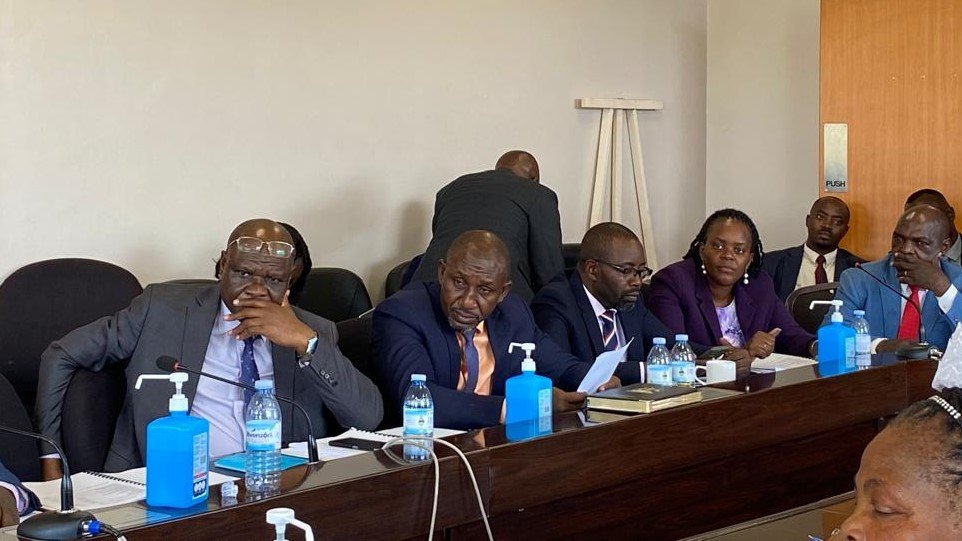
The revelation was made by Emmanuel Byaruhanga, Executive Director, Kawempe National Referral Hospital while meeting held to scrutinize the December 2023 Auditor General’s report, where he said the challenge is exacerbated by the high volume of patients, and worse still, the Hospital was built in a swamp and during the rainy season, lifts constantly breakdown and at the moment, one, out of the three is out of service.
“Out of the three lifts, one if down and that is on and off, the nature of this hospital, it is in a swamp, when it rains it becomes flooded. It needs overhaul because I was told it was built for 5years and it is more than 5years, so the whole system needs to be replaced. I am not the one who procured it. It was in 2016 is when it started working and it is now 7years, it is now obsolete,” explained Byaruhanga.
“We deliver around 60 babies per day, we handle around 80 mothers per day at any one time, we have about 130 mothers in the hospital, we have at least 120 babies in the hospital, 90% of which are neonates that is, babies between 0-8days and therefore, we are overwhelmed by referrals from all over, complications and burden of poor outcomes from mothers and children. We have many challenges but we work within the means we have and if you look at our statistics which I am sure you can, you will see how effective this hospital is,” added Byaruhanga.
This prompted Muwanga Kivumbi (Butambala County) to explain how Government would construct a facility like Kawempe Hospital which was meant to decongest Mulago Hospital and serve the poor people, with such a short lifespan lift, to which prompted Alfred Enywaku, Biomedical Engineer at Kawempe Hospital to explain the challenge affecting the lifts at the facility.
“The challenge that we are having is the high-water level by nature of construction of lifts, they usually go down into the grounds so what happens, water sips from the surrounding, it is like you are creating a well, so as the lift goes down in the basement, in the rain season like this one, it sips the water, so this water gets its way into the lift, the lift has chains behind with the thread that locks it. If the chain cuts, the water gets its way into the wires,” explained Enywaku.
However, Muwanga rejected the excuse given that the constant breakdowns of the lifts is due to the fact that Kawempe Hospital was built in a swamp but rather blamed it on the incompetent engineering job done by the contractors at the time of construction.
He said, “That was just an engineering challenge. We even build in proper swamps and even in the swamp when you build, you can even reach a firm level and once you reach a firm level from there, you can construct and I don’t think that firm level in this place is far. I do a lot of building. Actually, in some areas you go down, you excavate, you reach a firm ground, you begin to build from there, you do a water proof casing of where the lift will be all over the hospital. How can someone say that is a huge challenge? Even me a pedestrian without being an engineer, those things I can do.”