
Summary:
- The Cotton Development Organization handed over vital assets, including land, a cotton testing lab, and buildings.
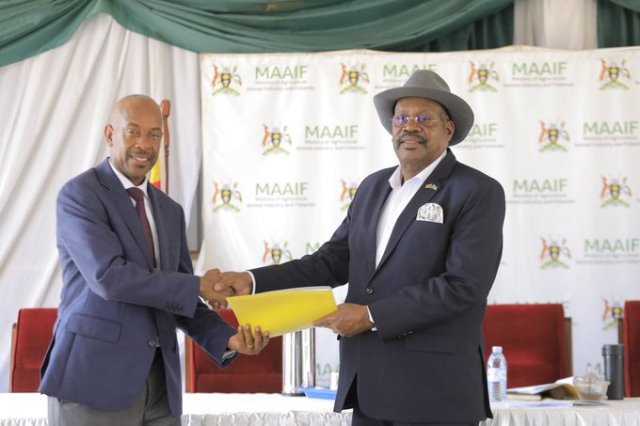
KAMPALA: In a move to streamline operations and enhance efficiency, the Uganda Coffee Development Authority (UCDA), the National Agricultural Advisory Services (NAADS), the Dairy Development Authority, and the Cotton Development Organization (CDO) have officially handed over their operations to the Ministry of Agriculture, Animal Industry and Fisheries (MAAIF).
This transition follows the recent dissolution of these agencies after President Museveni assented to amended Acts on December 23, 2024. The formal handover ceremony took place at MAAIF headquarters in Entebbe.
During the handover on Thursday, Permanent Secretary Maj. Gen. David Kasura-Kyomukama emphasized that rationalization is not abolishment but a reallocation of resources aimed at improving efficiency. He assured stakeholders that services and operations would continue uninterrupted, with no loss of assets or personnel.

Under the UCDA, Uganda’s coffee production has grown from 2.8 million bags in 1991 to 9 million bags annually, generating $1.1 billion in export revenue. UCDA’s significant assets, including regional offices and a Farmer Registration System, are now under MAAIF’s management.

The dairy sector has also witnessed impressive growth, increasing from 250 million liters to over 5 billion liters of production annually, contributing over $250 million in exports. MAAIF will sustain this progress under its new structure.
The Cotton Development Organization handed over vital assets, including land, a cotton testing lab, and buildings. Key activities, such as cotton marketing, ginning, and processing, remain ongoing. The organization noted liabilities worth UGX 1.7 billion and highlighted efforts to support youth employment through new job frameworks.
The Ministry of Agriculture, Animal Industry and Fisheries has committed to ensuring the seamless continuation of impactful projects such as the Coffee Centre of Excellence, the Enhanced Regional Agricultural Growth Opportunities Network (ERAGON), the Kyambogo Hub, and various marketing initiatives.
Projects under NAADS, including irrigation systems and high-value crop promotion, will also be absorbed into MAAIF’s mandate.
Stakeholders were assured that the transition would ensure continuity and sustained progress. Assets, staff, and ongoing projects are fully integrated into MAAIF to maintain momentum in Uganda’s agricultural transformation.
The restructuring is seen as a step towards realizing the government’s vision of optimizing public resources, boosting agricultural production, and positioning Uganda as a regional leader in agriculture and exports.
During the event, UCDA, represented by Eunice Kabibi, the Board Secretary and Director of Legal Affairs, presented a detailed report on its operations. The report showcased UCDA’s accomplishments, assets, and ongoing projects during its existence. According to the report, the UCDA has been instrumental in overseeing the coffee sector’s growth and development. Operating with six directorates, the UCDA’s headquarters are located at Coffee House on Jinja Road.
It maintains a laboratory at UMA Show Grounds and has established regional and sub-regional offices across coffee-growing districts. The agency’s operations span 126 districts, supported by a workforce of 175 employees.
At the handover to MAAIF, Dr. Samuel Mugasi, the former Executive Director of NAADS, highlighted the agency’s long-standing impact, particularly in empowering farmers through resources and advisory services.
He reassured stakeholders that ongoing agricultural projects, such as irrigation systems and market linkages, would be seamlessly integrated into the ministry’s mandate. Dr. Mugasi also announced the establishment of a new Department of Development within MAAIF to absorb key staff and functions from the former agencies.
He flagged legal and financial challenges, including unresolved arrears and pending court cases, for further attention. Recommendations included scaling up high-value crops and enhancing extension services to address emerging needs in the agricultural sector.