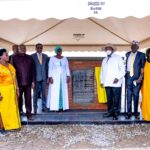
KABALE: The Minister of Finance (General Duties), Henry Musasizi, has called on the Church to remain a beacon of hope for the poor and to promote initiatives aimed at lifting Ugandans out of poverty and improving their quality of life.
Minister Musasizi made the remarks while officiating as Guest of Honour at the climax of the 15th Caritas Week, held at Our Lady of Good Shepherd Rushoroza Cathedral in Kabale Municipality on Sunday.
Minister Musasizi reaffirmed the government’s commitment to partnering with the Church by fostering a conducive policy and legislative environment and supporting joint development programs in pursuit of shared national goals.
“Your Lordship, you are aware that the Government of Uganda, through its ministries, regularly provides funding to NGOs on a Public-Private Partnership basis. Ministries such as Agriculture, Gender, and Social Development have issued calls for proposals many times,” Musasizi elaborated.
He acknowledged the Catholic Church’s significant role in Uganda’s socio-economic transformation from a low-income to a projected middle-income status by 2040 through private sector-led development.

“The Catholic Church, since the pre-independence era, has established and continues to manage numerous educational institutions across the country from nursery schools to tertiary institutions,” he noted.

He further applauded the Church for establishing health facilities in underserved and hard-to-reach areas, as well as for implementing socio-economic empowerment programs that promote financial inclusion for low-income earners and provide skills training for youth and adults in various sectors, including value addition in agriculture.
Minister Musasizi also highlighted the impact of Catholic Church-linked financial institutions like Centenary Bank, Promic Kabale, and HOFOKAM in deepening financial inclusion for unbanked populations.
“These initiatives, many of which started under Caritas, align with the government’s priorities as outlined in the National Development Plan IV, especially in key sectors like agriculture and minerals,” he added.
Despite the macroeconomic progress made over the past four decades, Minister Musasizi acknowledged that poverty still affects many households across Uganda.
He pointed to several government initiatives designed to tackle this challenge, including Emyooga, the Youth Livelihood Programme (YLP), the Uganda Women Empowerment Programme (UWEP), Operation Wealth Creation (OWC), and the Parish Development Model (PDM).
“These programs are designed to help poor households access funding and inputs to invest in profitable enterprises that can improve their livelihoods,” he said. “Through its community-based efforts, the Church is directly contributing to the goals of these programs. We urge Caritas and the Church to continue raising awareness and mobilizing community participation.”
He also encouraged Caritas to proactively respond to government calls for proposals and to position itself competitively to access funding.
Rev. Fr. Vincent Byaruhanga, Director of the Caritas Commission for Kabale Diocese, noted that Caritas Uganda has become increasingly vulnerable following the suspension of foreign aid by former U.S. President Donald Trump, with significant reductions in funding from the U.S.
Speaking at the same event, Kabale Municipality MP Nicholas Kamara urged Ugandans to support organizations like Caritas through local donations to reduce reliance on foreign assistance.
Ndorwa East County MP Wilfred Niwagaba also called on the government to increase support for private-sector organizations like Caritas to help bridge the funding gap left by international donors.