
President Yoweri Kaguta Museveni has reiterated his dedication to honoring Uganda’s war heroes and strengthening community security as the nation marked the 36th Heroes Day celebrations.
The event took place at Lyantonde Technical Institute Grounds in Kaliiro Town Council, Lyantonde District on Monday, with the President accompanied by First Lady and Minister of Education and Sports, Maama Janet Kataaha Museveni.
President Museveni praised the fighters of the National Resistance Army (NRA) and recognized the vital support from the people of Kabula and Sembabule in the liberation struggle.
“I want to salute the fighters who stood firm during the resistance movement, especially the people of Kabula and Sembabule who supported us in the struggle,” he said.
The 36th Heroes Day was held under the theme: “The Legacy and Ideals of Our Heroes: A Memorable Inspiration.” Heroes Day is a national public holiday established to honor individuals who contributed significantly to Uganda’s liberation and development. It commemorates June 9, 1981, when NRA fighters led by Edidian Mukiibi Luttamaguzi were killed by the Uganda National Liberation Army (UNLA) for aiding the resistance, laying the foundation for recognizing national heroes.

President Museveni directed a fresh review of the Ministry of Luwero Triangle’s budget, emphasizing practical support for families of fallen and living war veterans.

He proposed supplying materials such as iron sheets and cement to families, who would contribute bricks and labor, focusing on solving one clear problem at a time.
“The budget must be focused. You may not build an entire house but at least give iron sheets and cement, and let the families make their own bricks,” he said.
Recalling past initiatives, the President noted that when NAADS and Operation Wealth Creation began in 2013, inputs were first provided to veterans’ families. He also announced a plan to shift veterans’ medical treatment to Entebbe Grade B Hospital to reduce costs and introduced plans for a special burial fund for former fighters.
On rural security, President Museveni attributed rising insecurity to poor communication and slow responses. Citing a deadly attack in Kisojo, Bukomansimbi, he directed police at every sub-county to operate a 24-hour toll-free emergency line.
“When I visited, I realized the problem was poor coordination. Now, police at every sub-county manage a toll-free line in shifts,” he explained.
He urged citizens to contact their nearest police stations directly during threats, highlighting the case of nurse Nakyambadde near Lukaya, whose quick call to police helped thwart an armed attack.
“These killers were not special. What they took advantage of was our disorganization,” the President said.
He also referenced the successful tracking of criminals involved in the killing of elders in Masaka, underscoring the importance of trained police units and coordination to curb rural crime.
President Museveni condemned landlords who evict bibanja tenants, calling it a colonial legacy that must end. He stressed that land disputes require government intervention rather than private negotiations.
“If someone claims to be your landlord, brings papers, and tells you to leave, that’s abuse of your ignorance,” he said.
A new law will soon allow bibanja tenants to pay rent at sub-county offices, preventing landlords from manipulating or threatening tenants with eviction.
President Museveni praised local wealth creation efforts in cattle keeping, coffee production, and other ventures, pledging government support for smallholder irrigation projects to help vulnerable communities maintain productivity during dry seasons.
He encouraged farmers to grow pasture for livestock instead of relying solely on natural grazing and urged families to adopt better succession practices to avoid fragmenting property.
Responding to local demands, he assured that infrastructure projects, including the Ntutsi–Kashagama–Lyantonde and Lyantonde–Lumbugu–Rakai roads, would be prioritized.
Minister for the Presidency, Hon. Babirye Milly Babalanda, praised President Museveni as a living hero whose sacrifices continue to shape Uganda’s destiny. She highlighted Kabula’s role as a crucial corridor for freedom fighters and lauded the bravery of residents who supported the struggle despite risks.
“Your Excellency, we thank you for fighting for Uganda’s freedom. You gave up everything to liberate our motherland,” she said, calling Uganda a beacon of regional stability and refuge.
Hon. Alice Kaboyo, State Minister for the Luwero Triangle and Rwenzori Region, also commended the President’s leadership and the new sub-county policing model, which improves grassroots security.
She noted government efforts to build houses for civilian veterans and highlighted a recent medical outreach treating over 2,300 patients in the Luwero and Rwenzori sub-regions.
Kigundu Kabandwa, Chairperson of Civilian Veterans in Luwero Triangle, described President Museveni as a true national hero and praised Lyantonde for its deep roots in Uganda’s liberation history.
He urged the public to preserve the professionalism of the Uganda People’s Defence Forces (UPDF), calling it a vital national asset.
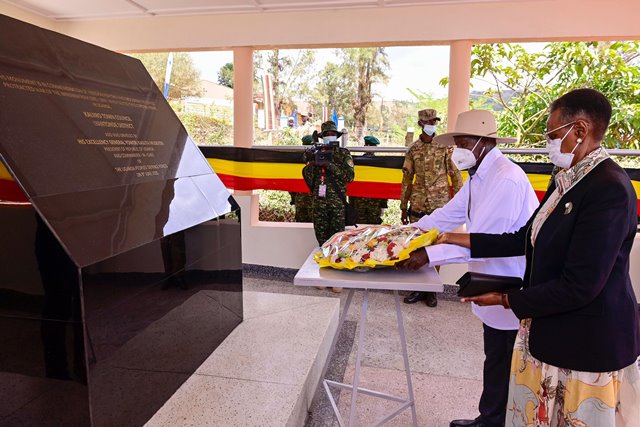
Before the celebrations, President Museveni and Maama Janet visited a monument commemorating freedom fighters who died during the NRA protracted war (1981-1986), laying a wreath in their honor.
This Heroes Day, President Museveni reaffirmed Uganda’s commitment to honoring its heroes, strengthening community security, and fostering national development, urging Ugandans to remain vigilant, united, and focused on the mission ahead.