


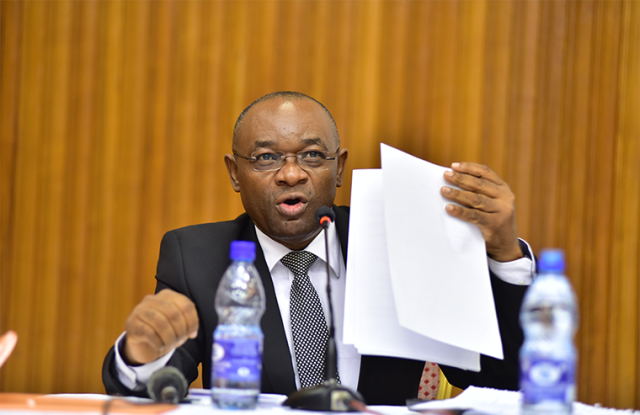

The Minister for Local Government, Hon. Raphael Magyezi, has admitted to major challenges hindering the full operationalisation of newly created cities and requested one month to implement urgent reforms recommended by Parliament.
His remarks followed the presentation of a report by the Committee on Government Assurances and Implementation during plenary on Tuesday, 5 August 2025.
The report highlighted serious administrative, financial, and infrastructure gaps in the 15 cities approved between 2020 and 2023.
According to the committee, only 10 cities have been partially operationalised, while the remaining five that include Kabale, Moroto, Nakasongola, Entebbe, and Wakiso remain non-functional.
The committee cited weak governance frameworks, staffing shortages, lack of funding, and failure to gazette district headquarters as key setbacks.

Presenting the report, Committee Chairperson Hon. Abed Bwanika (NUP, Kimanya–Kabonera Division) said government had failed to honour its pledge to ensure the functionality of the new cities.

“To a large extent, government has not implemented this assurance,” Bwanika stated, pointing to the absence of legal frameworks, weak urban policy implementation, and underfunded statutory bodies.
He noted that cities like Masaka were operating at only 32.1% staffing capacity, despite the Cabinet’s approval of staffing structures in 2022.
In some cases, critical bodies such as City Service Commissions, Land Boards, and Public Accounts Committees lacked adequate funding.
For instance, Mbarara’s City Service Commission received only Shs18 million for the entire 2022/2023 financial year.
The report also revealed that most cities lack approved Physical Development Plans and are entangled in unresolved asset-sharing disputes with their parent districts, fueling conflicts and allegations of fraudulent land transactions.
In response, Minister Magyezi accepted the findings and committed to implementing the committee’s recommendations.
“We agree with the committee report and fully embrace the recommendations. Most of them give us 30 days to act. I request Parliament to allow us this time to focus on implementation and report back with tangible progress,” Magyezi said.
He pledged to address key issues such as gazetting district headquarters, resolving asset-sharing disputes, finalising staffing structures, and improving waste management and road infrastructure.
He also committed to introducing legislation to streamline city governance and harmonise local leaders’ remuneration.
“We will also demonstrate improvement in city financing and local revenue collection, but we need time to compile a comprehensive update,” he added.
Speaker of Parliament Anita Among granted the minister’s request but emphasized the need for accountability.
“We shall give you one month under Rule 229, but we expect an action-oriented report,” she said.
MPs across the political divide welcomed the report but raised further concerns.
Hon. Karim Masaba (Independent, Industrial Division, Mbale City) decried the financial burden of maintaining borrowed road equipment, citing lack of government support.
He also criticised the state of Mbale’s garbage dumpsite at Doko.
“When you arrive in Mbale, you’re greeted by heaps of garbage. It’s an eyesore,” he said.
Hon. John Baptist Nambeshe (NUP, Manjiya County) questioned the return of over Shs41 billion to the Consolidated Fund despite the disbursement of Shs427 billion in city start-up funds, citing poor absorption and planning.
He also criticised delays in staff restructuring and the absence of clear asset management frameworks.
Hon. Silas Aogon (Independent, Kumi Municipality) called attention to the ongoing water crisis in urban areas, noting the policy limitations on borehole construction despite a lack of piped water infrastructure.
Speaker Among clarified that borehole construction is permitted with authorisation from the National Water and Sewerage Corporation.