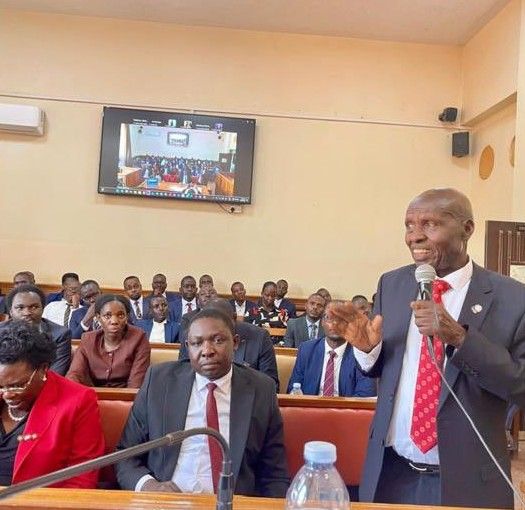

The Mbarara High Court Circuit this week on Tuesday convened a hybrid Bar–Bench meeting at the court premises, bringing together judicial officers, prosecutors, and advocates to strengthen collaboration and improve case management within the circuit.
Deputy Registrar HW Grace Atwongyeire welcomed participants and commended legal practitioners for their professionalism and cooperation over the past year.
She also extended a warm reception to judicial officers recently transferred or deployed to the circuit. She noted that the meeting was intended to promote constructive dialogue between the Bench and the Bar to enhance coordination for more efficient justice delivery.
Highlighting the court’s performance during the second quarter, Atwongyeire reported that the court conducted targeted criminal sessions in Mbarara, Ntungamo, and Ibanda, alongside a Settlement Fortnight held in November 2025 and a Plea-Bargaining Camp conducted in December 2025 at Mbarara Main Prison.
She said the court disposed of 766 cases against a target of 500, achieving a 153.2 percent disposal rate, attributing the achievement to teamwork and commitment to people-centred justice in line with the Judiciary of Uganda Client Charter.

Justice Nshimye Allan, the Head of the Circuit, praised stakeholders for maintaining professionalism and collaboration in supporting justice delivery.

He outlined priority areas under the Judiciary’s 6th Strategic Plan (FY 2025/26–2029/30), including digital transformation, reduction of case backlog, strengthening integrity and accountability, and improved stakeholder engagement.
Justice Nshimye also announced that Mbarara High Court and selected Chief Magistrates’ Courts under the circuit had been selected for the next phase of rollout of the Electronic Court Case Management Information System (ECCMIS).
He further revealed plans to operationalize Ibanda and Ntungamo High Court circuits, saying the move would ease workload pressure and reduce travel costs for litigants and lawyers.
He encouraged advocates to adopt digital innovations, utilize alternative dispute resolution mechanisms, and make use of the Mbarara Open Court Days held every Wednesday afternoon to address case management concerns.
Representing the Bar, Advocate Collins Nuwagaba appreciated the leadership of the circuit for institutionalizing regular Bar–Bench engagements.
He acknowledged improvements in case management but pointed out persistent challenges, including delays in judgment delivery in some cases, denial of costs in lower courts, inadequate staffing in registries, missing mother case files during execution stages, and limited training opportunities for advocates on ECCMIS.
During plenary discussions, stakeholders proposed several recommendations to the Judiciary. These included structured training for advocates on ECCMIS, fast-tracking the operationalization of Ibanda and Ntungamo High Court circuits to reduce workload and travel expenses, publishing notices of expression of interest for advocates seeking appointment to the Roll of State-Appointed Advocates, appointing acting judicial officers to help reduce backlog, expanding parking and office space at Mbarara High Court to accommodate increasing court users, and deploying more support staff.