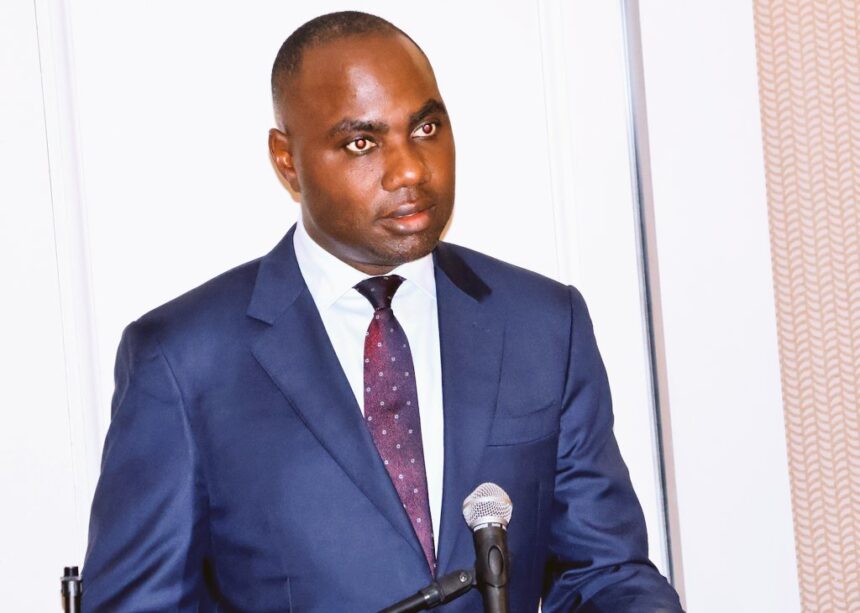

The Minister of State for Finance in charge of General Duties, Henry Musasizi, is leading a delegation from the Ministry of Finance to the 2026 Spring Meetings of the International Monetary Fund and the World Bank in Washington, D.C., scheduled for April 13–18, 2026.
The high-level gathering has brought together policymakers, government leaders, private sector representatives, and development partners to deliberate on global economic trends, financial stability, growth prospects, and poverty reduction. This year’s meetings are held under the theme: “Building Prosperity through Policy.”
“It is a pleasure to be here to discuss business, investment and opportunities that would make all of us more prosperous,” said the Minister.
He said Uganda has a bold national goal: to grow the economy tenfold by 2040 and reach a GDP of $500 billion.
“We want partners in investment, trade, tourism, and technological upgrading to achieve this strategic goal,” he said.

The Minister said Uganda has inexhaustible opportunities in Agro-Industrialization, Tourism, minerals and the entire extractive sector, Science and Technology; and in infrastructure development.

Speaking ahead of the meetings, the Permanent Secretary and Secretary to the Treasury, Ramathan Ggoobi, said Uganda’s key focus will be advancing negotiations for a new Extended Credit Facility (ECF) programme with the IMF.
He added that the country will also seek additional concessional financing from the World Bank to support transformative projects and budget financing through Development Policy Operations.
Other senior government officials attending the meetings include the Attorney General, Kiryowa Kiwanuka, and the Governor of the Bank of Uganda, Michael Atingi-Ego.
While in Washington, the Ugandan delegation will participate in the second U.S.–Uganda Business and Investment Forum and hold bilateral meetings with the U.S. Administration and the World Bank Vice President for the Africa Region.
The team will also engage with the IMF Africa Department Director, Abebe Aemro Selassie, and take part in the Coalition of Finance Ministers on Climate Action meeting.
At the Spring Meetings, global leaders are expected to explore how policy, investment, and innovation can drive job creation and unlock private sector investment to accelerate economic growth.
Discussions will also focus on practical approaches to delivering results in key sectors such as energy, water, agriculture, health, and digital development.
Leaders are further expected to agree on effective policies for creating jobs, attracting and sustaining private investment, and expanding economic opportunities and service delivery across sectors.
According to the latest Africa Economic Update released by the World Bank in April 2026, economic recovery in Sub-Saharan Africa is losing momentum following successive global shocks, with growth projections for 2026 revised downward.
The report attributes the slowdown to factors including geopolitical tensions in the Middle East, high debt service burdens, and persistent structural challenges.
It recommends a pragmatic, ecosystem-based approach that aligns policy tools with country capabilities to drive productivity gains and support long-term structural transformation.