
Finance ministers from Kenya, Rwanda and Uganda have agreed to prioritise financing for the Standard Gauge Railway (SGR) project, following a high-level meeting held in Washington, D.C. on the sidelines of the ongoing IMF and World Bank 2026 Spring Meetings.
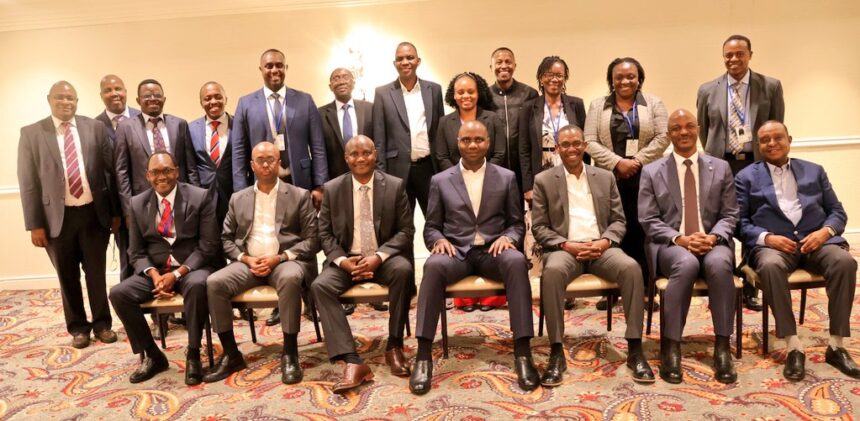
The meeting brought together Kenya’s Cabinet Secretary for the National Treasury and Economic Planning, John Mbadi; Rwanda’s Minister of Finance and Economic Planning, Yusuf Murangwa; and Uganda’s Minister of State for Finance in charge of General Duties, Henry Musasizi.
Also in attendance were Uganda’s Attorney General Kiryowa Kiwanuka, Permanent Secretary and Secretary to the Treasury Ramathan Ggoobi, Kenya’s National Treasury Permanent Secretary Chris Kiptoo, and Rwanda’s Head of Development Finance Gerald Mugabe, alongside other senior government officials.
Kenya reaffirmed its commitment to spearheading the completion and extension of the SGR to the Malaba border with Uganda. Mbadi emphasised the need for stronger regional cooperation to ensure the project’s long-term viability.
Rwanda, through Murangwa, expressed readiness to extend the railway from the Uganda border, describing the SGR as a strategic opportunity to enhance regional connectivity, trade and investment across East Africa and beyond.

Murangwa also commended Kenya and Uganda for taking the lead, noting that Rwanda is already preparing for its phase of implementation.

On Uganda’s part, Minister Musasizi reiterated the country’s commitment, revealing that implementation of the Malaba–Kampala section is already underway. He stressed that the success of the SGR hinges on collective commitment from all partner states.
“The viability of this SGR depends on all of us committing to do the project,” Musasizi said, adding that Uganda plans to extend the railway to the borders of Rwanda and the Democratic Republic of Congo.
Ggoobi confirmed that Uganda has already contracted the construction of the 270-kilometre Malaba–Kampala line and appointed Citibank as the lead arranger and coordinator for project financing.
He added that progress has been made in acquiring the right of way and that discussions are ongoing with the World Bank to support the project.
Earlier, the Ugandan delegation held talks with a World Bank team led by Division Director Qimiao Fan to explore financing options for the SGR.
Ggoobi described the railway as a transformative infrastructure project that will ease regional connectivity, reduce cargo transport costs and enhance trade competitiveness.
The World Bank signalled its willingness to support Uganda, indicating it would consider available financing opportunities for the project.
In a separate engagement, the Ugandan delegation also met Citibank officials led by Managing Director and Global Head of Export and Agency Finance, Richard Hodder, to assess progress in mobilising funds for the SGR.