
Ministers-designate appointed by President Yoweri Museveni are set to appear before Parliament’s Appointments Committee for vetting starting Monday, 01 June 2026.
The ministers, appointed by the President earlier this week, will interface with the committee chaired by Speaker Jacob Marksons Oboth and deputised by the Deputy Speaker.
The Appointments Committee was formally constituted during a plenary sitting of Parliament on Thursday, 28 May 2026, presided over by Speaker Oboth.
The committee comprises members drawn from across the political divide, including the Leader of the Opposition in Parliament, Hon. Joel Ssenyonyi, alongside representatives from the ruling National Resistance Movement (NRM), opposition parties, and independent MPs.
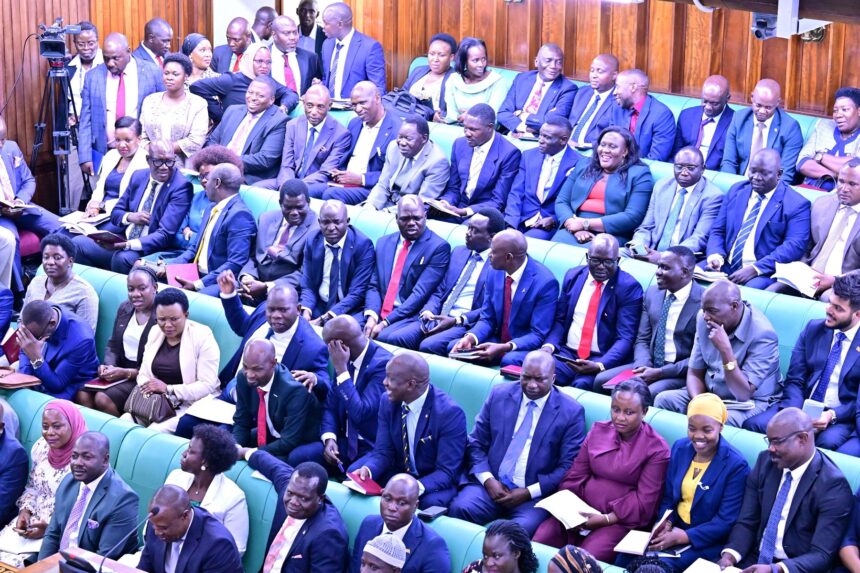
Ahead of the anticipated vetting exercise, Parliament, during Thursday’s plenary sitting, the second of the 12th Parliament, approved an increase in the number of Cabinet Ministers and Ministers of State to 30 and 51 respectively, in line with Articles 113(2) and 114(3) of the Constitution.

Under the Constitution, parliamentary approval is required to increase the number of Cabinet Ministers and other ministers beyond the statutory 21 positions.

The approval followed a motion moved by Prime Minister Robinah Nabbanja, who, together with Vice President Jessica Alupo, had earlier been approved by Parliament for their respective positions.
“For the efficient running of the State, the President has determined that there is need to increase the total number of Cabinet Ministers from twenty-one to thirty, and the total number of Other Ministers from 21 to 51,” Nabbanja told the House.
She explained that Uganda’s growing population and expanding governance demands necessitated an increase in ministerial portfolios to improve service delivery and ensure equitable representation.
According to Nabbanja, flagship government programmes such as the Parish Development Model (PDM), the Emyooga initiative, and climate resilience strategies require dedicated ministerial oversight to ensure effective implementation.
“Specialised portfolios are needed to coordinate cross-cutting programmes, monitor government performance, and guarantee accountability at the grassroots level. More ministers allow specialisation, clearer mandates, and stronger oversight,” she said.
The motion was seconded by Kyaka South County MP, Hon. Jackson Kafuuzi, the Deputy Attorney General-designate, who argued that Parliament’s approval serves as a safeguard against unchecked expansion of Cabinet.
“The framers of the Constitution anticipated evolving governance needs and deliberately vested Parliament with the authority to approve such adjustments. This is not a departure from the law, but its faithful application,” Kafuuzi said.
However, several opposition MPs opposed the proposal, urging Parliament to retain the constitutional limits on the number of ministers.
Hon. Betty Nambooze (NUP, Mukono Municipality) argued that governance gaps, if any, could be addressed through local leadership structures.
“For the first time in the history of this country, let us maintain the number of ministers as provided for in the Constitution and see how it works,” Nambooze said.
Chief Opposition Whip Hon. Paul Mwiru also urged government to retain the constitutional threshold, arguing that reducing the number of ministers would free up more resources for service delivery.
Kassanda North County MP, Hon. Patrick Nsamba, echoed similar concerns, citing the recent rationalisation of government agencies and calling for a reduction in ministerial appointments.
In response, Prime Minister Nabbanja clarified that the proposed numbers reflected existing ministerial portfolios and did not amount to an expansion beyond the operational structure already in place.
“The number of ministers and ministers of state carrying out duties remains the same. Rationalisation focused on eliminating duplication of roles in departments and agencies linked to ministries,” Nabbanja explained.
Parliament is expected to constitute the remaining 30 standing and sectoral committees of the House in due course.
The committee comprises representatives from the NRM, opposition parties, and independent legislators, ensuring broad political representation in the vetting of presidential appointees.