







Kabale University has appealed to the government for increased funding to expand infrastructure and recruit additional staff to cope with its growing student population and sustain the quality of education.
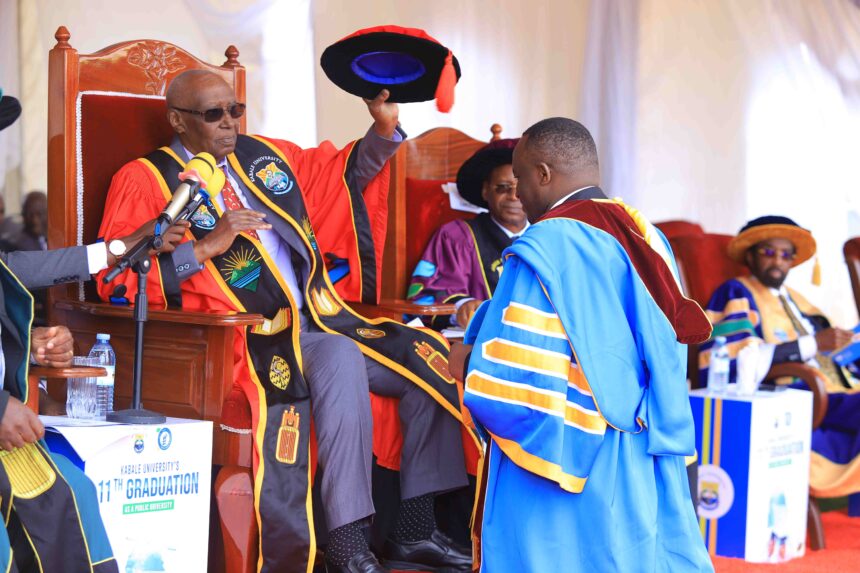
The appeal was made on Friday during the 11th university’s graduation ceremony, where 2,469 students were awarded degrees and diplomas at the university grounds in Kabale District.
Addressing the congregation, the Chairperson of the University Council, Adson Kakuru, said that despite the institution’s continued growth and expansion, it faces emerging challenges that require increased government support.
Kakuru noted that the university had recently expanded its operations to Rukungiri District, where it opened a new campus, and was preparing to commence operations in Kisoro District after receiving the former Teachers Training College (TTC).
He said the expansion had increased the university’s responsibilities, including the need to recruit more academic and non-academic staff, meet rising operational costs and upgrade facilities to meet the required university standards.

“I would therefore like to make a passionate appeal to the government to increase funding, particularly for infrastructure development, to enable us to adequately address the demands arising from our recent expansion,” Kakuru said.

CUE IN KAKURU…ON THE APPEAL…ENG//
The University Chancellor, Canon Mathew Rukikaire, said the institution was currently operating at approximately 25 per cent of its approved staffing establishment, a shortfall that had affected teaching, mentorship, research and community engagement.
Rukikaire cited the need for modern lecture facilities, laboratories, workshops and research spaces to support the university’s expanding academic programmes.
He also called for increased government support towards staff recruitment, promotions and improved remuneration, noting that the quality of a university largely depends on the commitment and motivation of its workforce.
Rukikaire further asked the government to support Kabale University’s ambition of becoming a regional centre of academic excellence serving students from neighbouring countries, including Rwanda, Burundi, Tanzania and the Democratic Republic of Congo.
He said the university’s strategic location positioned it to contribute to regional integration, research and development within the Great Lakes region.
CUE IN RUKIKAIRE….ON THE CHALLENGES….ENG//
The Acting Vice Chancellor of Kabale University, Prof. Johnny Mugisha, outlined plans to expand research, strengthen academic programmes and improve infrastructure as the institution seeks to consolidate its growth and enhance the quality of higher education.
Mugisha said the university was prioritising the alignment of academic programmes with national, regional and labour market demands through the implementation of competence-based curricula and the integration of information and communication technology (ICT) into teaching and learning.
He said the institution intended to strengthen partnerships with industries and other strategic stakeholders to equip students with practical skills and improve graduate employability.
Other priorities include expanding postgraduate training, attracting international students, strengthening research capacity and establishing centres of excellence.
Mugisha added that the university planned to modernise its teaching and research facilities through investment in digital learning infrastructure, specialised laboratory and workshop equipment, as well as completing infrastructure for the Faculty of Engineering at Nyabikoni in Kabale Municipality.
On human resource development, he said the university would recruit, develop and retain competent academic and administrative staff, with a target of attaining at least 50 per cent of its approved staffing establishment.
CUE IN PROF MUGISHA…ON THE MATTER….ENG//
The Minister of Security, Maj. Gen. (Rtd) Jim Katugugu Muhwezi, who represented the Prime Minister, Robinah Nabbanja, pledged to follow up on the concerns raised by the university and ensure they are presented to the relevant government authorities for consideration.
CUE IN MINISTER MUHWEZI…ON RESPONSE…ENG//
Meanwhile, Prime Minister Nabbanja urged Kabale University to align its academic programmes, research and investments with Uganda’s national development priorities to accelerate economic transformation, industrialisation and job creation.
Nabbanja said the university should focus on areas with high economic potential, including agriculture, tourism, mineral-based industrialisation, science, technology and innovation, to produce graduates with practical skills capable of driving national development.
She emphasised the need to strengthen agricultural value addition, particularly in Irish potato production, dairy farming and horticulture, noting that the university should build on its Irish potato value addition initiative to support agro-processing, enterprise development and increased household incomes.
On tourism development, Nabbanja urged the institution to invest in tourism and hospitality training, research, digital tourism promotion and community-based tourism, citing its strategic location within the Kigezi tourism region.
She said partnerships with tourism operators, conservation institutions and private sector players would help develop a skilled workforce, attract investment, improve tourism competitiveness and create employment opportunities.
On mineral-based industrialization, the Prime Minister called for stronger training in engineering, technology and applied sciences to produce the technical workforce required in manufacturing, mineral processing and infrastructure development.
She further urged the university to equip its engineering workshops and laboratories, strengthen industrial attachments and promote partnerships with industries to ensure graduates acquire practical and market-relevant skills.
Nabbanja also identified science, technology and innovation as critical areas, urging the institution to prioritise applied research, digital transformation, innovation incubation and commercialisation of research outputs.
She recognised Kabale University’s selection to host an artificial intelligence node under the East African Regional Artificial Intelligence Network, saying the opportunity should be harnessed to promote digital skills, technology transfer and innovations that address challenges in agriculture, healthcare, tourism and industry.
On human capital development, the Prime Minister called for stronger competence-based education, practical training and internship programmes to improve graduate employability.
She said academic programmes should respond to labour market demands and equip graduates with technical, entrepreneurial, digital and problem-solving skills to enable them to secure employment and create opportunities for others.
Nabbanja also encouraged the university to strengthen research and community engagement through partnerships with local governments, farmers, cooperatives, industries and development partners to translate research into improved livelihoods and better public services.
She particularly emphasised the need to support the Parish Development Model and other national wealth creation initiatives.
On institutional capacity, the Prime Minister urged the university to prioritise investment in modern teaching facilities, laboratories, ICT infrastructure, research facilities and qualified academic staff.
She said such investments should be guided by national development priorities, value for money, prudent resource management and innovative financing arrangements, including appropriate public-private partnerships.
CUE IN NABBANJA…ON KABALE UNIVERSITY….ENG//