







Government will host the 2026 National Justice Week from November 23 to December 4, with a focus on improving access to justice, strengthening institutional coordination and addressing challenges affecting the justice delivery system.
The annual event, organized by the Justice, Law and Order Sector (JLOS), will provide a platform for public engagement, accountability and access to justice services.
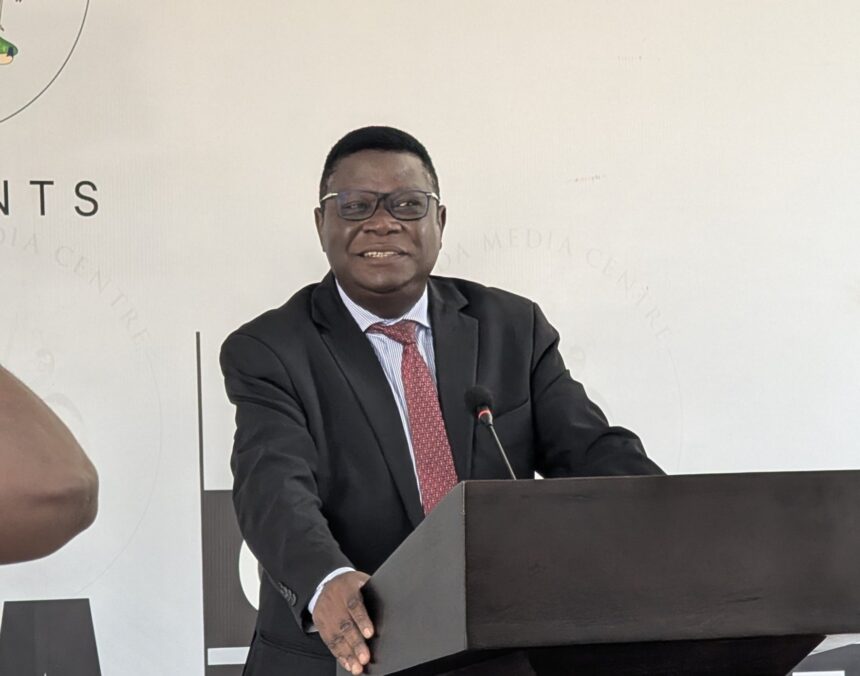
Announcing the event at Uganda Media Center on Wednesday, the Minister of Justice and Constitutional Affairs, Norbert Mao, said this year’s celebrations will be held under the theme: “Advancing Integrated People-Centred Justice, Law and Order Delivery System for Socio-Economic Transformation.”
Minister Mao said the theme underscores the need to place citizens’ needs, rights and dignity at the centre of justice delivery while strengthening coordination among institutions responsible for administering justice.
“Justice should not just be like a cheque in your pocket. If you have a cheque in your pocket, you cannot go to the market with it because it is not going to buy anything for you. Justice should not be a promise which is just in the laws and the Constitution. Justice must be experienced daily by Ugandans,” he said.

He said justice should be measured by citizens’ experiences rather than the existence of laws, constitutional provisions or institutional structures.

Minister Mao identified land disputes, family disagreements, inheritance conflicts, delayed trials, unfair dismissal of employees and failure to enforce contractual obligations among the everyday challenges that require an accessible and efficient justice system.
He said the theme also highlights the relationship between justice and economic development, arguing that reliable justice systems protect property rights, enforce contracts, promote fair competition and build investor confidence.

“When commercial disputes are resolved quickly, the cost of doing business comes down, prices become lower for citizens and there is enterprise development. Justice is not just a social service; it is an economic necessity. Without justice, the wheels of the economy will grind to a halt,” he said.
The minister said this year’s celebrations will also mark 25 years of the Justice, Law and Order Sector, which he said had registered progress in expanding judicial services, improving case management and introducing alternative dispute resolution mechanisms.
Among the achievements he highlighted was the establishment of the JLOS Towers in Kampala, which has brought several justice institutions under one roof, improving coordination and service delivery.
He also cited the expansion of judicial infrastructure, including the establishment of a High Court in Lugazi, which has reduced the distance residents previously travelled to access services in Mukono.
He said government remains committed to establishing a High Court in every district and a magistrate’s court in every constituency to bring justice services closer to citizens.
He also highlighted the automation of case management systems, which allows litigants to file cases digitally, as well as the introduction of mobile courts and alternative dispute resolution mechanisms to reduce pressure on conventional courts.
He said the Chief Justice had issued an instrument declaring every children’s remand home a magisterial area and another providing for mobile courts, which he said would help expedite the handling of cases, including traffic offences.
However, he acknowledged that the sector continues to face challenges, including case backlog, the high cost of legal services and difficulties faced by communities whose members are detained far away from their homes.
The minister said the celebrations would provide an opportunity for the sector to reflect on its achievements while openly discussing gaps that continue to affect access to justice.
He said government would prioritize legal aid, community justice; mediation and public legal education to ensure vulnerable citizens understand their rights and can access justice without necessarily engaging expensive legal services.
Minister Mao, who said much of his legal career, was spent providing legal aid to disadvantaged communities emphasizing that justice should not be reserved for wealthy or influential individuals.
“Justice should not only go to the highest bidder. Justice should not only go to those who have status or those who are near the courts. However vulnerable, however remote, everybody deserves justice,” he said.
He also said the sector would continue addressing case backlog through plea bargaining, which allows accused persons to acknowledge responsibility for offences under agreed terms, subject to court approval.
The minister cited the case involving businessman Matthew Kanyamunyu, who was convicted over the 2016 killing of Kenneth Akena, as an example of plea bargaining following engagement with the victim’s family.
On judicial capacity, Minister Mao said Parliament had approved an increase in the number of High Court judges to 151 and Court of Appeal justices to 56, although the approved positions had not all been filled.
He also highlighted the decentralization of the Court of Appeal, saying residents of western Uganda can now access its services in Mbarara instead of travelling to Kampala, while those in northern Uganda can use the Gulu station.
As part of the celebrations, JLOS will hold recognition awards on December 3 to honour individuals and institutions that have made outstanding contributions to promoting justice and the rule of law.
Minister Mao said the sector would also hold a review on December 3, during which members of the public would be given an opportunity to question officials about progress, challenges and gaps in justice delivery.
He called on government institutions to embrace coordination, saying the JLOS experience over the past 25 years had demonstrated that institutions achieve more when they work together.
He cited instances where road works undertaken by Kampala Capital City Authority are later disrupted by utility companies such as the National Water and Sewerage Corporation, saying such practices demonstrate the consequences of poor coordination.
He said the National Justice Week would bring together government institutions, development partners, civil society organizations and other stakeholders to discuss ways of making justice more accessible, affordable, efficient and people-centred.
Minister Mao reaffirmed the government’s commitment to ensuring timely access to justice, stressing that the need for speedy trials should not undermine fairness, due process and the protection of human rights.
He said the justice system must uphold the principle that justice delayed is justice denied, but warned against turning justice delivery into a fast-food process where speed takes precedence over fairness.
He also highlighted the importance of juvenile justice, rehabilitation and reintegration, saying children who come into conflict with the law should not be condemned to a lifetime of exclusion through stigma and discrimination.
He noted that the November 23 to December 4 National Justice Week 2026 will also focus on digital transformation, public trust, accountability and improved access to justice services.
Key issues raised in his remarks include:
1. Speedy justice: Reducing delays in case handling without compromising fairness.
2. Juvenile justice: Promoting diversion, rehabilitation and reintegration of children in conflict with the law.
3. Digital transformation: Using technology to reduce the cost of accessing justice, track cases and improve efficiency.
4. Innovation: Organizing a hackathon to encourage young people to develop technology-based solutions to justice-related challenges.
5. Public trust: Strengthening equality before the law, professionalism, integrity, transparency and respect for human rights.
6. Accountability: Inviting members of the public to share experiences and provide feedback to help identify corrective measures.
He admitted that the credibility of the Justice, Law and Order Sector (JLOS) was at stake because citizens’ experiences were not matching the promises made by the institutions.
He also appealed to the media to publicize practical justice services, particularly those targeting vulnerable communities and people in remote areas.