







Summary:
- Despite adjustments in forecasts downward compared to the previous round, short-term projections suggested a potential rise in inflation to between 5.5% to 6% within the next 12 months, with a return to the medium-term target of 5% anticipated in the second half of 2025.
KAMPALA: Bank of Uganda’s Monetary Policy Committee (MPC) has announced an upward adjustment in the Central Bank Rate (CBR).
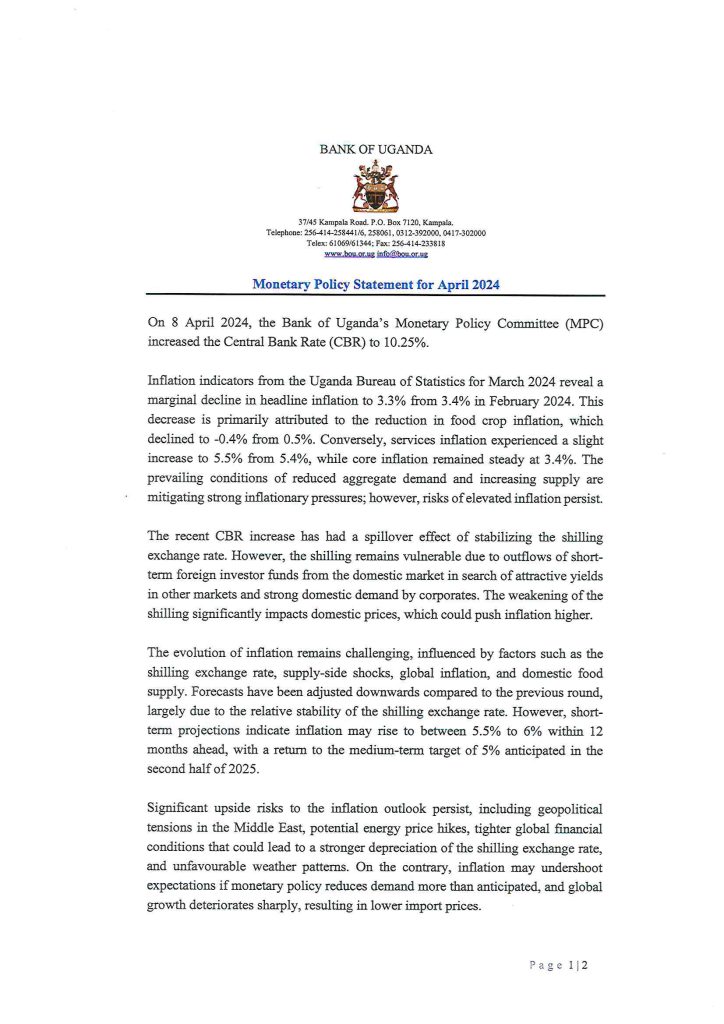
On April 8, 2024, Michael Atingi-Ego, Deputy Governor of the Bank of Uganda, stated that the MPC decided to raise the CBR to 10.25% in response to recent economic indicators.
Atingi-Ego cited data from the Uganda Bureau of Statistics for March 2024, indicating a slight decrease in headline inflation to 3.3% from 3.4% in February 2024. He attributed this decline primarily to a reduction in food crop inflation, which decreased to -0.4% from 0.5%. However, services inflation saw a slight uptick to 5.5% from 5.4%, while core inflation remained steady at 3.4%.

“The prevailing conditions of reduced aggregate demand and increasing supply are helping to alleviate strong inflationary pressures; nevertheless, risks of elevated inflation persist,” Atingi-Ego remarked.

He noted that the recent increase in the CBR had a positive impact on stabilizing the exchange rate of the shilling. However, he warned of vulnerabilities in the shilling due to outflows of short-term foreign investor funds and strong domestic demand by corporates.
“The weakening of the shilling could significantly impact domestic prices, potentially pushing inflation higher,” he cautioned.
Atingi-Ego acknowledged the challenges in forecasting inflation, influenced by factors such as the exchange rate of the shilling, supply-side shocks, global inflation, and domestic food supply. Despite adjustments in forecasts downward compared to the previous round, short-term projections suggested a potential rise in inflation to between 5.5% to 6% within the next 12 months, with a return to the medium-term target of 5% anticipated in the second half of 2025.
He highlighted significant upside risks to the inflation outlook, including geopolitical tensions, potential energy price hikes, tighter global financial conditions, and unfavorable weather patterns. Conversely, inflation could undershoot expectations if monetary policy reduces demand more than anticipated and if global growth deteriorates sharply.
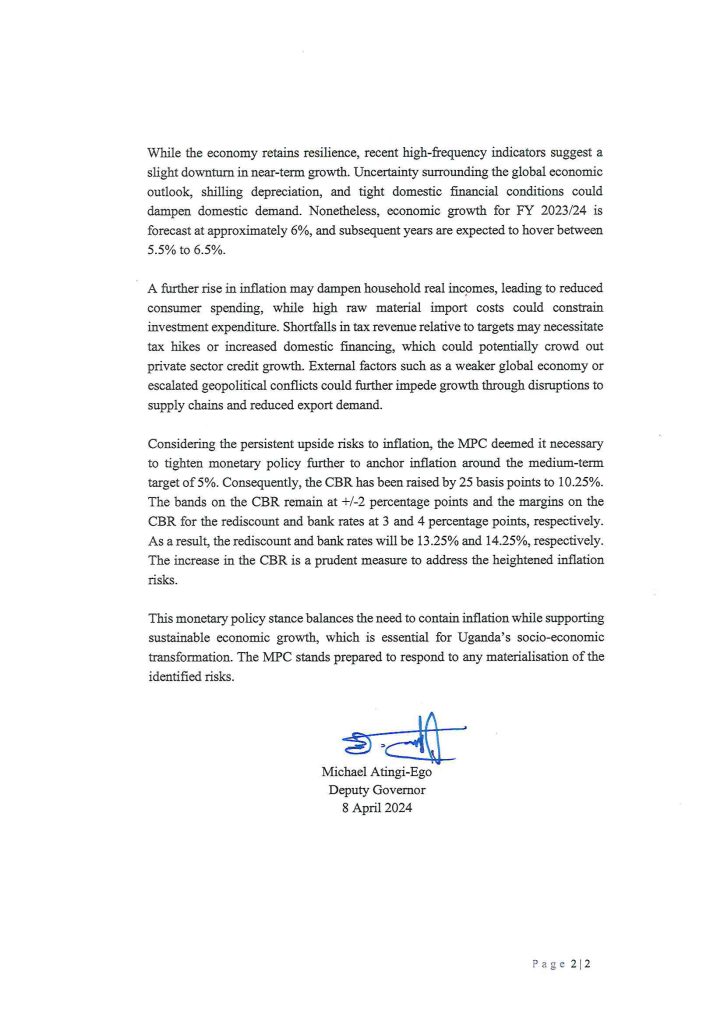
Regarding economic growth, Atingi-Ego mentioned a slight downturn in near-term growth based on recent high-frequency indicators. He emphasized uncertainty surrounding the global economic outlook, shilling depreciation, and tight domestic financial conditions, which could dampen domestic demand. Nonetheless, economic growth for FY 2023/24 was forecasted at approximately 6%, with subsequent years expected to hover between 5.5% to 6.5%.
Atingi-Ego cautioned that further inflationary pressures could dampen household real incomes, leading to reduced consumer spending, while high raw material import costs could constrain investment expenditure. He also warned of potential shortfalls in tax revenue relative to targets, which may necessitate tax hikes or increased domestic financing, potentially crowding out private sector credit growth. External factors such as a weaker global economy or escalated geopolitical conflicts could further impede growth through disruptions to supply chains and reduced export demand.
“In light of the persistent upside risks to inflation, the MPC deemed it necessary to tighten monetary policy further to anchor inflation around the medium-term target of 5%. Consequently, the CBR has been raised by 25 basis points to 10.25%,” Atingi-Ego declared. He emphasized that this measure was prudent to address heightened inflation risks while maintaining support for sustainable economic growth.
“This monetary policy stance balances the need to contain inflation while supporting sustainable economic growth, which is essential for Uganda’s socio-economic transformation. The MPC stands prepared to respond to any materialization of the identified risks,” he concluded.