







Summary:
- The 132kV Kole – Gulu – Nebbi – Arua Transmission Line is capable of delivering over 200MW of power to West Nile. Both the Nebbi and Arua Substations have been constructed with an 80MVA capacity each.
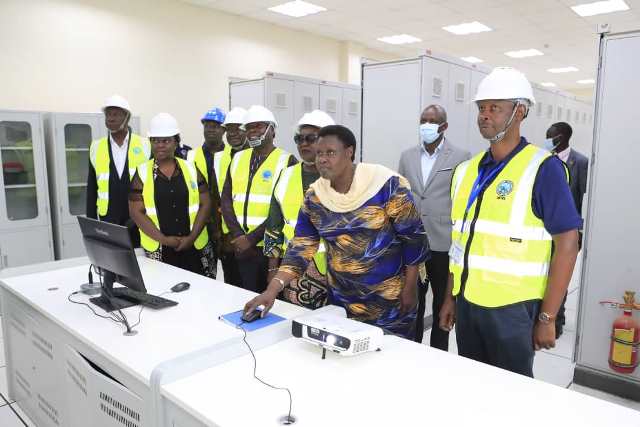
ARUA: On Sunday, Vice President Maj. (Rtd) Jessica Alupo inaugurated the 132kV/33kV Arua power substation to enhance electricity supply in the West Nile region.
The previous day, President Yoweri Museveni officially commissioned the Nebbi substation (132kV), which facilitated the connection of the West Nile sub-region to the high voltage national grid.
The 132kV Kole – Gulu – Nebbi – Arua Transmission Line is capable of delivering over 200MW of power to West Nile. Both the Nebbi and Arua Substations have been constructed with an 80MVA capacity each.

Commissioning the project on behalf of President Museveni, Vice President Alupo highlighted that connecting West Nile to the national grid will enable the evacuation of electricity from key power projects such as Karuma, Agago/Achwa, and Nyagak I and III.

“This will not only meet the region’s unserved demand but also stimulate economic growth, improve livelihoods, and foster industrial development,” Alupo said.
She emphasized that energy development is a significant enabler of industrialization, advanced agricultural production, and reducing business costs.
Alupo further noted that energy availability facilitates the establishment of rural industries, aligning with the NRM’s goal of building an integrated and self-sustaining manufacturing sector based on locally available raw materials.
“It also helps preserve the environment by reducing reliance on wood fuel for domestic purposes. The NRM government is working tirelessly to increase energy availability and consumption across the country,” Alupo added.
She recalled that when the NRM came to power in 1986, the country faced a severe energy problem despite its high hydropower potential. The country had a hydro-electricity generation capacity of 165 megawatts, but only 60 megawatts were being generated, affecting development and industrialization. In 2005, a decision was made to invest in power generation to address the low supply issue.
“With the commissioning of Karuma and Isimba Hydropower Plants, generation capacity is now more than 2,000MW. Uganda is in the preliminary stages of developing its Nuclear Energy Programme for peaceful applications in health, trade, agriculture, and power generation. The government has commenced developing 8,400MWe of nuclear energy in Buyende District,” Alupo said.
She warned that the current hydropower generation capacity will be outstripped by increasing demand by 2028.
“Electricity will not be adequate for manufacturing industries by then. Therefore, the government is scaling up investments in new generation capacity due to increasing industrialization,” she added.
Alupo informed the people of Arua that electricity transmission capacity has increased from 3,500 km to 4,218 km of high voltage as of 2019/20.
“The government is fast-tracking transmission lines to load centers such as mining and industrial parks. Efforts are being made to intensify distribution to support the implementation of the Parish Development Model,” she said.
She urged leaders to mobilize people to exploit the reliable power supply to produce goods and services in commercial agriculture, industries, services, and ICT sectors.
“The necessary socio-economic infrastructure to transform Uganda from a predominantly peasant society to a modern economy is in place, including tarmacked roads from border to border, sufficient electricity supply, and an ICT backbone,” the vice president said.
Alupo stressed that to achieve total societal transformation, this infrastructure must be utilized to create jobs and wealth for households. “Poverty in Uganda is due to 38% of households still being trapped in subsistence farming,” she said.
She urged leaders to guide people on enterprise selection in the four sectors to ensure profitability of their businesses.
The Kole-Gulu-Nebbi-Arua 132kV transmission line, financed by the World Bank and the government of Uganda, aims to reinforce supply to West Nile and connect the region to the national grid.
Ruth Nankabirwa, the Minister of Energy and Mineral Development, explained that the project’s objective is to increase the availability and efficiency of bulk electricity supply in the project area. She emphasized that this will enable the evacuation of electricity from the Karuma, Agago/Achwa, Nyagak I, and III power projects to meet the region’s unserved demand.
She thanked all stakeholders, especially the development partners and the World Bank, for their support towards the project’s successful completion.
Geoffrey Feta, Chairperson of the West Nile Parliamentary Caucus and Ayivu East Member of Parliament in Arua City, hailed the development as a fundamental change in West Nile’s history, bringing stable and industrially reliable electricity. He urged the government to extend this power to local beneficiaries at the grassroots level.