
Summary:
President Museveni emphasized that the government is committed to promoting sustainable wetland management alongside human development through collective action.
RUBIRIZI: President Yoweri Kaguta Museveni has reaffirmed the Government’s commitment to the protection and preservation of wetlands across Uganda.
“The NRM Government is fully dedicated to environmental conservation, which is embedded in our major policies, including Vision 2040, the NRM Manifesto, the Parish Development Model, and the National Development Plan,” said President Museveni.

He highlighted that the Constitution of Uganda and the National Environment Act of 2019, along with 10 other laws, provide a strong framework for environmental management, particularly for wetland conservation.

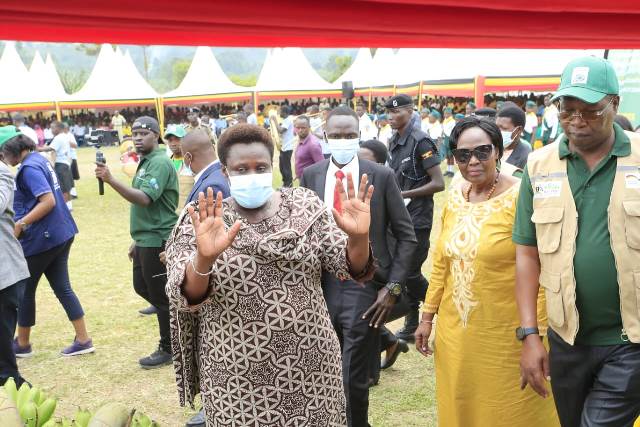
The president made these remarks during Uganda’s commemoration of World Wetland Day, held in Rubirizi District, Western Uganda, on February 2, 2025. The event was organized under the theme “Conserving Wetlands for a Secure Tomorrow.”
In a powerful speech delivered by Vice President Maj. (Rtd) Jessica Alupo, President Museveni urged all Ugandans who value nature to invest in the protection of wetlands for the sake of future generations. He declared 2025 as a nationwide “Year of Wetlands Action.”
President Museveni emphasized that the government is committed to promoting sustainable wetland management alongside human development through collective action.
“To this end, we have taken several important steps: the creation of the Environment Protection Police Unit in 2011, the 2014 Cabinet directive to cancel land titles erroneously issued in wetlands, the gazetting of all wetlands, and wetland restoration and boundary demarcation,” he explained.
Healthy wetlands are crucial for rainfall formation, managing the water balance, and maintaining both above-ground and underground water sources. On the other hand, the degradation of wetlands can result in severe consequences for public health, water quality, and many other essential ecological functions.
The Government has recently approved a 10-year Environment and Natural Resources Restoration Action Plan, which aligns with the UN’s Decade on Ecosystem Restoration. This plan aims to enhance existing efforts toward wetland recovery.
Thanks to these initiatives, President Museveni noted that Uganda’s wetlands are showing signs of recovery. The percentage of intact wetlands has risen from 8.9% in 2015 to 9.3% today, with a target of 12% recovery by 2040.
He explained that the country has transitioned from viewing wetlands as wastelands to recognizing their value as assets critical to national development and poverty reduction.
Under the National Development Plan III, wetlands are integral to “sustainable industrialization, inclusive growth, and employment creation.”
The president reassured the public that the government will continue working until all Ugandans recognize the importance of preserving these resources for both present and future generations.
He commended local governments that have taken the message of wetland protection seriously and urged them to continue supporting institutions like the National Environment Management Authority (NEMA) in halting wetland degradation.
“I call on each of you to stop blaming NEMA or the Ministry of Water and Environment and instead work together to protect wetlands starting in your own neighborhoods,” he said.
The president also urged the Ministry of Water and Environment and its partners to double their efforts in securing Uganda’s wetlands, which are biodiversity hotspots, carbon sinks, and vital sources of livelihood. He encouraged activities such as promoting irrigation off wetland areas, fish farming at wetland edges, and adding value to wetland products.
However, Museveni stressed that new innovations and value chains for wetland resources are necessary to drive socio-economic transformation.
“Academia, research institutions, and the private sector must take a leading role in this. Let’s support companies like MAKA Pads, which are already producing sanitary towels from papyrus,” he said.
He thanked development partners, non-state actors, and the private sector for their continued support of conservation efforts. Museveni also urged people living in wetlands to peacefully relocate, encouraging them to use the Parish Development Model to explore alternative livelihoods and reduce reliance on wetlands.
He called on the private sector and development partners to invest in wetland conservation, emphasizing that it is vital for Uganda’s survival.
State Minister for Environment, Beatrice Anywar, highlighted that, according to the latest Global Biodiversity Assessment, wetlands are disappearing three times faster than forests. This is supported by Uganda’s National Biodiversity Assessment, which identifies wetlands as the most threatened of the country’s ecosystems.
“The consequences of environmental degradation are evident. We are facing high temperatures, erratic rains, and crop failure. Globally, natural disasters such as wildfires, cyclones, floods, and hurricanes are becoming more frequent,” said Anywar.
She also noted that World Wetlands Day symbolizes Uganda’s commitment to joining the global community in protecting and managing wetland resources.
Anywar further explained that this day also offers a chance to assess Uganda’s progress as a Contracting Party to the Ramsar Convention since 1988.
Wetlands in Uganda contribute over $1 billion annually to the national economy.
David Okurut, the Commissioner for Wetlands at the Ministry of Water and Environment, urged all stakeholders to reaffirm their commitment to wetland preservation, investing the necessary financial, human, and political resources to prevent the further loss of wetlands and to restore those that have been degraded.
He acknowledged the significant support from partners, including the Rubirizi District local government, UNDP, GIZ, WWF, the Royal Danish Embassy, the EU, ABi Trust, Join for Water, Nature Uganda, NEMA, and Teens Uganda.