
Summary:
President Museveni proposed that land for the factory be identified on the bare hills within Ntungamo and Kigezi.
NTUNGAMO: President Yoweri Kaguta Museveni has tasked the people of Ntungamo District to identify 300 acres of land for establishing a factory to manufacture industrial charcoal.
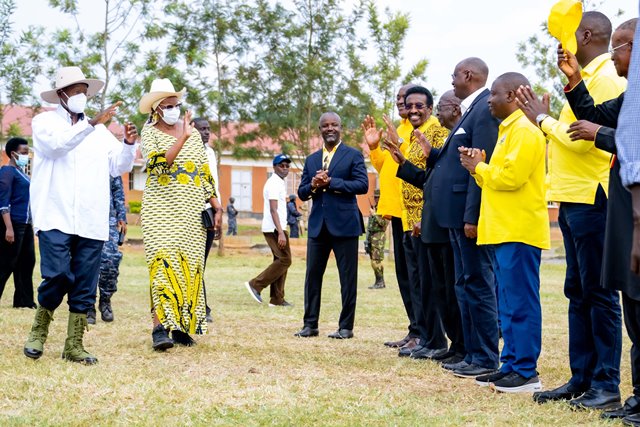
Speaking at a meeting of leaders from Ankole and Kigezi on Saturday, March 1, 2025, at Kyamate Secondary School in Ntungamo, President Museveni revealed that young industrialists under Abyssinia Industries had expressed interest in investing in the region.

“I was in Jinja recently and met young industrialists from Abyssinia Industries who are manufacturing steel products. One of them told me he loved Ntungamo,” the President said.

The President, accompanied by the First Lady and Minister of Education and Sports, Maama Janet Museveni, made these remarks as he concluded his performance assessment tour on the Parish Development Model (PDM) in the Ankole subregion.
Abyssinia Iron & Steel (Uganda) Ltd, a subsidiary of the Abyssinia Group of Industries, is one of East Africa’s largest steel producers, with an annual capacity exceeding 700,000 metric tons. President Museveni emphasized Uganda’s exceptional iron ore quality, noting that it is among the best in the world, with a purity of up to 70%. However, he pointed out a challenge in sourcing charcoal required for steel production.
Mr. Jateen Patel, Chief Executive Officer of Abyssinia Group, who attended the meeting as a special guest, informed the President that Abyssinia Group seeks 10,000 acres of land (approximately 15 square miles) to plant trees and establish a factory to produce industrial charcoal for steel production.
“Currently, we transport iron ore from this region, mainly Kabale, to Jinja. Our plan is to manufacture industrial charcoal in an organized and sustainable manner to enable liquid steel production in this region,” Mr. Patel explained. He added that the project would generate approximately 1,500 direct jobs and create a turnover exceeding $300 million.
He further elaborated that eucalyptus, a fast-growing tree, would be used for charcoal production, with a three-year harvest cycle.
President Museveni proposed that land for the factory be identified on the bare hills within Ntungamo and Kigezi.
“Patel, can you grow the trees you need on these bare hills? The lowlands are already occupied, but the hills are available,” the President asked.
The First Lady supported the proposal, recalling past efforts to plant trees in Ruhama during her tenure as an MP.
“I heard a rumor that this company particularly wanted to come to Ntungamo. I knew very well that the hills were bare. If they are willing to work with communities to plant trees, I believe the people of Ntungamo would take up this challenge and do a good job,” Maama Janet said.
However, regional leaders suggested an alternative approach. Dr. Charles Ngabirano from Rwampara proposed partnering with existing tree growers to supply mature trees.
“I lead a group of farmers with 4,000 hectares of mature trees. Many other out-growers can also ensure a sustainable supply,” Dr. Ngabirano said, adding that they only needed expert guidance on the best tree species to plant.
Ms. Sophia Tukamushaba Kyomugasho echoed similar sentiments, emphasizing that allowing local tree growers to supply the company would empower them economically.
“If the company grows its own trees, what role will we play?” she asked.
President Museveni welcomed this approach and tasked the NRM Vice Chairperson for the Western Region and Minister of ICT and National Guidance, Dr. Chris Baryomunsi, to work with the First Lady and Ministers of Trade, Hon. Francis Mwebesa and Hon. David Bahati, to finalize discussions with stakeholders and report back within two months.
“This is a zonal effort. Trees will come from Kabale, Ntungamo, Isingiro, and Rwampara. That is why I called you all—not just to impose a project on you,” he explained.
On wealth creation, President Museveni urged the people of Ntungamo to focus on eliminating household poverty through commercial agriculture, manufacturing, services, and ICT.
“Development benefits everyone, but individual wealth creation is essential. Some areas have amenities like tarmac roads and electricity, yet many households remain poor,” he said.
He cited the example of the Kampala-Masaka-Kabale road, tarmacked since 1963, where poverty persists among communities along the route.
“For 60 years, this road has been tarmacked, yet poverty remains. The tarmac is there, but so are the poor people,” he remarked.
The President highlighted success stories from the PDM, such as Mrs. Tumusiime Deziranta from Rubirizi and Apio Vicky from Lira, who had never held UGX 1 million until benefiting from PDM funds. The initiative, launched in 2022, aims to boost household incomes by channeling UGX 100 million annually to each parish Sacco, benefiting 100 households per year.
Regarding the challenge of accessing affordable animal feeds, President Museveni pledged to engage the National Enterprise Corporation (NEC) to produce feeds for poultry, pigs, and fish.
He also underscored the importance of irrigation, encouraging farmers to utilize swamp water efficiently rather than growing crops like rice and cabbages in wetlands.
“Dr. Muranga, who irrigates her banana plantation, harvests 53 tons per acre, while the Banyankore get only 5 tons. You misuse wetlands and underutilize dry land,” he observed.
Since Tuesday, President Museveni, accompanied by the First Lady, has been on an assessment tour in the Ankole subregion, focusing on wealth creation and the impact of the PDM.