
President Yoweri Kaguta Museveni has pledged to focus on improving the welfare of Ugandans and advancing national development if given another mandate to lead the country.
Speaking after his nomination as the National Chairman of the National Resistance Movement (NRM) and the party’s flag bearer in the 2026 general elections on Saturday, President Museveni emphasized his continued commitment to peace, stability and responsible freedom.
“As Ssaabalwanyi (Chief Fighter), I will continue to protect the rights of all Ugandans by ensuring that freedom of movement is exercised with responsibility, and that no person’s livelihood is destroyed by the indiscipline or arrogance of others,” President Museveni stated.
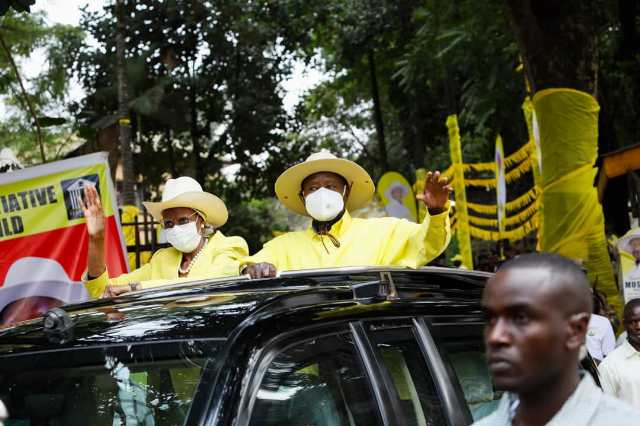
The nomination ceremony was held on Saturday at the NRM Electoral Commission offices in Kampala and was attended by thousands of jubilant supporters, who gathered to show solidarity with the long-serving leader.
President Museveni, who has led the NRM for decades, said the next phase of his leadership will prioritize consolidating the gains of previous years and accelerating efforts toward socio-economic transformation.

In a detailed address, Museveni traced the historical roots of the NRM from a student movement in 1965 to a transformative force that has shaped Uganda’s political, economic, and social trajectory over the last 60 years.

“I stand here on behalf of the very NRM that started as a student movement in 1965. It emerged in a fragmented Uganda divided along tribal and religious lines, a division that crippled governance and institutions,” Museveni recounted.
A Nation Reborn
The President reflected on Uganda’s post-independence crises: the collapse of constitutional order in the 1960s, the 1971 coup by Idi Amin, and the disintegration of the economy characterized by acute shortages of essentials. By 1986, Uganda was grappling with three major traumas: political fragmentation, institutional collapse, and economic ruin.
He credited the NRM with leading Uganda through three major phases: liberation (1965–1986), stabilization (1986–2025), and economic recovery, which involved the revival of key cash crops like coffee, tea, and cotton, the end of shortages, and the expansion of a narrow enclave economy into a more diversified and dynamic system.
“Today, Uganda is no longer a Least Developed Country,” he declared, citing the nation’s GDP growth from $3.9 billion in 1986 to $61 billion in 2025 (foreign exchange method) and $172.2 billion (PPP method), achieving lower middle-income status with a per capita income of $1,263 for its 46 million people.
A Call for a Qualitative Leap
President Museveni emphasized that Uganda must now pursue a “qualitative leap” from a lower middle-income economy to a high middle-income country, projecting a target GDP of $500 billion within the next few years, well ahead of Vision 2040.
The strategy? Deepening value addition to Uganda’s abundant raw materials.
“A kilogram of de-husked coffee fetches $2.58, but when roasted, ground, and packaged, it earns between $25 to $40. Why should Germany, a non-coffee-growing nation, make $65 billion from coffee, while all African producers earn just $25 billion combined?” he questioned.
He further highlighted Uganda’s success in purifying gold, copper, and tin to global standards and called for vertical and horizontal sector integration, leveraging Uganda’s educated workforce to boost industries such as automobile manufacturing, pharmaceuticals, diagnostics, electronics, and ICT.
Anchoring on Six Pillars of Prosperity
President Museveni laid out six key aspects as the foundation for Uganda’s transformation:
- Peace – No war and strong crime control
- Development – Infrastructure and investment
- Wealth creation – Expanding private enterprise
- Jobs – Especially from commercial farming, factories, services, and ICT
- Social services – Health, education, and spiritual development
- Markets – Regional integration to absorb Uganda’s growing output
He stressed the critical need to understand that prosperity stems from wealth creation and the private sector, not government employment.
A Message to the New NRM Leaders
Museveni praised the recently elected NRM structure leaders, particularly the youth, urging them to embrace productive and ideological politics grounded in patriotism, Pan-Africanism, socio-economic transformation, and democracy—not “jobology” or careerism.
“Leadership is about fighting for the people’s interests, not securing a job. We were not driven by salaries. We abandoned our comfortable positions to liberate Uganda,” he said, citing early revolutionaries like Kategaya, Rwaheru, Mwesigwa Black, and others.
He urged them to become wealth creators through government initiatives like the Parish Development Model (PDM) and Emyooga, instead of viewing political office as a livelihood.
Looking Forward
Museveni’s renewed bid comes at a time of both reflection and ambition. He sees Uganda’s future not just in economic growth, but in transformation through value addition, technological innovation, and regional integration.
“God has enabled me to lead the NRM through phases of struggle and rebuilding. I am ready to contribute to the next phase of transformation,” he concluded.
The President also paid tribute to Uganda’s early nationalists, Bataka-bu of the 1920s and I.K. Musaazi of the 1930s–50s, whose efforts paved the way for independence, though later undermined by sectarian politics.