







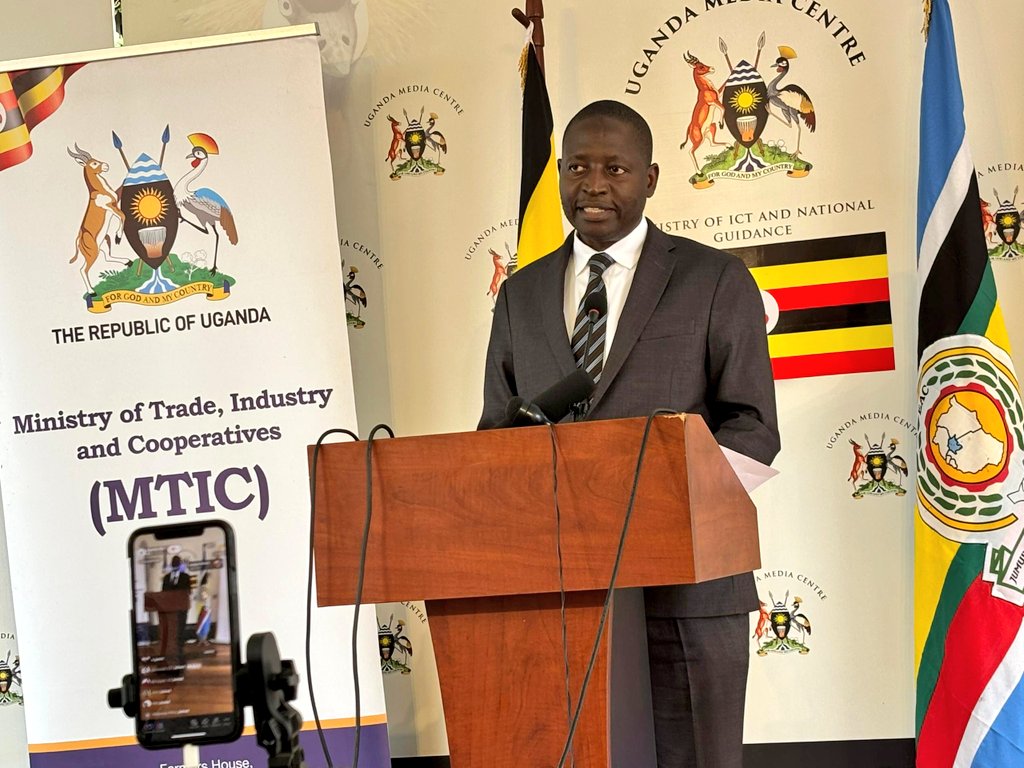

The State Minister of Trade, Industry, and Cooperatives (Industry), Hon. David Bahati, has reaffirmed the government’s commitment to empowering Small and Medium Enterprises (SMEs) through accreditation, ahead of the World Accreditation Day (WAD).
While addressing the Media at Uganda Media Center on Wednesday ahead of the national celebrations slated for tomorrow (Thursday), Minister Bahati emphasized that accreditation is a vital tool for strengthening Uganda’s SMEs, boosting exports, and driving economic growth.
The 2025 WAD is celebrated globally under the theme: “Accreditation: Empowering Small and Medium Enterprises (SMEs)”, highlighting the role of accreditation and the broader quality infrastructure system in enhancing SME competitiveness.
“SMEs form the backbone of our economy, contributing over 70% of Uganda’s GDP and nearly 90% of employment across key sectors like agriculture, manufacturing, trade, and services,” Hon. Bahati noted.
He explained that despite their significance, SMEs face major hurdles such as limited access to finance, stiff competition from larger corporations, rising operational costs, and difficulties in entering global markets.

World Accreditation Day, established by the International Laboratory Accreditation Cooperation (ILAC) and the International Accreditation Forum (IAF), is commemorated in over 100 economies worldwide.

It aims to raise awareness about the importance of accreditation among governments, industries, and the general public.
Minister Bahati highlighted the benefits of accreditation for SMEs, especially in improving product quality, minimizing business risk, and facilitating international market access.
He underscored Uganda’s potential to expand its export footprint through trusted quality assurance systems.
“Accreditation ensures businesses can trust the testing and certification services they rely on. With proper accreditation, rejection rates for Ugandan products in international markets will fall, reducing export losses from USD 700 million to USD 100 million by 2030,” he said.
Uganda currently exports goods worth approximately USD 6 billion annually, with agriculture alone contributing USD 1.5 billion in 2024.
Minister Bahati projected this figure to rise to USD 3.5 billion by 2030, driven by improvements in accredited testing and certification, particularly in agro-industrial exports.
Recalling the 2022 World Cup in Qatar, Minister Bahati lamented the rejection of Ugandan beef exports due to the absence of accredited halal certification.
He projected that with proper halal accreditation, Uganda could boost its halal exports to the Middle East to USD 1.09 billion by 2030.
Minister Bahati stressed that accreditation is vital for Uganda to tap into regional trade blocs such as:
EAC (343 million people, $349bn GDP)
COMESA (640 million people, $1 trillion GDP)
AfCFTA (1.3 billion people, $3.4 trillion GDP)
“Accredited once, accepted everywhere, that is the goal,” he declared, referring to international recognition of accredited products and services.
Uganda has over 2,000 testing and certification facilities, but only 125 are accredited, mostly by expensive foreign bodies, costing around $10,000 annually per facility.
To address this, the government established the Uganda National Accreditation Service (UGANAS) through the Accreditation Service Act of 2021. Bahati proudly announced that as of 15th May 2024, UGANAS achieved Associate Member status with the African Accreditation Cooperation (AFRAC).
“The cost of accreditation will now reduce by 35–40%. This is a huge relief to our local enterprises,” he said.
UGANAS is now fully operational at Makubya Road in Nakawa, offering both accreditation and training services locally, services that Ugandans previously had to seek abroad.
“Through accreditation, we are building trust, improving quality, and unlocking new opportunities for our SMEs, driving Uganda closer to its development goals.” Minister Bahati said.