
President Yoweri Kaguta Museveni has once again called on Uganda’s political leaders to embrace dialogue and reject violence as the country heads toward the 2026 general elections.
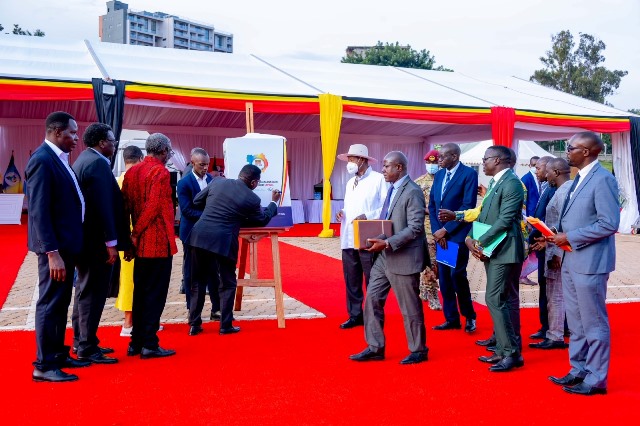
Speaking at the Inter-Party Organisation for Dialogue (IPOD) Summit held at Kololo Ceremonial Grounds on September 18, 2025, President Museveni stressed that Uganda’s stability and progress depend on leaders addressing national challenges through peaceful means rather than subversion, violence, or divisive politics.
The summit, themed “Together for a Peaceful and Sustainable Uganda,” brought together presidents and secretary generals from six political parties: the National Resistance Movement (NRM), Democratic Party (DP), Uganda People’s Congress (UPC), Forum for Democratic Change (FDC), Justice Forum (JEEMA), and the People’s Progressive Party (PPP).
In his keynote address, Museveni, speaking as both NRM National Chairman and IPOD Summit Chair, urged opposition leaders to prioritize dialogue. He argued that mistakes in governance can always be corrected if peace is maintained.
“As we have seen in the last 40 years, the NRM has revived Uganda’s economy. Even if one has a wrong understanding, as long as they are not violent, the country remains stable and mistakes can be corrected in the future,” Museveni said.

He warned that Africa’s biggest tragedy lies in leaders both misdiagnosing societal problems and resorting to violent solutions.

“Politics must be like medicine,” Museveni added. “A leader should be like a doctor—able to correctly diagnose the problems of society. If the diagnosis and prescription are wrong, the patient dies.”
Reflecting on his six-decade political journey, which began in the Democratic Party in 1960, Museveni reiterated the NRM’s four guiding principles, patriotism, Pan-Africanism, socio-economic transformation, and democracy, as anchors of Uganda’s future.
The President also weighed in on the recent teachers’ strike, urging resource prioritization. Citing the example of Soroti Flying School, he said tough choices, like prioritizing pilots and engineers over equal pay demands, help institutions survive.
At the same event, Museveni handed over the IPOD chairmanship to Democratic Party President General Norbert Mao after five years of NRM stewardship.
“Thank you for trusting us with this responsibility. I now peacefully hand over,” Museveni said.
NRM Secretary General Richard Todwong praised Museveni for sustaining IPOD even after international donors withdrew support.
“We were orphaned when donors left, but as a father, you picked us up. You’ve shown that homegrown solutions can address African challenges,” Todwong said.
Mao Pledges Open Dialogue
Accepting the IPOD leadership, Hon. Mao promised to keep the platform inclusive and focused on ensuring a peaceful 2026 election.
“Our agenda will be to ensure a peaceful, free, and fair election. We shall talk honestly about Uganda’s problems rather than attacking each other. Consensus is the foundation of unity,” Mao said. He also commended Museveni for releasing nearly 70 political detainees earlier this year, describing it as a meaningful step toward reconciliation.
UPC President Jimmy Akena reaffirmed his party’s commitment to dialogue, while FDC’s Patrick Oboi Amuriat urged that discussions must yield tangible results. Amuriat also called for clemency for political prisoners to promote national healing.
JEEMA’s Asuman Basalirwa stressed that Uganda’s problems demand dialogue and consensus, while PPP President Saddam Gayira credited peaceful engagement for his party’s non-confrontational record.
Dr. Lawrence Sserwambala, IPOD’s Executive Director, acknowledged the platform’s progress but warned of persistent challenges such as electoral violence, weak enforcement of the code of conduct, and youth vulnerability to manipulation.
“Uganda is watching us. History will judge us by the choices we make. Let us choose peace, let us dialogue, let us put Uganda first,” he said.