






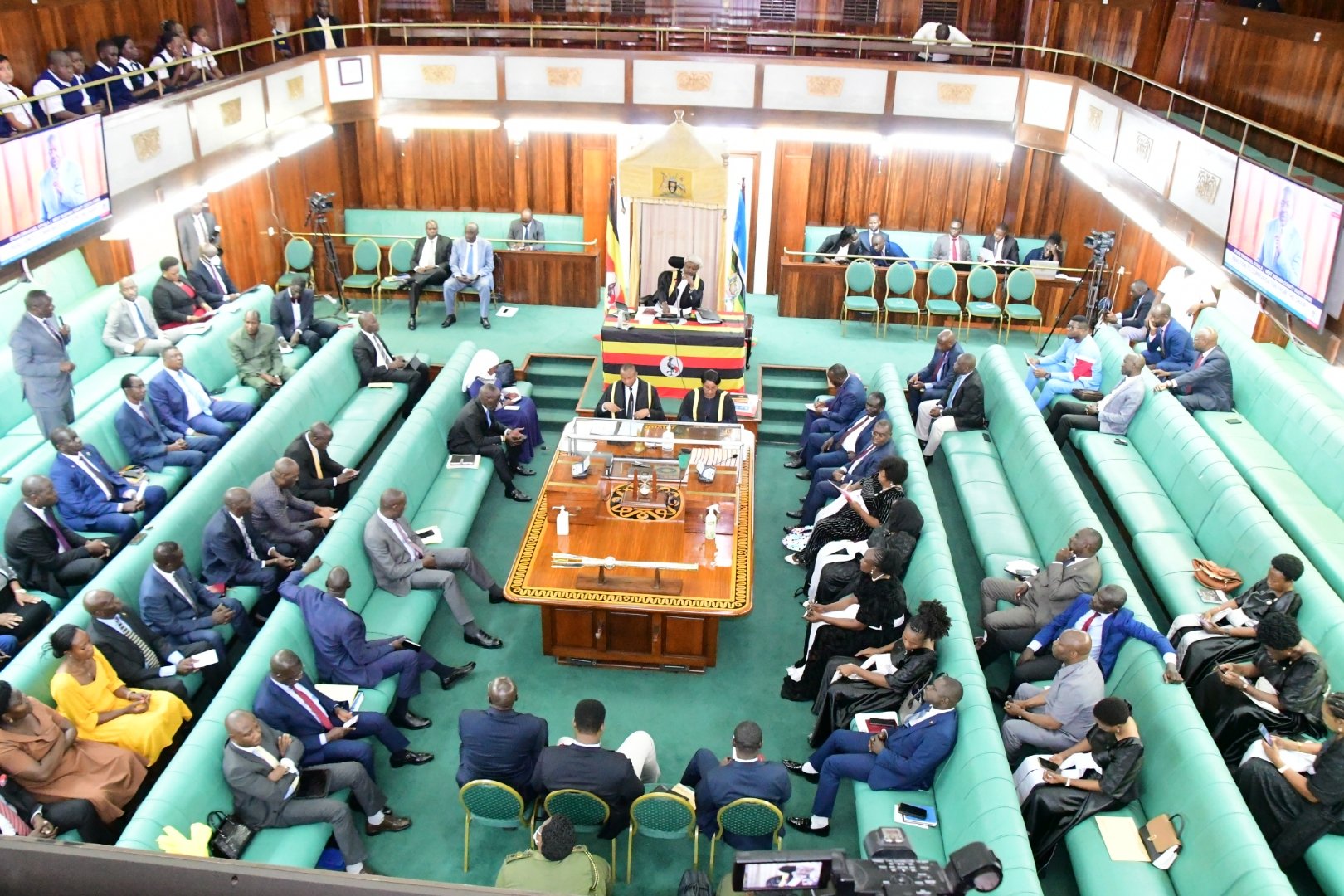

Lawmakers have been urgently summoned back to Parliament for a plenary session on Tuesday, December 16, 2025, to scrutinize yet another major borrowing request from the Ministry of Finance, Planning, and Economic Development.
The proposed loans, totaling approximately UGX 2.172 trillion (equivalent to USD 610 million), come on the heels of recent approvals for supplementary spending, fueling fears of fiscal overreach and unsustainable debt levels.
In a notice issued by Clerk to Parliament Adolf Mwesige Kasija, a copy of which was obtained by Parliament Watch, Members of Parliament (MPs) were informed of the resumption of plenary. The session follows the adjournment sine die by Speaker Anita Among during the 5th sitting of the 2nd meeting of the 5th session of the 11th Parliament on December 2, 2025.
“This is therefore to inform you that plenary will resume on Tuesday, December 16, 2025, at 2:00 PM to receive the National Budget Framework Paper for Financial Year 2026/2027 – Financial Year 2030/2031 pursuant to Section 9(5) of the Public Finance Management Act,” the Clerk’s letter stated.
Section 9(5) of Uganda’s Public Finance Management Act (PFMA) 2015 mandates that the Minister of Finance, with Cabinet approval, submit the Budget Framework Paper (BFP) to Parliament by December 31 of the preceding financial year. The BFP outlines medium-term macroeconomic forecasts, fiscal frameworks, and expenditure projections, ensuring alignment with the National Development Plan and the Charter for Fiscal Responsibility. It must also include a certificate confirming gender and equity responsiveness.


According to the order paper, the agenda includes receiving the National Budget Framework Paper for FY 2026/27–2030/31, the Tax Expenditure Report for July to September 2025 (FY 2025/26), and a waiver of tax arrears for Newplan Limited. Finance Ministry will then table three key motions:

- A resolution to authorize pre-financing for the design and build of the 87km Kayunga-Bbaale-Galiraya Road upgrade from gravel to paved standard.
- A resolution to borrow up to USD 162 million (approximately UGX 579.2 billion) from the Korea Export-Import Bank for the Makerere University Improvement Project.
- A resolution to borrow up to EUR 385 million (approximately USD 448 million or UGX 1.595 trillion) from Rand Merchant Bank (RMB) and other financial institutions to finance the Government’s infrastructure and development budget for FY 2025/26.
These borrowings, aimed at bolstering infrastructure and education, reflect Uganda’s ongoing reliance on external financing for capital projects. However, they add to a ballooning public debt, which stood at UGX 116.2 trillion (USD 32.3 billion) as of June 2025, a 26.2% increase from the previous year.
Domestic debt accounts for UGX 60.3 trillion (52% of the total), while external debt is UGX 55.9 trillion, pushing the debt-to-GDP ratio to 51.3%, exceeding the International Monetary Fund’s (IMF) recommended 50% threshold for low-income countries and breaching Uganda’s Charter for Fiscal Responsibility.
This latest request follows Parliament’s approval on December 2, 2025, of an UGX 8.104 trillion supplementary expenditure for FY 2025/26, which revised the national budget from UGX 72.376 trillion to UGX 78.631 trillion. The supplementary was funded largely through UGX 4.278 trillion in external financing and UGX 3.770 trillion in domestic borrowing, sparking a heated debate in the House.
Opposition MPs decried the move as emblematic of “runaway fiscal indiscipline” and excessive dependence on debt.

Kira Municipality MP and Shadow Finance Minister Ibrahim Ssemujju Nganda lambasted the normalization of supplementary budgets: “These Supplementaries 1, 2, and 3 have revised the 2025/26 annual budget to Shs 78 trillion. This revision carries far-reaching consequences for the economy. Financing these supplementary requests through borrowing will automatically raise the public debt. Remember, we were already borrowing Shs 32 trillion to finance the approved budget. We are now set to return to commercial banks to borrow for all sorts of things.”
Minister of State for Finance Henry Musasizi defended the supplementary by invoking Section 25 of the PFMA, which allows for supplementary appropriations when budgeted funds are insufficient or new needs arise, provided they are “unabsorbable, unavoidable, and unforeseeable.” The Act caps ministerial approvals for supplementary budgets at 10% of the Contingencies Fund (equivalent to 3.5% of the previous year’s appropriated budget), but larger amounts require parliamentary authorization.
Budget Committee Chair Patrick Isiagi confirmed compliance with Rule 153(2) of Parliament’s Rules of Procedure, which requires supplementary requests to specify financing sources.
The Auditor General’s 2023 audit report echoed these concerns, warning that supplementary budgets have “become wasteful and undermine planning.” It highlighted how such requests are often unnecessary, submitted without consulting program secretariats, and distort program-based budgeting, leading to inefficiencies in implementation and reporting.
Uganda’s public debt has nearly tripled since 2018, rising from UGX 41.7 trillion to UGX 116.2 trillion by 2025, driven by factors like the COVID-19 pandemic, geopolitical disruptions (e.g., the Russia-Ukraine war), and the suspension of concessional aid from donors amid governance concerns.
The government has increasingly turned to non-concessional loans with higher interest rates, exacerbating repayment burdens. Debt servicing now consumes 67% of domestic revenue, totaling UGX 21 trillion in FY 2025/26, more than allocations for health, education, and social protection combined.
Analysts warn of mounting risks: Poor loan utilization, due to delays in project readiness, absent feasibility studies for 15 projects, land acquisition hurdles, and weak inter-agency coordination, has led to underperformance. Moody’s downgraded Uganda’s credit rating to B3 in 2025, citing vulnerability to external shocks and tightening global financing. Corruption siphons an estimated UGX 10 trillion annually, further straining resources.
With a population of about 45 million, this translates to a per capita debt burden of roughly UGX 2.58 million, equivalent to UGX 280,000 annually per person over a decade. Youth and marginalized groups face long-term impacts, including reduced fiscal space for development, higher debt costs, and limited responses to crises.
Civil society groups like the Uganda Debt Network (UDN) and Civil Society Budget Advocacy Group (CSBAG) urge stronger governance, transparency, and debt monitoring to avert a crisis.
The session will also feature the second and third readings of the Energy Efficiency and Conservation Bill, 2024, presented by the Minister of Energy and Mineral Development.
As Uganda grapples with these fiscal pressures, critics like Leader of Opposition Joel Ssenyonyi question priorities: “When shall we stop borrowing money?” Echoing broader sentiments, one analyst quipped on social media, “An argument can be made that politicians are selling our country to foreigners.” The upcoming deliberations could test Parliament’s resolve to safeguard fiscal discipline amid mounting public scrutiny.