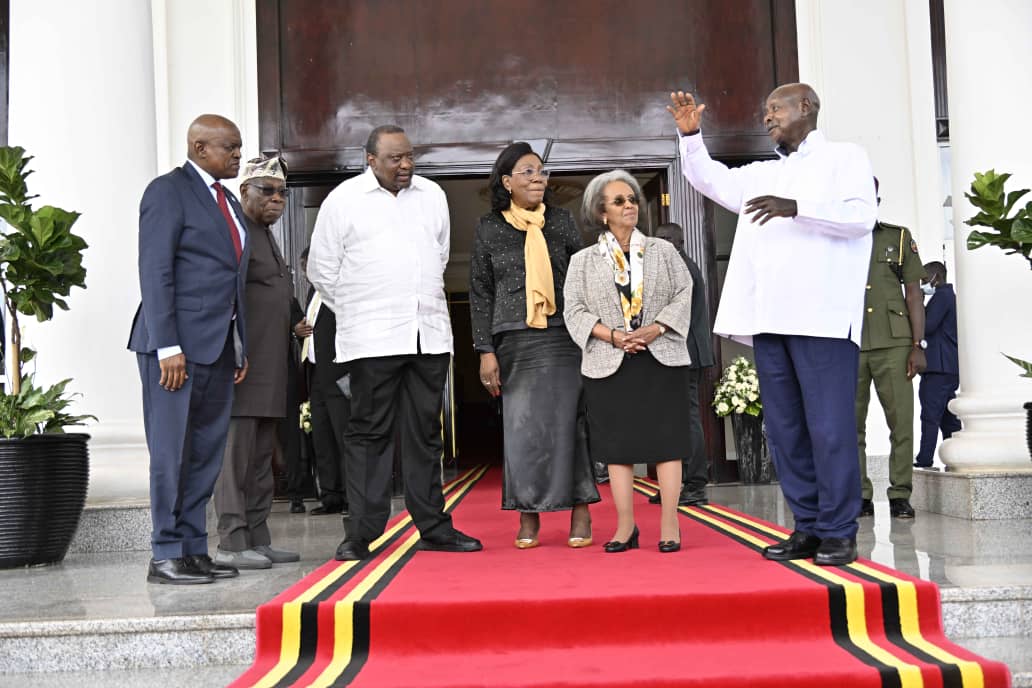

President Yoweri Kaguta Museveni’s meeting with the AU–EAC–SADC panel of facilitators on the Democratic Republic of Congo (DRC) peace process has once again highlighted the enduring regional consequences of instability in Eastern Congo and the slow pace of resolving a conflict whose roots are widely understood.
Hosting the high-level delegation at State House, Entebbe on Tuesday, President Museveni framed the DRC crisis not as a distant foreign problem, but as a humanitarian, social and security issue that directly affects Uganda and the wider Great Lakes region.
Uganda currently hosts more than 500,000 Congolese refugees, part of nearly two million refugees from neighbouring countries, placing sustained pressure on public services, land, and host communities.
Beyond numbers, Museveni emphasised the deep ethnic and cultural links that bind communities across borders, particularly between Eastern DRC and western and south-western Uganda.
These shared identities, he argued, mean that violence in Congo inevitably spills over into neighbouring states, making regional peace inseparable from Congo’s stability.

Despite decades of regional and international engagement, Museveni expressed frustration at the lack of a lasting solution, describing it as “a shame” that clearly identifiable grievances have taken so long to address.

He noted that while past debates once focused on Congo’s territorial integrity, such as the Katanga secession, today’s conflict is largely driven by unresolved political, social and governance grievances rather than questions of state breakup.
The visiting panel, chaired by Togolese President Faure Essozimna Gnassingbé and comprising several former African heads of state, echoed this diagnosis.
Former Nigerian President Olusegun Obasanjo cautioned against narrowing the crisis to a single armed group such as M23, warning that doing so risks ignoring deeper structural problems within the DRC, including the management of diversity and strained relations with neighbouring countries.
Obasanjo underscored a broader concern: the tendency to rely heavily on externally driven peace initiatives. While acknowledging the usefulness of international partners, he argued that sustainable peace in Eastern DRC must be rooted in African realities and led by Africans themselves. External interventions, he said, should complement, not dominate, regional efforts.
The panel’s engagement with President Museveni reflects a growing push for African-led conflict resolution under the auspices of the African Union, including the establishment of a joint coordination mechanism in Addis Ababa.
For the facilitators, Museveni’s long involvement in regional diplomacy positions him as a key voice in shaping practical, locally grounded solutions.
At its core, the meeting exposed a central issue confronting the DRC peace process: the gap between widespread understanding of the conflict’s causes and the political will required to implement durable solutions.
As long as grievances related to identity, governance, and regional relations remain unresolved, the humanitarian burden, felt acutely by countries like Uganda, is likely to persist.
The talks in Entebbe, attended by senior Ugandan officials and diplomats, reinforced the urgency of moving beyond statements and diagnoses toward concrete action, with African leadership taking primary responsibility for restoring peace and stability in Eastern DRC.