
President Yoweri Kaguta Museveni has called for a bold and strategic shift in how Africa addresses challenges surrounding the Nile, emphasizing that the continent’s future lies in electrification, industrialization, and regional integration.
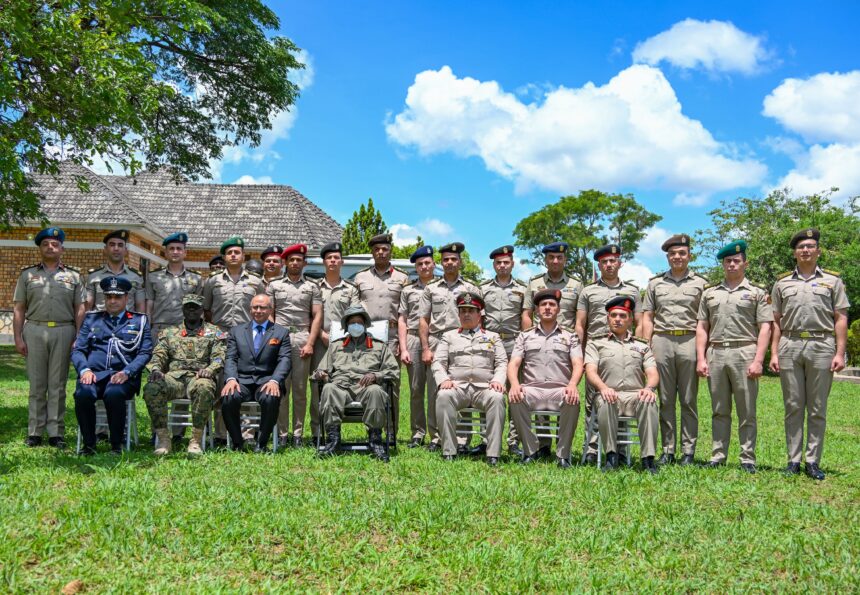
Speaking on Thursday at the National Leadership Institute Kyankwanzi, the President delivered a lecture of opportunity to a delegation from Egypt’s Armed Forces Staff and Command College. The delegation was led by Egypt’s Ambassador to Uganda, H.E. Monzer Selim, alongside Maj. Gen. Khaled Elnahraway.
Museveni urged African leaders to move away from debates rooted in colonial-era agreements and instead focus on the real drivers of the Nile Basin’s challenges.
He pointed to underdevelopment in tropical regions as the primary threat, particularly the lack of electricity, which forces communities to depend on biomass for survival.
“When people don’t have electricity, they depend on biomass, and that is the real danger,” he said, noting that this dependency accelerates environmental degradation.

The President explained that limited industrialization has further worsened the situation, as growing populations encroach on forests and wetlands for agriculture. He emphasized that industrial growth would reduce overreliance on subsistence farming and help protect vital ecosystems.

Museveni also highlighted the impact of global climate change, linking it to emissions from industrialized nations, and called for a comprehensive master plan for the Nile Basin centered on electrification and economic transformation.
He revealed that water flow from Uganda to South Sudan has declined significantly—from about 60 billion cubic meters in the 1960s to approximately 40 billion today—largely due to reduced rainfall.
Drawing comparisons, Museveni pointed to the immense potential of the Congo River, saying it could support multiple Nile-equivalent systems if regional peace and cooperation are strengthened.
The President outlined Africa’s three key historical missions: prosperity, strategic security, and brotherhood. He stressed that true prosperity comes from production, trade, and market access—not dependence on aid.
“You need patriotism for national growth, but also Pan-Africanism to expand markets beyond borders,” he said, adding that regional integration is essential for Africa to compete on the global stage.
On security, Museveni emphasized that individual African countries are too small to stand alone in an increasingly competitive world, making unity and cooperation critical.
Reflecting on Uganda’s liberation history, he acknowledged the support of African leaders such as Julius Nyerere and Samora Machel in strengthening the country’s defence forces.
The President also underscored the importance of environmental conservation, warning that continued reliance on biomass and primitive agriculture poses a serious threat to the Nile Basin.
He cited key natural water towers—including the Rwenzori Mountains, Mount Kenya, and Mount Elgon—as critical to sustaining rainfall systems across the region.
“The problem is not water in Africa; it is ideological. The solutions are known, but the focus must shift to the right priorities,” Museveni said.
On behalf of the delegation, Maj. Gen. Khaled Elnahraway praised Uganda’s hospitality and the insights shared during the visit.
He noted that their tour included Jinja, where they visited the source of the Nile, describing it as a vital resource for both Uganda and Egypt.
He added that the delegation was impressed by Uganda’s role in promoting regional peace and cooperation, including its participation in Common Market for Eastern and Southern Africa, and expressed optimism about strengthening ties between Egypt, Uganda, and the wider African continent.