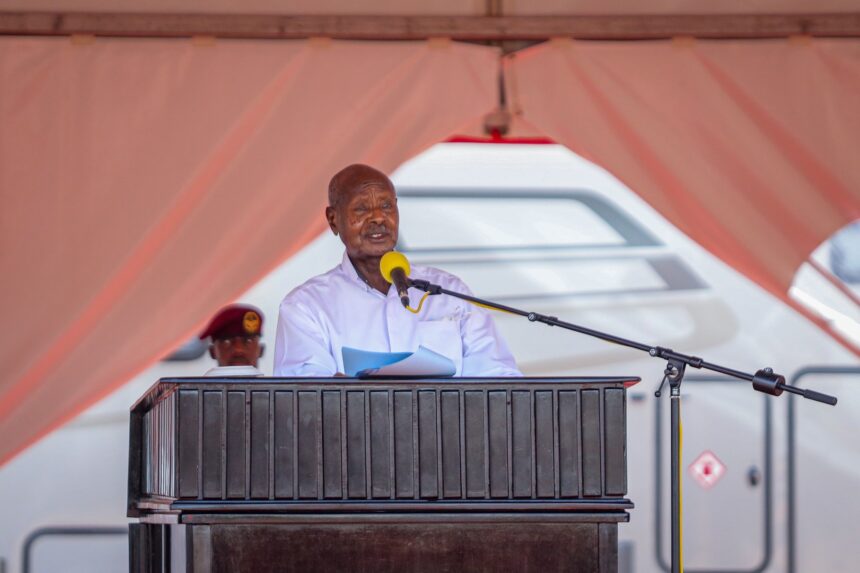

President Yoweri Kaguta Museveni has called for increased discipline, productivity, and accountability in public service as he delivered the State of the Nation Address, urging leaders and citizens to embrace the next phase of Uganda’s socio-economic transformation.
President Museveni commended Ugandans for actively participating in the 2026 General Elections and praised the continued support for the National Resistance Movement (NRM). He noted that the country maintained peace and stability throughout the electoral period despite isolated incidents aimed at disrupting order.
The President clarified his earlier message of “no more sleep,” explaining that it was not to be interpreted literally but rather as a call for improved performance, discipline, and results-oriented public service delivery.
President Museveni emphasized a zero-tolerance approach to corruption, non-performance, deviation from agreed priorities, and inefficiency within leadership structures, stressing that all leaders must be held accountable for results.
Reflecting on Uganda’s long-term socio-economic transformation journey, he highlighted the need to transition citizens from subsistence livelihoods to a fully integrated money economy driven by commercial agriculture, industrialization, services, and Information and Communication Technology (ICT).

He noted progress in key sectors, particularly agriculture, citing improvements in production and household incomes as more Ugandan’s engage in income-generating activities supported by government programmes.

Museveni further underscored that government interventions, including the Parish Development Model (PDM), are intended to empower citizens, expand access to capital, and support household wealth creation.
The President also highlighted ongoing government investments in infrastructure, especially roads and connectivity, while cautioning against corruption and inefficiency in the implementation of public works projects.
He reaffirmed that peace and security remain the cornerstone of Uganda’s development, calling for continued vigilance to safeguard national stability.
President Museveni urged leaders and citizens alike to embrace productivity, reject corruption, and work collectively toward building a peaceful, prosperous, and self-reliant Uganda under the national transformation agenda.
President Museveni also emphasised the need to prioritise efficient transport systems, noting that heavy cargo such as petroleum products should increasingly be moved from roads to pipelines and railways to preserve road infrastructure for passengers and light cargo.
The President stressed that roads must be maintained at all times to support mobility, trade, and service delivery across the country.
He reiterated that Uganda’s socio-economic transformation agenda is aimed at ensuring prosperity for individuals, families, and enterprises through wealth creation and job generation.
According to the President, those who embrace the development message are steadily becoming active participants in the money economy.
President Museveni further underscored the importance of expanding markets beyond domestic boundaries, stating that internal markets alone are insufficient to sustain large-scale economic growth.
He emphasised the need for regional, East African, and continental integration to widen opportunities for production and trade.
Drawing comparisons with global economic realities, the President observed that even major economies such as China and India rely on vast external markets, reinforcing the importance of integration for Uganda’s economic growth.
He called for renewed discipline in national development efforts, emphasising “no more sleep” as a call for urgency, accountability, and improved performance in service delivery and implementation of government programmes.
The President warned against corruption, non-performance, tolerance of failure, and leadership driven by ego and personal interests, stressing that such practices undermine national progress.
President Museveni highlighted Uganda’s ongoing economic transformation, noting significant expansion and diversification across key sectors including agriculture, industry, services, and ICT. He cited growth in exports such as coffee, milk, fish, sugar, cement, and bananas, alongside increased industrial output.
He also pointed to improvements in electricity generation and ongoing investments aimed at strengthening capacity to support industrialisation.
The President noted progress under programmes such as the Parish Development Model, which is integrating millions of households into the money economy through production and enterprise support. However, he emphasised the need for accountability to ensure public resources reach intended beneficiaries and deliver tangible results.
Reaffirming government’s commitment to rural transformation, productivity, and inclusive growth, President Museveni called for discipline, transparency, and focus in the implementation of national programmes.
He also emphasised the importance of strengthening modern agricultural practices, including zero grazing and improved pasture management, as key drivers of increased productivity and wealth creation.
The President cautioned against outdated and fragmented inheritance practices, noting that such systems often contribute to poverty by breaking up productive family units and reducing economic efficiency. He stressed the need to shift towards more organised, family-based economic models that support large-scale production and job creation.
President Museveni described agriculture as a central pillar of Uganda’s transformation while reaffirming the importance of other sectors such as manufacturing, services, and ICT in driving inclusive economic growth.
He observed that one of Africa’s longstanding challenges has been “ignorance,” saying many people often underestimate the value of their own resources and productive activities.
The President further noted that development requires a strong understanding of local realities and scientific approaches, stressing that Uganda’s transformation must be rooted in practical knowledge and continuous adaptation.
He concluded his address by presenting the Government’s Executive Programme to Parliament, noting that a total of 38 Bills are being tabled for consideration as part of the national legislative agenda aimed at advancing socio-economic transformation.
Speaking during the official opening of the State of the Nation Address, Speaker of Parliament Rt. Hon. Jacob Oboth-Oboth called upon Members of the 12th Parliament to embrace their leadership responsibilities with dedication and patriotism, emphasizing that electoral victory marks only the beginning of leadership.
He noted that the true responsibility of leaders lies in delivering on the aspirations of the people.
The Speaker congratulated President Museveni upon his re-election and commended Members of Parliament for earning the trust of Ugandans. He urged legislators to prioritize effective governance, fulfill their commitments to the electorate, and promote national unity and social cohesion.
Rt. Hon. Oboth-Oboth also reaffirmed Parliament’s commitment to supporting the implementation of the Government’s development agenda, including the Ten-Fold Growth Strategy aimed at transforming Uganda’s economy and advancing socio-economic development.
He added that the State of the Nation Address remains a key constitutional obligation through which the President reports on government achievements, national priorities, and the legislative agenda for the year ahead.