
President Yoweri Kaguta Museveni, who is also the Commander-in-Chief of the Uganda People’s Defence Forces (UPDF), has called for political integration in East Africa and across the African continent as a key strategy to address future security threats.
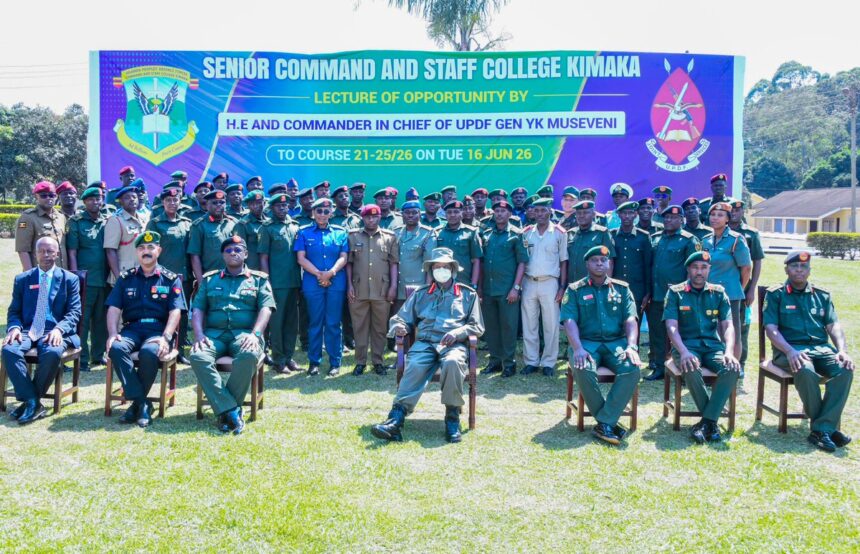
The President made the remarks on Tuesday while delivering a lecture of opportunity to army officers at the Senior Staff College–Kimaka in Jinja.
During the lecture, President Museveni criticized some African leaders during the colonial era for failing to resist colonial domination, attributing part of Africa’s current challenges to selfish leadership and lack of strategic foresight.
“The chiefs and kings were here glorifying themselves when their building was falling down. This strategic danger was known but neglected by kings and chiefs,” he said.
President Museveni told the officers that for the last 60 years, the National Resistance Movement (NRM) has been emphasizing what he described as the historical missions necessary for Uganda, East Africa, and Africa to achieve prosperity and compete globally.

“The first historical mission is how to ensure prosperity for our people. One of the key factors to help us prosper is economic integration of the African market,” he said.

He urged young people to champion regional integration, warning that failure to unite economically could leave African countries vulnerable.
On security, President Museveni said Africa must politically integrate to effectively address emerging global and strategic threats.
“We must be able to operate on land, air, navy and in space, but can Uganda alone have a space program? Can we go to the ocean? No, we are cut off by irrational colonial borders. That is why political integration is the answer,” he said.
The President argued that East African political integration remains necessary, but cautioned that progress could be hindered if leaders prioritize personal political interests over regional goals.
Addressing concerns about land shortages in some African countries due to population growth, President Museveni said the challenge is largely driven by underdevelopment and overdependence on subsistence agriculture.
“Land is only crucial for agriculture, but in a money economy, many people are in manufacturing and services while only a few remain in agriculture,” he noted.
Commenting on ongoing conflicts in the Middle East and their potential impact on East Africa, President Museveni said Africa is less vulnerable because the continent possesses abundant natural resources that, if properly utilized, can sustain its economies.
On sectarianism based on tribe and religion, the President described identity politics as “ideological bankruptcy,” adding that “the politics of identity is politics of parasites.”
He also emphasized the importance of patriotism and Pan-Africanism in expanding markets for Uganda’s products and strengthening economic growth.
Regarding employment creation, President Museveni said Uganda’s economy offers opportunities through four major sectors: commercial agriculture, manufacturing, services, and information communication technology (ICT).
The Commandant of the Senior Staff College–Kimaka, Brig. Gen. Michael Kabango, praised President Museveni for what he described as visionary and strategic leadership that has guided Uganda toward peace, stability, and prosperity.
“Your presence today is a great inspiration to both the faculty and the students gathered here,” Brig. Gen. Kabango said.
He revealed that the current course intake, Intake 21 (2025/2026), commenced on July 8, 2025, and is expected to graduate on July 2, 2026.
According to Brig. Gen. Kabango, the course comprises 52 students, including 38 Ugandans and 14 officers from friendly countries such as Burundi, Egypt, Kenya, Malawi, Rwanda, South Africa, South Sudan, and Tanzania.