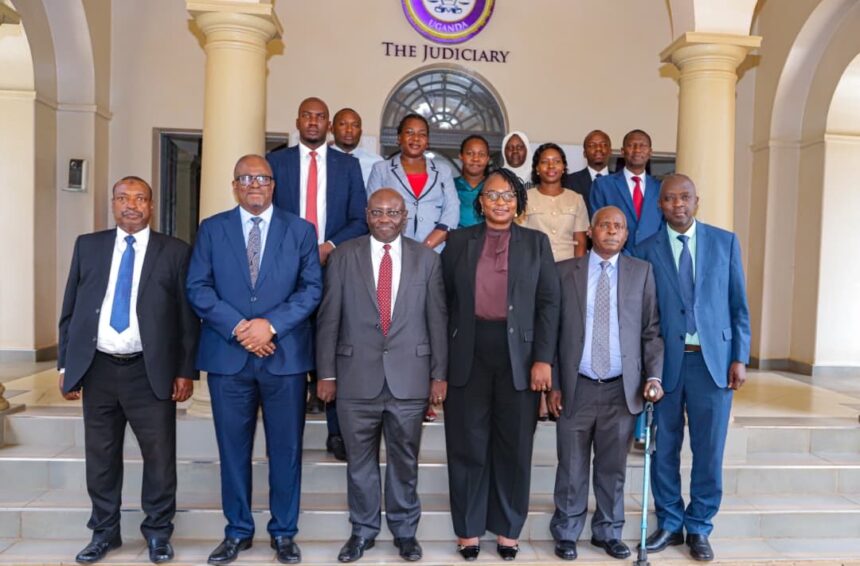

The Chief Justice of the Republic of Zambia and Chairperson of the African Chief Justices’ Alternative Dispute Resolution Forum (ACJADRF), Justice Dr. Mumba Malila, has praised Uganda’s Judiciary for its innovative criminal justice reforms following a courtesy visit to the Criminal Division of the High Court in Kampala.
Justice Malila, who is in Uganda on official engagements following his assumption of leadership of the continental forum, was received by the Head of the Criminal Division, Justice David Matovu, alongside Justice Paul Gadenya Wolimbwa, Justice Isah Sserunkuma, Justice Prof. Andrew Khaukha, and the Division’s Deputy Registrar, His Worship Samuel Twakyire.
During the meeting, Justice Matovu briefed the delegation on the mandate and operations of the Criminal Division, noting that the court handles capital offences arising from the Kampala Metropolitan area and has fully adopted the Electronic Court Case Management Information System (ECCMIS).
He explained that the Division now operates a technology-driven registry that enables electronic filing, case allocation, and efficient case management, while modern court recording systems have enhanced the quality and speed of proceedings.
“The Criminal Division is now operating under ECCMIS and conducts daily hearings of capital cases under the Daily Hearings Scheme. This has greatly improved case management and enhanced access to justice,” Justice Matovu said.

The Executive Director of the Judicial Training Institute (JTI), Justice Prof. Andrew Khaukha, highlighted the transformation in criminal case management within the Division and paid tribute to Justice Paul Gadenya for his contribution to criminal justice reforms.

Justice Khaukha noted that the Division previously operated under a session-based system but has since transitioned to a Daily Hearings Scheme, under which each judge is expected to dispose of 20 cases per month, 60 per quarter, and 180 annually.
“This approach has significantly reduced the lead time for criminal cases to approximately 300 days,” he said, adding that plea bargaining has lowered the cost of criminal trials while accelerating case disposal.
Justice Malila commended Uganda’s effective use of plea bargaining, describing it as a vital feature of modern justice systems.
“Plea bargaining has taken its rightful place in most judiciaries, and it is encouraging to see how effectively Uganda is utilising it to improve access to justice and reduce delays,” he said.
He stressed that delays in justice delivery undermine the efficiency and credibility of judicial systems.
“Anything that causes delays to justice delivery is a threat to the effectiveness and efficiency of the system,” Justice Malila observed.
The Zambian Chief Justice explained that the African Chief Justices’ Alternative Dispute Resolution Forum advocates for practical reforms aimed at improving efficiency and service delivery across African judiciaries.
Drawing from Zambia’s experience, he suggested that all High Court judges, regardless of divisional assignment, should be empowered to preside over criminal sessions to address the growing volume of criminal cases.
The engagement also offered judicial officers an opportunity to discuss challenges affecting criminal justice delivery, including case backlog, complex public interest litigation, delayed production of prisoners, absence of witnesses, inadequate court space, and prolonged court processes that affect public confidence in the justice system.
Despite these challenges, participants noted that reforms such as the Daily Hearings Scheme and plea bargaining have transformed criminal justice administration by reducing delays and making the system more people-centred.
The Criminal Division also shared several best practices, including the establishment of Case Clearing Teams composed of State Attorneys, court process servers, police officers, prison officials, assessors, and State Brief Advocates to expedite case resolution.