








For decades, the Busoga sub-region in eastern Uganda has relied heavily on sugarcane farming, seasonal rice cultivation and subsistence agriculture. Jinja, once a bustling industrial hub, also experienced changes in its manufacturing sector over the years.
Today, however, a journey through Jinja and Bugiri districts reveals an economy undergoing significant transformation. Subsistence farming and overreliance on a single cash crop are gradually giving way to a more diversified economic system driven by industrial production, government wealth creation programmes and public infrastructure investments.
In Jinja City, the New Nile Bridge stands as a landmark infrastructure project and a gateway connecting Busoga and eastern Uganda to other parts of the country.
Jinja’s industrial rebirth
Contrary to popular belief, manufacturing in Jinja has not disappeared; it has evolved. Specialised manufacturing facilities are helping sustain the region’s industrial base by providing employment, practical skills training and economic opportunities for thousands of young people.
A visit to Jinja reveals groups of workers entering and leaving factory premises as they report for their shifts, reflecting the continued importance of industry to the local economy.

At Nile Transformers Limited, on the outskirts of Jinja, technicians assemble electrical equipment used to support power distribution.

The factory manager, Hardik Pandya, said manufacturing a transformer requires precision engineering, despite the equipment appearing simple to an ordinary passer-by.
“To an ordinary passer-by, a transformer is just a dark box on a roadside pole, but inside the factory, creating one requires precise engineering,” Pandya said.
Nile Transformers assembles transformers for the domestic market and exports to the Democratic Republic of Congo, Tanzania, Kenya and South Sudan.
Pandya said the factory also provides young people with opportunities to bridge the gap between vocational training and practical workplace experience.
“Our main aim is to empower young people in the surrounding communities to acquire more skills, especially women in science,” he said.
Annet Anena, one of the factory employees, said she joined the company as an intern after completing technical training and gradually advanced to become a lead testing technician.
“I joined here as an intern, and they trained me and gave me a job. I started at the bottom, but now I am a lead technician. I test transformers before they leave the factory for customers,” Anena said.
She added that her job had enabled her to become financially independent, support her mother and pay school fees for her siblings.
At Nile Agro Industries, which manufactures cooking oil and soap, formal employment is similarly helping workers support their families.
Birungi, a single mother employed on the production line, said her salary enables her to meet household needs and pay school fees for her son, who is now in Top Class.
Her colleague, Mary Namugenyi, said factory work equips employees with technical skills and discipline that can improve their prospects of securing employment elsewhere.
Search and rescue centre boosts lake safety
While industrial growth continues to shape Jinja’s urban economy, improving safety on the region’s extensive waterways has also become a priority.
Many communities in Busoga depend on fishing and water transport for their livelihoods. Traders regularly transport food, charcoal and other merchandise between islands and the mainland, making Lake Victoria an important route for economic activity.
However, the heavy reliance on water transport has also exposed communities to accidents and other safety risks.
At Masese Landing Site in Jinja City’s Southern Division, the government has established a Search and Rescue (SAR) Centre to strengthen emergency response and improve safety on Lake Victoria.
The modern facility, equipped with distinctive orange rescue boats, is intended to provide a dedicated base for rescue operations serving fishermen, traders and other water transport users in Jinja and surrounding areas.
The centre’s coordinator, Philemon Kudeera, said frequent accidents along Jinja’s Lake Victoria shores had highlighted the need for a specialised rescue facility.
He estimates that about six incidents occur each week, underscoring the importance of improving emergency response capacity.
The centre is expected to help rescue teams respond more effectively to emergencies and protect the lives of people who depend on the lake for transport and livelihoods.
Parish Development Model opens up rural opportunities
Beyond Jinja’s industrial facilities and lakeside infrastructure, rural communities in Busoga are also experiencing changes through government wealth creation initiatives, particularly the Parish Development Model (PDM).
Since its launch on February 26, 2022, the government has invested Shs4.317 trillion in the PDM Parish Revolving Fund, distributing the money through 10,589 PDM Savings and Credit Cooperative Organisations (SACCOs) across the country.
The programme is intended to help households transition from subsistence production to the money economy by providing affordable financing for income-generating activities.
According to the programme figures provided, each parish SACCO has received at least Shs400 million over the rollout period to support beneficiaries, with more than 3.5 million people reached nationally.
Beneficiaries can access loans of up to Shs1 million at an annual interest rate of six per cent to invest in enterprises such as livestock rearing, crop farming and small businesses.
In Bugiri District, which has 98 parishes, Shs100 million is allocated annually to each parish, while more than 35,000 households have accessed microcapital through the programme.
Mutesi Zaituni, the district principal and acting commercial officer, said Bugiri had recovered Shs10 million in revolving funds and redistributed the money to other beneficiaries.
She said the absence of collateral requirements had made it easier for residents to access affordable credit without relying on moneylenders who charge high interest rates.
Mutesi added that the programme had also changed perceptions among some beneficiaries who initially regarded the funds as akasimo ka President (a presidential gift), rather than money that must be invested and repaid.
Across the district, beneficiaries say the programme has improved their ability to support their families, pay school fees and invest in productive assets.
In Kasule Ward, Bugiri District, Naume Taaka used her initial PDM funding to buy two pigs. Through breeding, livestock sales and crop farming, she accumulated enough money to purchase her own farmland for Shs3 million.
“What began with two pigs has grown into a permanent personal asset that secures my family’s future,” Taaka said.
Amwatok Caroline, from Namayemba Sub-county, said the programme had improved her household’s financial position and strengthened her contribution to family welfare.
“I am not the Amwatok I was a few years ago. With profits from PDM, at least my husband and I now have some money in our pockets, and as a woman, I am very happy that my family’s livelihood has improved,” she said.
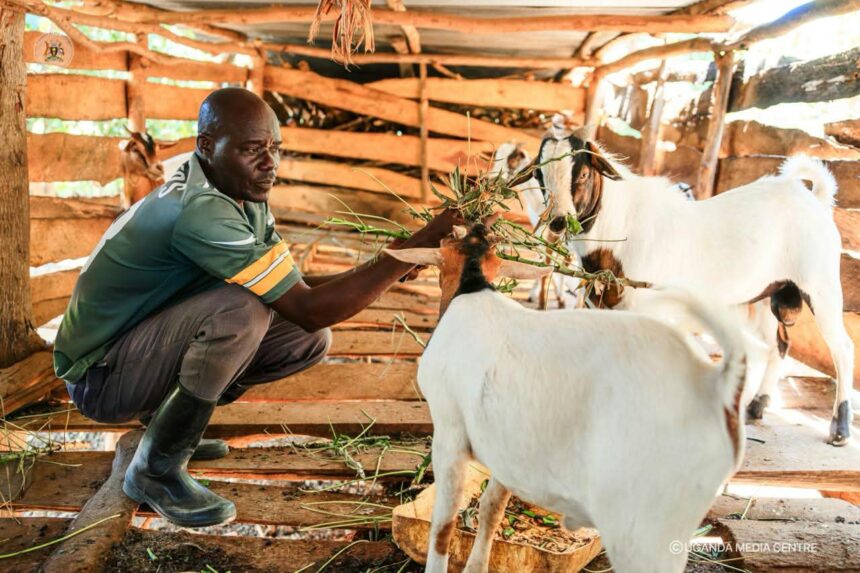
Fred Bogere, the chairperson of Namayemba East B Village, also used his initial investment to establish a livestock enterprise.
His farm now comprises eight goats, eight pigs, a cow and a calf, while he continues to repay his PDM loan.
The experiences of these beneficiaries illustrate how access to affordable capital can help rural households build productive assets and diversify their sources of income.
Palm oil farming offers an alternative to sugarcane
For decades, many farmers in Bugiri District have depended on sugarcane, a crop that can take a long time to mature and exposes growers to price fluctuations and high transportation costs when delivering their produce to mills.
In 2024, the Ministry of Agriculture, Animal Industry and Fisheries introduced palm oil farming in the district as an alternative crop intended to diversify agricultural production and improve farmers’ earnings.
More than 522 farmers organised under the Bugiri District Palm Oil Growers Cooperative Limited have adopted the crop, with early adopters expecting their first harvest in early 2027.
Under the project model, farmers with at least two acres receive seedlings and maintenance support until their crops mature. The financing is channelled through structured loan accounts with Equity Bank, with repayment tied to harvests.
Farmers are expected to repay 33 per cent from each harvest until the full amount advanced has been recovered.
Mugoya Paul, a former sugarcane grower in Nankoma Sub-county, said he had initially been cautious about adopting another commercial crop after experiencing losses from sugarcane farming.
“As a former sugarcane farmer, I lost money on sugarcane and was initially cautious. But palm oil is a good crop, whether it rains or shines. No thieves can steal or destroy it, and a kilo of fruit is currently over Shs1,000,” he said.
For Monica Namumbya, who manages two acres of palm oil, the crop represents an opportunity to secure her future through farming.
“Even though I haven’t harvested yet, I already see the future. I am optimistic that this is going to be the end of my poverty as a woman in farming,” she said.
Mwanje James, another landowner participating in the project, receives operational support of approximately Shs1.3 million annually. He also grows beans and groundnuts between the palm oil plants as he waits for the trees to mature.
The involvement of industrial buyers such as BIDCO, which collects the harvested produce directly from farmers, is expected to reduce transportation challenges and improve access to markets.
Together, the financing arrangements, agricultural support and planned market linkages are intended to make palm oil farming a more viable long-term enterprise for participating households.
Rice farmers seek support to increase earnings
Despite the introduction of alternative crops, rice remains an important part of Busoga’s agricultural economy.
Farmers such as Moses Musuubo say additional government support would help them increase production, improve their earnings and provide better livelihoods for their families.
Rice cultivation is particularly important in Busoga, where farmers have traditionally used low-lying areas and wetlands for production.
The government intends to support efforts to increase rice production, although the expansion of cultivation in wetlands must be balanced with environmental protection and applicable wetland regulations.
Improved farming methods, access to appropriate inputs and better market opportunities could help rice farmers increase productivity and earn more from their produce.
A changing economic landscape
The developments taking place across Jinja and Bugiri illustrate how industrial investment, public infrastructure, access to affordable credit and agricultural diversification can contribute to local economic transformation.
In Jinja, manufacturing enterprises are providing jobs and technical skills, while the Search and Rescue Centre at Masese is intended to improve safety for communities that depend on Lake Victoria.
In rural Bugiri, the Parish Development Model is helping some households invest in livestock and other income-generating activities, while palm oil farming offers an alternative to traditional dependence on sugarcane.
However, sustaining these gains will depend on effective programme implementation, timely loan repayments, reliable markets, environmental protection and continued support for farmers and small businesses.
As Uganda pursues the objectives of the Fourth National Development Plan, Busoga’s evolving economic landscape offers an example of how government programmes, industrial activity and agricultural investment can complement one another.
The region’s transition from an economy heavily dependent on traditional cash crops towards a more diversified system is still unfolding, but the experiences of workers, farmers and entrepreneurs point to growing opportunities for employment, household income and long-term economic resilience.