







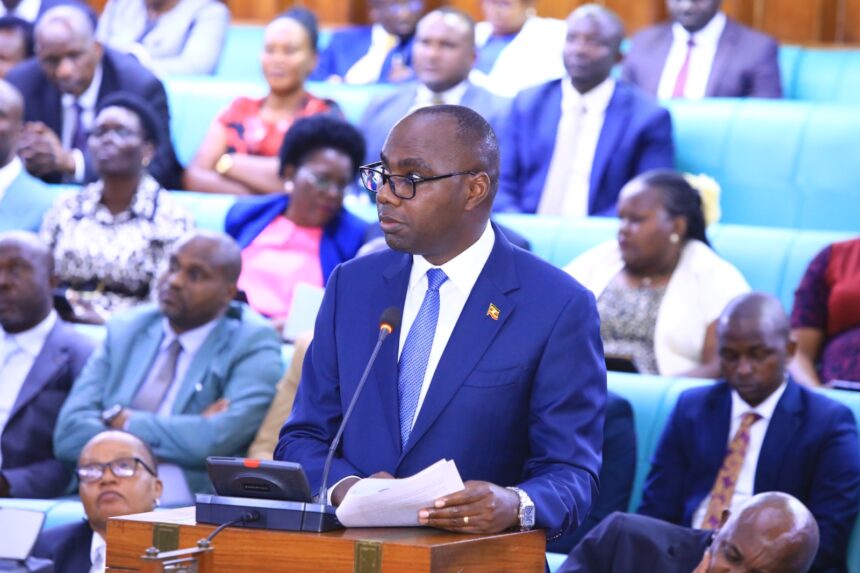

The Minister of Finance, Planning and Economic Development, Henry Musasizi Ariganyira has outlined measures being undertaken by government and the Bank of Uganda to stabilise the shilling, contain inflation and ease pressure on households and businesses following the currency’s recent depreciation.
Presenting a statement on the state of the economy to Parliament on Tuesday, October 27, Minister Musasizi said the measures include tighter monetary policy, expenditure restraint, improved fuel supply security and efforts to strengthen Uganda’s foreign exchange earnings through increased production and export diversification.
He said the shilling had come under significant pressure in recent weeks, driven by rising demand for foreign currency to finance petroleum and other imports, declining earnings from some agricultural exports and changes in international financial conditions.
The minister said the depreciation had increased the cost of importing fuel, putting additional pressure on transport, production and the prices of goods and services.
“Government recognises the difficulties that higher fuel prices, transport costs and production costs are placing on our people,” Musasizi said, adding that the government’s responsibility was to explain the causes of the economic pressures and take appropriate action to protect economic stability.

He said headline inflation stood at 4.6 per cent in September 2026, while core inflation was 3.7 per cent, below the Bank of Uganda’s five per cent target. However, inflation for energy, fuel and utilities had risen to 14.5 per cent, increasing the cost burden on households and businesses.

Musasizi attributed the pressure on the shilling partly to increased demand for dollars by the energy sector, noting that net foreign exchange demand from the sector had risen from $360 million in the three months to September 2025 to $620 million during the corresponding period in 2026.
He said geopolitical tensions in the Middle East had increased international petroleum, shipping and insurance costs, forcing Uganda, which relies on imported petroleum products, to spend more foreign currency on fuel.
Other factors included increased demand for imported goods ahead of the December festive season, imports required by oil projects ahead of commercial production, lower global coffee and cocoa prices, and reduced tourism receipts.
To address the pressure, the minister said the Bank of Uganda had raised the Central Bank Rate from 9.75 per cent to 12 per cent and increased the commercial banks’ cash reserve requirement from 11 per cent to 13.5 per cent.
He said the measures were intended to moderate excessive demand, contain inflation and support confidence in the shilling, although their effects would take time to filter through the economy.
The central bank would also continue managing liquidity and intervene in the foreign exchange market where necessary to address excessive volatility, while maintaining a market-determined exchange rate.
Musasizi said government was complementing monetary policy through expenditure restraint, with first-half expenditure releases for the 2026/2027 financial year limited to 45.6 per cent of the approved budget, compared with the planned 55.7 per cent.
He said the restraint would be accompanied by tighter controls on government commitments to avoid accumulating domestic arrears that could undermine businesses and delay payments to suppliers and workers.
Government would prioritise essential public services and investments expected to increase production, employment and foreign exchange earnings, particularly in agro-industrialisation, tourism, mineral development, science, technology and innovation.
On fuel prices, Musasizi said government was pursuing measures to improve petroleum supply security, including centralised bulk fuel importation, expansion of storage infrastructure, development of lower-cost pipeline transportation and investment in domestic refining capacity.
He said government would promote competition in the petroleum market and avoid unsustainable interventions, including price controls, broad-based subsidies and tax reductions, which could undermine public revenues, distort markets and create fuel shortages.
“Instead, our approach is to promote competition, ensure reliable fuel supplies and protect consumers through sustainable market-based measures,” he said.
The minister said long-term stability would depend on Uganda’s ability to expand domestic production, diversify exports and reduce dependence on imported goods and fuel.
He said government was pursuing investments to improve agricultural productivity and agro-processing, expand tourism, strengthen manufacturing, promote mineral value addition and improve access to export markets.
The commencement of commercial oil production was also expected to contribute to foreign exchange earnings and public revenues over time, although petroleum revenues would be managed in accordance with the applicable legal and fiscal frameworks.
Musasizi urged households to prioritise essential expenditure, conserve fuel and energy, and purchase locally produced goods where quality and prices were competitive.
He also asked businesses to improve efficiency, source inputs locally where commercially viable and expand production for export markets. Businesses whose earnings are mainly in shillings were advised to manage foreign exchange risks carefully and avoid borrowing in dollars without appropriate safeguards.
The minister further cautioned Ugandans against panic buying of foreign currency and speculative transactions driven by rumours, saying such behaviour could intensify short-term pressure on the shilling.
Despite the current challenges, Musasizi said Uganda’s economic fundamentals remained strong, with the economy growing by 6.4 per cent in the 2025/2026 financial year, up from 6.3 per cent in the previous financial year.
He said the economy had expanded to Shs250.4 trillion, equivalent to $69.3 billion, supported by positive performance in agriculture, industry and services.
Musasizi acknowledged that currency depreciation and measures to contain its effects could affect households, businesses, credit, employment and public finances, adding that government would continue monitoring developments and adjust its response where necessary.
He said government could not responsibly promise a specific exchange rate or predict exactly when the current pressures would ease, but committed to disciplined policymaking, transparent communication and evidence-based decisions.
He appealed to Ugandans to remain calm and make informed financial decisions as government and the Bank of Uganda pursue measures to restore macroeconomic stability, protect livelihoods and sustain production and employment.