








The Minister of Finance, Planning and Economic Development, Henry Musasizi Ariganyira, has outlined Government priorities aimed at strengthening Uganda’s construction value chain through simplified building approval processes, improved access to financing, stronger local contractors and enhanced accountability in public investments.
Minister Musasizi said the proposed reforms are intended to reduce the cost and time of construction, promote local participation and attract long-term private sector investment to accelerate economic growth.
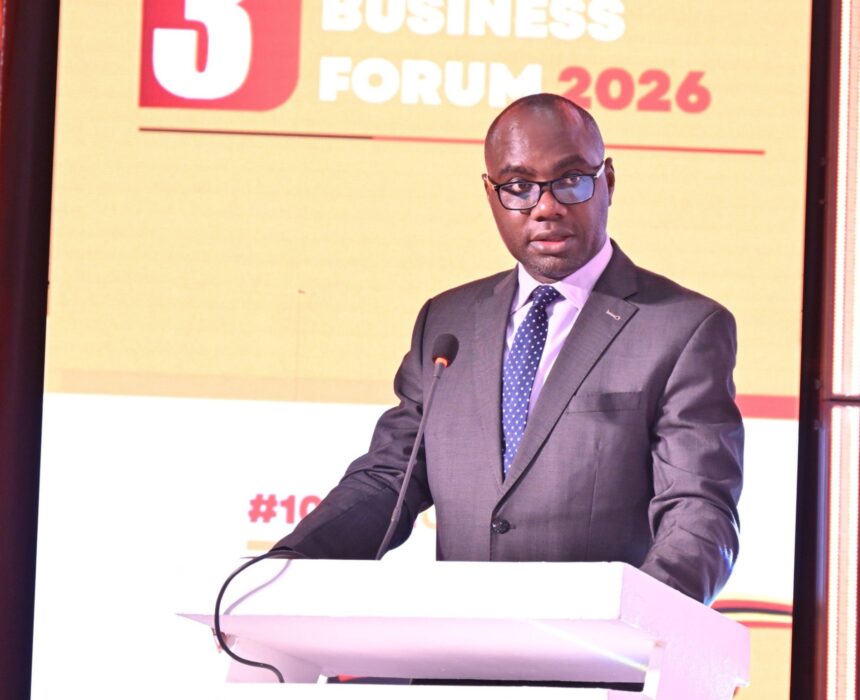
He made the remarks on Thursday while addressing the 3rd Doing Business Forum held at Mestil Hotel in Kampala under the theme, “Unlocking Uganda’s Tenfold Growth through the Construction Value Chain: Regulatory Reform, Local Capacity and Infrastructure Investment.”
He said Government would work with local governments to improve physical planning, simplify building approval procedures and enforce construction standards to create a predictable business environment for developers.
Musasizi said developers should have clear information about the requirements, costs and timelines involved in obtaining building approvals to enable them to undertake projects safely and efficiently.

He also emphasised the need to strengthen the capacity of Ugandan contractors through skills development, access to equipment and improved management systems, saying this would enable local firms to compete effectively and deliver quality infrastructure projects.

The minister called for increased support for innovations in locally produced building materials to make them more affordable and competitive, noting that this would reduce construction costs while creating opportunities for Ugandan businesses and workers.
On housing, Musasizi said Uganda’s estimated deficit of 2.4 million housing units presents significant investment opportunities but requires affordable financing options for both households and property developers.
He said the Ministry of Finance would support the phased capitalisation of the National Housing and Construction Company, alongside private sector innovations aimed at lowering the cost of construction.
Minister Musasizi added that Government would sustain investments in roads, electricity, water and other essential infrastructure, including in Greater Kampala, to facilitate construction activities and create an enabling environment for private investment.
He said Government would also advance digitisation and procurement reforms to strengthen accountability, combat corruption and ensure value for money in public investments.
The minister challenged forum participants to develop practical proposals that would reduce construction costs and timelines, improve the competitiveness of Ugandan firms in securing and executing contracts, and attract long-term investment into the sector.
He urged stakeholders to ensure that every proposal identifies the responsible institution and specifies what it can deliver within a clearly defined timeframe.
The Permanent Secretary and Secretary to the Treasury, Dr Ramathan Ggoobi, called for improved infrastructure delivery, stronger local contractor capacity, faster business approval processes and greater accountability in implementing reforms to unlock Uganda’s construction value chain.
Ggoobi said a competitive construction industry supports the wider economy by enabling infrastructure development and expanding opportunities for Ugandan contractors, manufacturers, professionals and workers.
Under the Fourth National Development Plan (NDP IV), Government targets to increase the paved share of national roads from 29 per cent to 33 per cent, raise rail’s share of cargo transportation from three per cent to 20 per cent and reduce the housing deficit from 2.4 million to 1.9 million units.
He said these investments should translate into lower transport costs, reliable electricity and more affordable development.
Ggoobi emphasised the need for better project preparation, coordinated provision of utilities and timely implementation to ensure infrastructure investments deliver the intended results.
He said local participation in the construction sector must go beyond Ugandan firms winning contracts, adding that they should also have access to financing, equipment, technical expertise and sound management systems to deliver quality work on time.
Through the Technical and Vocational Education and Training (TVET) Council, Government is strengthening practical training, industry attachments, apprenticeships and competency-based certification to equip young Ugandans with skills required by the construction industry.
Ggoobi said Government was also improving land administration through the Uganda National Land Information System and 22 Ministry of Lands zonal offices, bringing services closer to users.
He reported that land title processing time had reduced from 180 days to 45 days.
The Building Industry Management System is also digitising building permit applications, inspections, professional verification and fee payments.
Ggoobi called for building approval systems to be integrated with land administration, business registration, taxation and professional regulatory systems.
“Businesses should be able to track applications, know requirements and fees upfront, and receive decisions within published timelines. Electronic signatures should also reduce unnecessary visits, costs and delays,” he said.
He said Government was supporting indigenous contractors through the Uganda Development Bank’s Shs150 billion Local Contractors Financing Initiative, which provides affordable financing, equipment and capacity development.
Of the Shs59.03 billion approved under the initiative, Shs24.89 billion had been disbursed.
Ggoobi called for the challenges between loan approval and disbursement to be addressed to ensure the financing translates into completed projects.
“We must understand and address the constraints between approval and disbursement so that financing translates into completed work,” he said.
He called for an action matrix identifying each constraint, the required reform, responsible institution, delivery deadline and measurable outcome.
“We should measure success of this Forum when businesses experience faster services, lower costs and greater certainty,” Ggoobi said.
Meanwhile, Dianah Nannono, the Head of the Private Sector Development Unit, provided an update on Government’s response to concerns raised during the second Doing Business Forum in 2025.
On product certification, she said Government had increased funding to the Uganda National Bureau of Standards (UNBS) from Shs55.9 billion in the 2024/25 financial year to Shs133 billion in 2025/26.
A further Shs130 billion was allocated in the 2026/27 financial year to support certification, standards enforcement, laboratory operations and trade facilitation.
She said UNBS had also recruited 100 additional staff and invested in regional laboratories, modern testing equipment and digitalisation.
To address the cost of electricity connections, Government reduced charges under the rural electrification programme from Shs700,000 to Shs30,000 for connections requiring no poles, and from Shs1.8 million to Shs30,000 for those requiring one pole.
Government has also introduced an off-peak electricity tariff of US$0.05 per kilowatt-hour for extra-large consumers using more than 1.5 megawatts.
On industrial park infrastructure, Nannono said Government had increased funding for the Manufacturing Programme from Shs312 billion in 2025/26 to Shs1.03 trillion in 2026/27.
At Namanve Industrial Park, infrastructure works covering approximately 45 kilometres of roads, bridges, drainage, electricity distribution, water, sewerage and ICT had reached 82 per cent completion by September 2026, with completion expected by December 30, 2026.
At Mbale Industrial Park, Government approved Shs146.39 billion for the 2026/27 financial year to support the construction of internal roads, drainage systems and electricity infrastructure. Road works had reached 50 per cent completion, while water supply and sewerage works stood at 40 per cent.
At Kapeeka Industrial Park, road construction had reached 29 per cent, while a contractor had been procured to construct the power substation.
Nannono said construction was a foundational enabler of Uganda’s ambition to become a US$500 billion economy by 2040.
She said the value chain supports investments across agro-processing, industrial parks, tourism, real estate, housing, transport infrastructure and other productive sectors.
She cited ongoing investments, including the Kampala Capital City Authority’s upgrading of more than 78 kilometres of roads, a US$140 million African Development Bank facility supporting irrigation and agro-industrialisation in Bunyoro, and the development of a 320-million-litre fuel terminal in Mpigi.
Nannono said the investments presented opportunities for local contractors, engineers, transporters, farmers and manufacturers.
However, she said the challenge remained strengthening the capacity of Ugandan firms to participate in contracts and deliver quality work on time and within budget.