








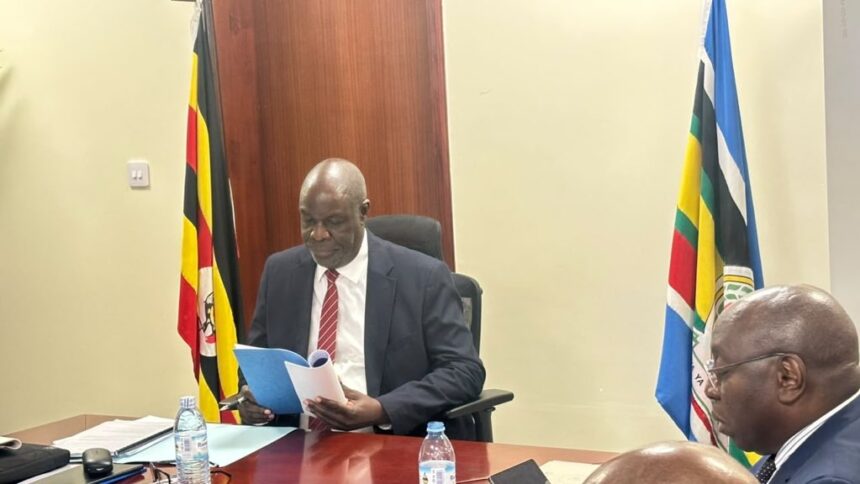

The Deputy Chief Justice, Justice Moses Kazibwe Kawumi, has called for strategic resource allocation and stronger accountability to ensure that investments in court infrastructure, technology and institutional capacity translate into improved access to justice.
Justice Kazibwe made the remarks on Tuesday while chairing a meeting of the Judiciary’s Planning, Development and Finance Committee at the Court of Appeal Building in Kampala.
The Committee reviewed progress on infrastructure projects, the proposed rollout of the Electronic Court Case Management Information System (ECCMIS) to the remaining courts and the draft Judiciary Budget Estimates for the 2027/28 Financial Year.
Justice Kazibwe said the Committee’s mandate goes beyond reviewing plans and financial proposals to ensuring that the Judiciary’s strategic priorities are translated into tangible results.
“Our responsibility extends beyond reviewing plans and financial proposals. We must ensure that the Judiciary’s strategic priorities are translated into well-considered investments, appropriate resource allocations, sound implementation frameworks and measurable institutional outcomes,” he said.

He urged members to consolidate successful interventions while developing strategies that respond to emerging institutional needs.

He added that financial and development priorities should be aligned with the Judiciary’s constitutional mandate, Uganda Vision 2040, the Fourth National Development Plan (NDP IV) and the Tenfold Growth Strategy.
Strengthen performance monitoring and accountability

The Deputy Chief Justice called for a functional monitoring and evaluation framework to track the implementation of the Judiciary’s Sixth Strategic Plan, measure progress and identify challenges requiring corrective action.
He emphasised the need for clear performance indicators, defined reporting responsibilities, regular reporting intervals and mechanisms for verifying results.
Justice Kazibwe said resource allocation decisions should be guided by credible evidence of institutional needs and performance gaps.
On the draft 2027/28 budget, he urged the Committee to prioritise expenditure, eliminate duplication and provide for recurrent costs necessary to sustain development investments.
“Proposals should be realistic, justified and based on expected institutional benefits. Avoid duplication, improve spending efficiency, and account for the recurrent costs of development investments,” he said.
Presenting the proposed budget estimates, the Commissioner for Policy and Planning, Mr Simon Peter Opolot, said case management accounted for the largest share of the proposed budget, followed by general administration, capacity building and capital development.
Court infrastructure must improve service delivery
Justice Kazibwe described infrastructure development as critical to expanding geographical access to justice but cautioned that construction projects must deliver accessible, functional and sustainable court facilities.
He urged the Committee to assess the physical progress of projects, compliance with contractual obligations, implementation timelines, construction quality and value for money.
He also called for scrutiny of completed facilities that were yet to become operational.
“Ensure investments deliver services, not merely completed structures,” he said.
Meanwhile, the Commissioner for Engineering and Technical Services, Eng. George Turyakira, presented progress reports on ongoing infrastructure projects.
He reported that construction of the Gulu Regional Court of Appeal was at 18 per cent completion, while the Mbarara Regional Court of Appeal stood at 16 per cent.
Other projects included Soroti High Court at 94 per cent, Tororo High Court at 95 per cent, Mpigi High Court at 13 per cent, Mukono High Court Annex Building at 45 per cent and Rakai Chief Magistrate’s Court at 51 per cent.
Turyakira also revealed that construction of Alebtong Court had remained at the finishing stage for more than two years, adding that a new contractor was expected to take over the site by December 1, 2026.
He highlighted gaps in contract management and called for interventions to bring delayed projects back on schedule, alongside early preparations for new construction projects.