


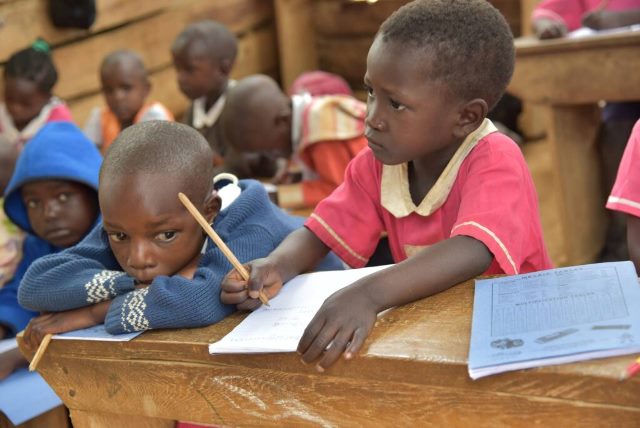

The Ministry of Education and Sports has revealed that the government will require more than Shs 1.48 trillion to implement free and compulsory education at both primary and secondary levels, as part of efforts to curb the exorbitant fees charged in schools.
The disclosure was made by Peace Busingye, Principal Education Officer (Guidance and Counselling) at the Ministry of Education and Sports, while appearing before Parliament’s Human Rights Committee on August 21, 2025. She was responding to concerns raised in the 2024 State of Human Rights and Freedoms Report by the Uganda Human Rights Commission (UHRC).
“The enforcement of school fees regulation should begin with 105 government-owned and government-aided secondary schools that have been receiving public funds but operating outside the Universal Secondary Education programme since 2007. In addition, the Cabinet approved UGX 1.48 trillion to finance free Universal Primary Education between FY 2024/25 and 2027/28 to ensure that no learner pays in government and government-aided schools,” Busingye said.
Defending the government’s plan to regulate school charges, Minister of State for Sports Peter Ogwang shared a personal example to illustrate the burden of school fees.
“In my extended family, one of my cousins has 19 children, and he is a peasant. I often step in to pay their school fees. If I, with my salary, pay up to UGX 2 million per term, how would such a man manage alone? That is why free compulsory education is necessary,” Ogwang explained.

The remarks followed UHRC’s findings that despite the law and objectives of the Universal Primary Education (UPE) and Universal Secondary Education (USE) programmes, most government and government-aided schools continue charging non-tuition fees. These include contributions for staffing gaps and development costs, which UHRC blamed on inadequate government funding.

UHRC Chairperson Mariam Wangadya warned that underfunding education has wider implications. “Inadequate funding undermines teacher training, curriculum development, infrastructure, digital learning tools, and school safety. Millions of children are being denied the opportunities they need to succeed and contribute meaningfully to society,” Wangadya said.
Busingye admitted to the funding gaps, noting that although Cabinet directed the Ministry of Finance to provide UGX 309.16 billion in FY 2024/25 to support free primary education, the funds are yet to be released.
She also revealed that the Ministry is finalizing the Universal Primary and Secondary Education Policy, which will guide the implementation of free and compulsory education. “We are prioritizing the provision of free education in all public schools. To achieve this, we are set to amend the Education Act to effectively regulate school fees and other charges,” Busingye added.
This prompted Fox Odoi, Chairperson of the Human Rights Committee, to press the Ministry for clear timelines. “You propose to amend the Education Act to provide a legal framework for compulsory education. What timeframe are you working with? The absence of a stringent legal framework has left loopholes that frustrate implementation,” Odoi asked.
In response, Minister Ogwang confirmed that consultations on the amendment are underway. “We already factored in the money needed for compulsory education, and while we await the Ministry of Finance’s support, consultations on the legal framework are ongoing. Allow me to report back formally on progress,” he said, stressing that many children are dropping out of school due to illegal charges.
Meanwhile, the Ministry informed the Committee that Cabinet had already disallowed several charges in schools, among them PTA fees, assessment fees, admission fees, board of governor fees, salary supplements, and foundation body charges, in a bid to reduce the cost of education.