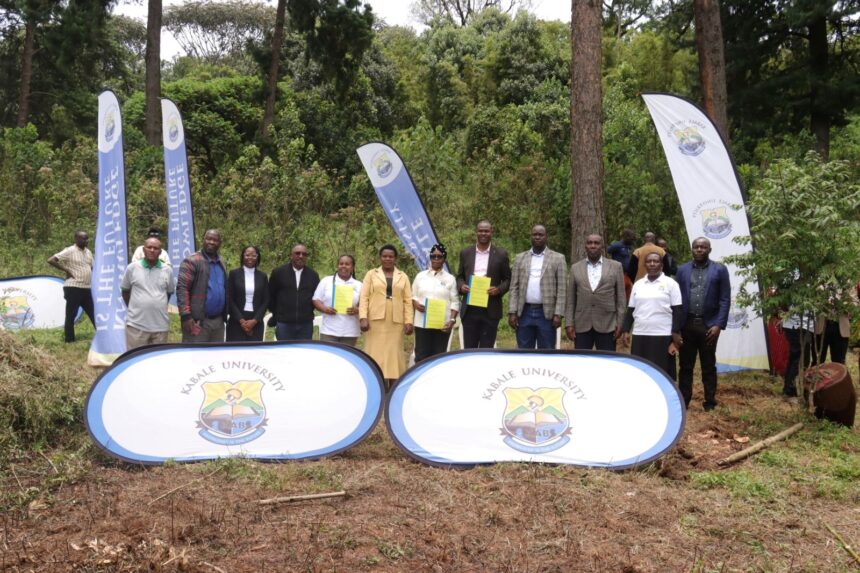

Kabale University has signed a Memorandum of Understanding (MoU) with the National Forestry Authority (NFA) to establish a Field Research Station in Echuya Central Forest Reserve, a move aimed at strengthening research, conservation, and practical training for students.
The agreement was signed on Friday at Echuya Forest in Rwaburindi Village, Ikamiro Parish, Muko Sub- County in Rubanda District.
Echuya Forest, known for its unique high-altitude bamboo vegetation, is an important ecological area that provides habitat for several endangered bird species, including the Grauer’s swamp warbler. The forest is also a popular birding destination, protects the Muchuya Swamp catchment, and offers cultural heritage experiences linked to the indigenous Batwa community.
Under the partnership, NFA will allocate 2.1 hectares of land within the forest reserve to Kabale University to facilitate the establishment of the research facility.
Kabale University Vice Chancellor, Prof. Joy Kwesiga, said the research station will provide a platform for staff and students to undertake scientific studies in forest ecology, biodiversity conservation, tourism development, and the socio-economic impacts of protected areas.

She noted that the facility will also offer students practical field-based learning while supporting efforts to identify, document, and conserve rare, threatened, and endangered plant and animal species.

Cue in: “We have a department of cultural…”
Cue out: “…We are also going.”
Dr. Akatwijuka Rogers, the Associate Dean of the Faculty of Agriculture and Environmental Sciences at Kabale University, explained that research conducted at the station will cover areas such as forest ecology, watershed management, tourism planning, ecosystem monitoring, conservation of endangered species, and the study of medicinal plants with scientific and socio-economic value.
Cue in: “We shall focus on areas of…”
Cue out: “…these are the ones keeping.”
Meanwhile, NFA Executive Director Stuart Maniraguha encouraged the university to develop a sustainable research station capable of attracting scholars from across Africa.
He cited Budongo Forest in northwestern Uganda as an example, noting that a research station established there in 1990 has since turned the forest into one of the most extensively studied tropical forests on the continent.
Maniraguha revealed that discussions leading to the partnership began in 2024 when Kabale University approached NFA seeking collaboration and land to establish a research station and botanical garden.
Cue in: “The laboratory cannot be visited once…”
Cue out: “…Because of existence of.”
Key activities expected to follow the signing of the MoU include developing a site layout plan, securing approval for architectural designs, conducting an Environmental and Social Impact Assessment, constructing the research station, carrying out research and training programs, and disseminating research findings to support conservation and sustainable development.