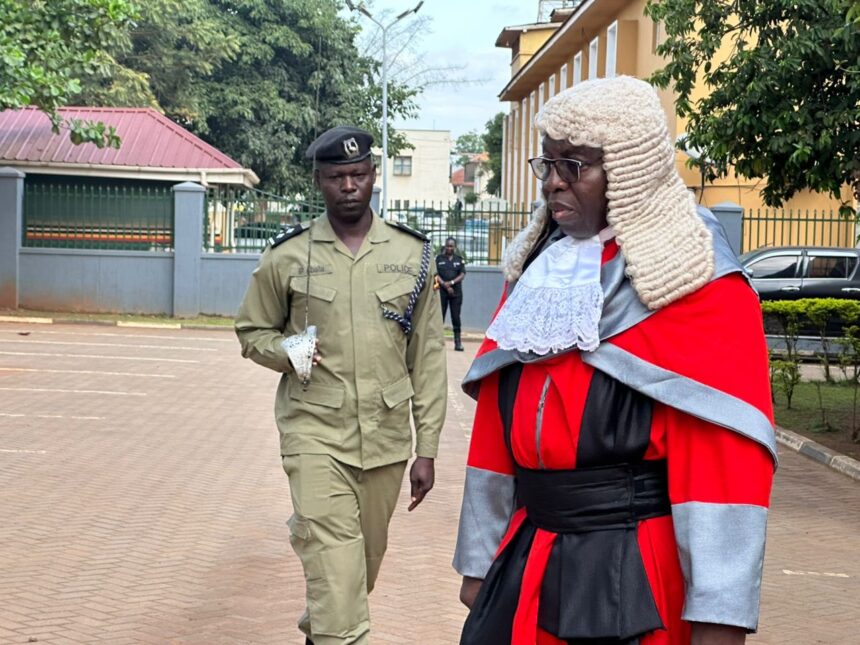

The Court of Appeal has kicked off a two-day criminal session in Mbale, bringing appellate justice closer to communities in Eastern Uganda and stepping up efforts to tackle case backlog.
The session, flagged off by Justice Geoffrey Kiryabwire, a Justice of the Court of Appeal and the Court’s Administrator, began on March 24, 2026, and will run until March 25, 2026. A total of 30 criminal appeals are lined up for hearing.
The panel presiding over the session includes Hellen Obura, Eva Luswata (appearing virtually), and Florence Nakachwa.
According to the cause list signed by Registrar HW Rukundo Allen Owembabazi, the majority of appeals stem from serious criminal convictions. These include 12 murder cases, 10 aggravated defilement cases, and four aggravated robbery appeals. Other cases involve charges such as kidnap with intent to murder, rape, and manslaughter. Four appeals have been filed by the State, challenging acquittals in some of these cases.
Speaking ahead of the session, Justice Kiryabwire emphasized Mbale’s growing importance in the Judiciary’s decentralisation agenda, noting that the area has already been gazetted for a regional Court of Appeal. He called on stakeholders to protect the land earmarked for the court from encroachment, stressing its importance for future judicial expansion.

He also highlighted the need for innovative approaches to justice delivery, pointing out that not all disputes must be resolved through traditional court processes. He encouraged the adoption of alternative mechanisms such as plea bargaining and mediation to complement formal litigation.

“These approaches can ease the burden on courts while delivering timely justice,” he noted, adding that collaboration among institutions including police, prisons, the legal fraternity, and civic leaders is key.
Justice Kiryabwire further pointed to ongoing digital reforms under the Judiciary’s transformation agenda, including the rollout of the Electronic Court Case Management Information System (ECCMIS), which is expected to improve efficiency through online access, automated tracking, and streamlined case handling.
Welcoming the appellate court session, Dr. Lubega Farouq, Head of the Mbale High Court Circuit, praised the initiative for improving access to justice in the region.
He revealed that Mbale High Court is currently handling 3,976 cases, with 1,827 classified as backlog—about 45.9 percent of the total caseload.
Despite challenges such as understaffing, unreliable internet, and delays in the rollout of digital systems, he noted progress in alternative dispute resolution, with 16 cases successfully settled through mediation between January and February this year.
Representing the Office of the Director of Public Prosecutions, Senior Assistant DPP Sam Oola highlighted operational gaps, including limited presence in some districts and delays caused by missing files and incomplete sessions.
Meanwhile, Eastern Uganda representative of the Uganda Law Society, Eddie Nangulu, raised concerns over delays in handling appeals, calling for continued reforms to ensure timely justice.
The Mbale session reflects the Judiciary’s broader commitment to decentralisation, innovation, and efficiency—bringing hope for faster resolution of cases and improved access to justice for communities across the region.