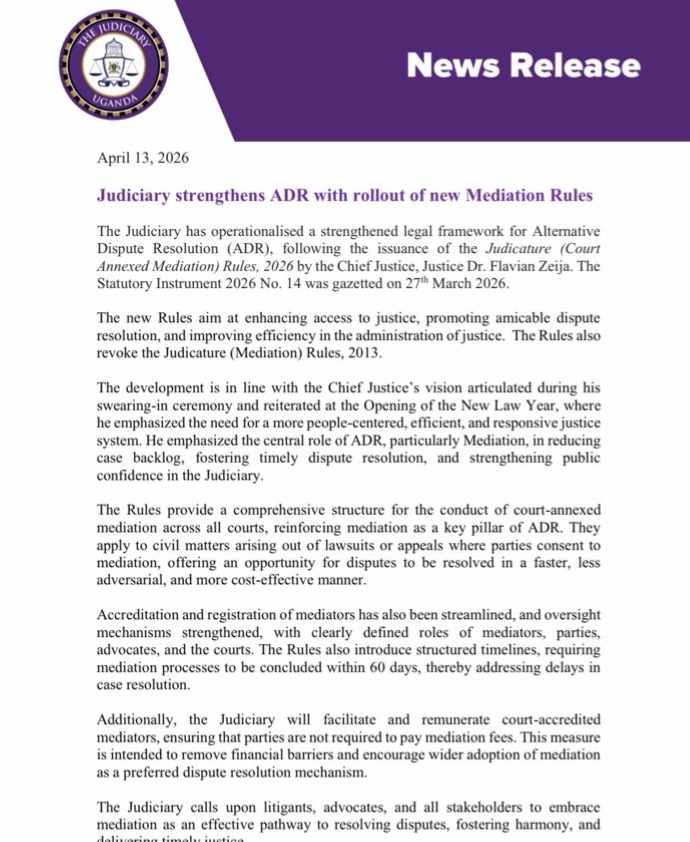

The Judiciary has taken a significant step toward improving access to justice with the rollout of a strengthened legal framework for Alternative Dispute Resolution (ADR), following the issuance of the Judicature (Court-Annexed Mediation) Rules, 2026 (Statutory Instrument No. 14).
Issued by the Chief Justice, Justice Dr. Flavian Zeija, the new Rules were officially gazetted on March 27, 2026, marking a major milestone in the ongoing efforts to enhance efficiency and responsiveness within Uganda’s justice system.
The updated framework replaces the Judicature (Mediation) Rules of 2013 and is designed to promote amicable dispute resolution, reduce case backlog, and ensure faster delivery of justice. It aligns with the Chief Justice’s vision of building a more people-centered judiciary—one that prioritizes timely, accessible, and cost-effective justice for all.
Under the new Rules, court-annexed mediation is strengthened as a central pillar of ADR, applying to civil matters arising from lawsuits or appeals where parties consent to the process. The approach offers a less adversarial and more collaborative path to resolving disputes, helping to preserve relationships while saving time and resources.
To further improve efficiency, the Rules introduce structured timelines, requiring mediation processes to be concluded within 60 days. They also streamline the accreditation and registration of mediators, while clearly defining the roles of all parties involved, including mediators, advocates, and the courts.

In a move aimed at removing financial barriers, the Judiciary will facilitate and remunerate court-accredited mediators, ensuring that parties do not incur mediation fees. This is expected to encourage wider adoption of mediation as a preferred method of dispute resolution.

The Judiciary has called on litigants, advocates, and stakeholders to embrace mediation as an effective tool for resolving disputes, fostering harmony, and strengthening public confidence in the justice system.