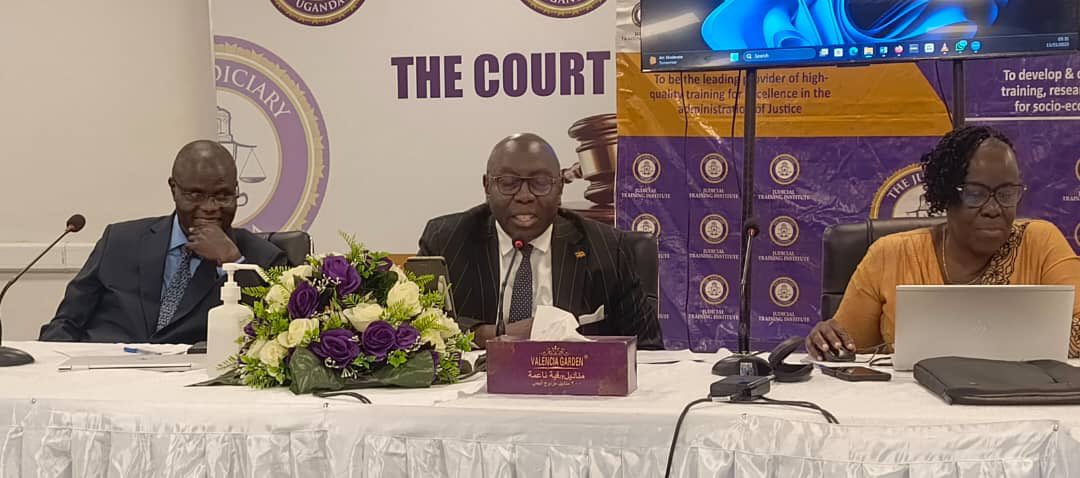

A two-day training session for Chief Magistrates on Electoral Dispute Management has kicked off at the Court of Appeal Conference Hall, aimed at enhancing the Judiciary’s preparedness for the upcoming election cycle.
Organized by the Judicial Training Institute (JTI), the training seeks to build the capacity of Chief Magistrates to handle election-related disputes efficiently, fairly, and in accordance with the law.
Delivering the opening remarks on behalf of the Deputy Chief Justice on Tuesday, Justice Dr. Flavian Zeija, Court of Appeal’s Justice Geoffrey Kiryabwire underscored the crucial role Chief Magistrates play in safeguarding the will of the people through the timely adjudication of post-election disputes.
Quoting Articles 126 and 128 of the Constitution, Justice Kiryabwire reminded judicial officers of their duty to dispense justice “without undue regard to technicalities” and “in a fair and expeditious manner.”
He cautioned that while speed is important, accuracy must never be compromised, noting that, “Expediency without accuracy is chaos, while accuracy without expediency is denial of justice.”

He also highlighted the challenges judicial officers face in managing election disputes, including tight statutory timelines, public pressure, intimidation, technological complexities, and inconsistent jurisprudence, warning that if unaddressed, these could erode public confidence in the Judiciary.

Representing the Chairperson of the JTI Governing Council, Justice Kibeedi Muzamiru Mutangula reaffirmed the Council’s commitment to ensuring quality judicial training, praising the JTI leadership for implementing practical, hands-on programs that align with the Chief Justice’s directives.
JTI Executive Director, Justice Prof. Andrew Khaukha, welcomed participants and emphasized the Institute’s commitment to equipping judicial officers with both resources and practical skills.
He pointed to the Uganda Legal Information Institute (ULII) as a critical research tool, noting that it has digitized all electoral dispute cases to enhance consistency in judicial decision-making.
Acting Chief Registrar, HW Pamela Lamunu Ocaya, urged Chief Magistrates to maintain integrity and impartiality in the face of growing political pressures during the election period. “Leadership, including self-leadership, is key to effective case management. You must demonstrate impartiality even under pressure and be the best face of the Judiciary to court users,” she said.
Meanwhile, in a related development, the Anti-Corruption Division (ACD) of the High Court held its first-ever Bar–Bench meeting at the Division’s premises, bringing together judicial officers, prosecutors, defence lawyers, and other justice sector representatives.
Chaired by Justice Michael Elubu, Head of the Division, the meeting provided a platform for improving coordination and service delivery in the administration of justice. Justice Elubu underscored the value of Bar–Bench engagements in promoting effective case management and urged participants to raise operational challenges openly.
He noted the need for stronger witness protection mechanisms and enhanced pre-trial procedures under the ACD Rules.
Lady Justice Okuo Jane Kajuga, Deputy Head of the Division, emphasized disciplined case management and cautioned against corruption among advocates who exploit litigants by falsely claiming influence over judicial decisions. “Integrity must guide all justice actors,” she said.
Justice David Makumbi called for transparency and proper record-keeping during disclosure processes, while Senior Counsel Henry Kunya urged disciplinary action against advocates who damage the Judiciary’s image while managing client expectations.
Participants agreed that the Bar–Bench forum will be held quarterly to review progress and tackle emerging challenges in case management, professionalism, and ethics within the Division.