
Summary:
- Minister Bahati pointed out that the African Continental Free Trade Area provides a vital framework for collective progress.
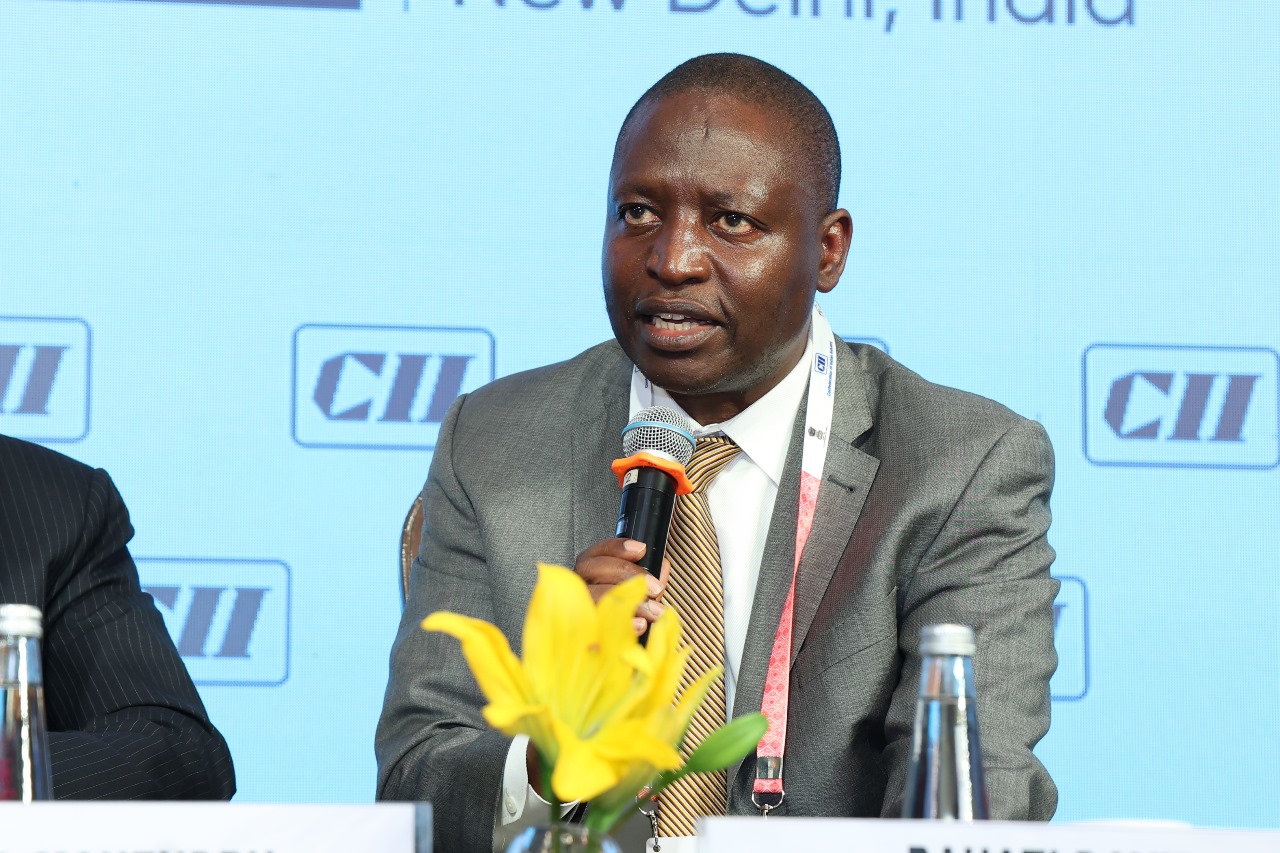
NEWS: David Bahati, the Minister of State for Trade, Industry, and Cooperatives (Industry) in Uganda, emphasized the importance of adding value to produce and maintaining factories as a cornerstone of strategy for Africa’s participation in the international market.
Speaking on behalf of the Minister of Education and Sports, Janet Museveni, at the 19th Confederation of Indian Industry (CII) African Business Conclave in New Delhi, India, Bahati highlighted that strong value chains and scaling up manufacturing are crucial for Africa’s growth.
Minister Bahati pointed out that the African Continental Free Trade Area provides a vital framework for collective progress.

“We must focus on critical sectors such as agriculture, minerals, pharmaceuticals, and vaccine production, where manufacturing is essential for our continent’s future,” said Minister Bahati.

“Uganda, as Africa’s powerhouse, has significant opportunities for industrialization. With our abundant resources, collaboration is crucial for scaling up our efforts. We’ve established export promotion initiatives to maintain high standards, and adhering to standard manufacturing practices is key to achieving excellence.” He added.
Abdisalam Sharif Hussein, Somalia’s Minister of State for Commerce and Industry, underscored the need for standardization in both imports and exports, given Somalia’s extensive coastline, agricultural land, and large cattle industry.
“Our strong blue economy necessitates international participation and an improved Office of Standards Bureau. This is critical not only for Somalia but for the entire continent. Our vision is to establish a robust standards bureau for all sectors in Somalia as soon as possible to fully leverage our economic potential and contribute meaningfully to Africa’s industrial growth,” Hussein said.
Ms. Verna Sinimbo, Deputy Minister of Industrialization and Trade in Namibia, addressed the challenges faced by Africa, including inadequate infrastructure and limited access to technology.
“These issues create inefficiencies, hinder growth, and restrict the flow of goods across borders, making it difficult for African manufacturers to scale up and compete internationally. To overcome these obstacles, African nations must collaborate and harmonize quality standards to create an enabling environment for industrial growth,” she said.
She added, “We believe that India can play a crucial role in supporting Africa’s manufacturing aspirations through its extensive experience in industrialization, technology, and innovation. As a natural partner, India can collaborate with African nations in meaningful ways, helping to turn our industrial dreams into reality.”
Mr. Michael Okyere Baafi, Deputy Minister for Trade and Industry in Ghana, shared that Ghana recognized early on the importance of manufacturing, industrialization, and technology.
“To focus on these critical areas, we aggressively adopted the ‘One District, One Factory’ policy in 2017. This initiative aims to bring manufacturing to every part of the country, accelerating our industrialization efforts. As of now, we have 266 companies operating under this policy, which has significantly increased employment and integrated quality standards into our national policies,” he said.
Mr. Ibrahim Kalil Konate, Minister of Digital Transition and Digitalization in Côte d’Ivoire, expressed confidence that Africa can achieve similar digital access as India, given its population size.
“Digitalization is both the present and the future. The penetration rate of mobile phones in Africa has surged from 5% in 2011 to 45% today, and we must leverage this for our digital revolution. To fully realize this potential, we must ensure data sovereignty by hosting our data in local data centers,” he said.
Ms. Aminata Zerbo Sabane, Minister of Digital Transition, Posts, and Electronic Communications in Burkina Faso, highlighted that Africa is at a pivotal moment where digitalization offers significant development opportunities.
“With a young and dynamic population, we are uniquely positioned to harness the benefits of this digital revolution. However, the quality of digital services remains a challenge due to insufficient infrastructure investment. Access is crucial; without it, we cannot fully benefit from the digital revolution. Nonetheless, we are committed to digital transformation and are implementing reforms to ensure better systems across all fields of digitization,” she said.