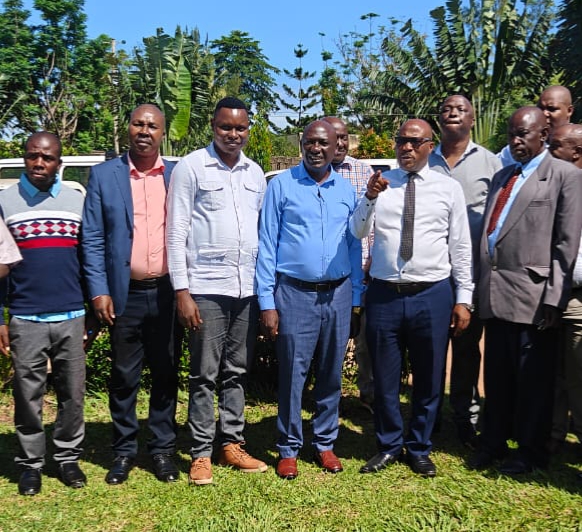

Resident District Commissioners (RDCs), Local Council Five Chairpersons, and technical leaders from Pallisa, Kaliro, and Buyende districts have pledged full political, technical, and security support for the fisheries restocking program under the Uganda Climate Governance and Sustainable Aquaculture Infrastructure Project (UCGSAIP).
The commitment was made during the NARO/DiFR-MAAIF Fisheries Stakeholder Sensitisation Meeting for District Leaders held at Bulamogi Inn in Kaliro District. The meeting, organized by the National Fisheries Resources Research Institute (NaFIRRI) under the National Agricultural Research Organisation (NARO), brought together RDCs, District Fisheries Officers, District Production Officers, Chief Administrative Officers (CAOs), and Community Development Officers (CDOs).
Speaking during a session on expectations from local government leadership, Pallisa RDC Majid Dikhsooka emphasized the need for strict enforcement and community discipline to ensure the success of the fisheries restocking initiative.
“No investment in fingerlings will yield meaningful results without proper enforcement and community responsibility,” Dikhsooka said.
He assured stakeholders of full administrative and security backing, noting that district leadership would work closely with the Uganda Police Force, the UPDF Fisheries Protection Unit, District Fisheries Officers, and local political leaders to safeguard fisheries resources.

“As RDC and Chairperson of the District Security Committee, we pledge full administrative and security support. We shall not allow illegal fishing gear, harvesting of undersized fish, or destruction of breeding grounds to undermine this important government program. Restocked fish are a public resource and must be protected,” he said.

Dikhsooka also called for greater political awareness of the UCGSAIP initiative, urging the Ministry of Agriculture, Animal Industry and Fisheries (MAAIF) to ensure national leaders, including President Yoweri Museveni, remain fully informed about progress in lake-surrounding districts.
He further emphasized the importance of regional cooperation in fisheries management, noting that fish migrate across district and international boundaries.
“Fish have no boundaries. We need synchronized enforcement, restocking, and security efforts with neighboring districts and countries to strengthen fish production and protect shared water resources,” he noted.
Drawing lessons from international examples, Dikhsooka observed that Egypt, despite lacking natural lakes, produces approximately two million metric tonnes of fish annually through strategic investment in aquaculture, compared to Uganda’s estimated 600,000 metric tonnes despite its abundant water resources.
He called for stronger enforcement, science-based restocking, and modern aquaculture practices to improve fish production in Uganda.
In response, officials from the Ministry of Agriculture advised districts to strengthen coordination through CAOs, CDOs, Natural Resources Officers, and Fisheries Officers for internal water bodies, while broader cooperation would be needed for transboundary water systems.
Pallisa District LCV Chairperson, Hon. Okiria Ben, confirmed that lakes earmarked for stocking and restocking in the district include Nakuwa, Kawi, Lemwa, Nyampasa, Nyaguo, and Omunuo.
He urged the Ministry’s technical team to begin assessments of the identified lakes starting Thursday, June 4, 2026, to fast-track implementation.
Meanwhile, community engagement barazas have been scheduled across the participating districts, beginning with Kaliro on June 3, Pallisa on June 4, and Buyende on June 5, 2026.
Dikhsooka also encouraged communities living around wetlands and water bodies to adopt alternative income-generating activities such as cage fish farming, fish ponds, wetland-friendly agriculture, beekeeping, ecotourism, and agroforestry.
He emphasized that while government will provide policy guidance and coordination, communities must embrace discipline and partnership to help Uganda increase fish production and improve livelihoods.