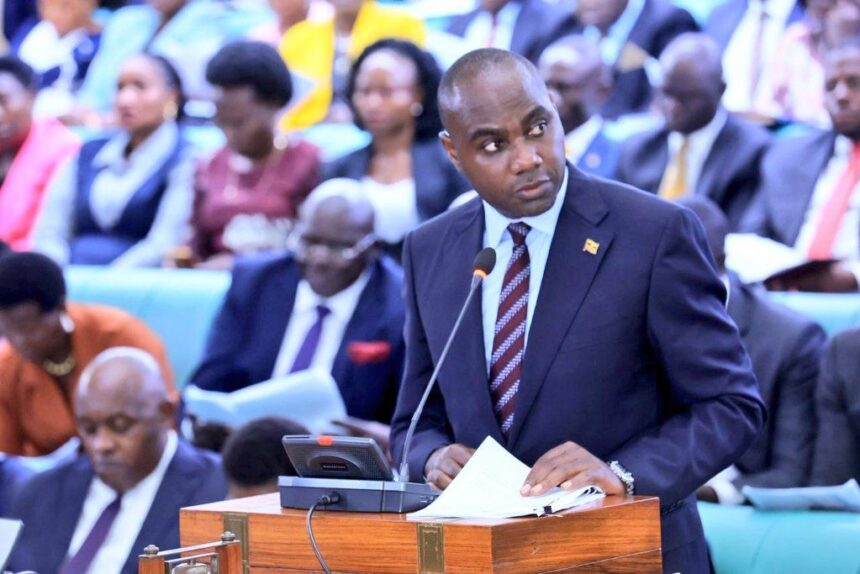

Parliament has approved a government proposal to borrow up to EUR 168,976,354 from the UK Export Finance (UKEF) and Citi Bank to finance Phase II of the Solar Powered Irrigation Systems Project aimed at boosting agricultural productivity across Uganda.
The motion was moved by the Minister of State for Finance, Planning and Economic Development, Henry Musasizi Ariganyira, during a plenary sitting of Parliament.
According to the Government Brief presented to Parliament, the proposed loan is already incorporated into Uganda’s Debt Sustainability Analysis and the Fiscal Year 2026/27 budget framework. Government assured legislators that the borrowing will not breach the country’s long-term debt sustainability thresholds.
The brief further noted that government continues to manage public debt through fiscal consolidation measures, including increased domestic revenue mobilisation under the Domestic Revenue Mobilisation Strategy, controlled borrowing and expenditure, and prioritisation of growth-driving sectors.
Government also cited the Public Investment Management System Policy and Strategy, which is designed to streamline the preparation, appraisal, approval and management of public projects before they are tabled before Parliament.

While presenting the motion, Minister Musasizi said Phase II of the project will establish 427 solar-powered irrigation systems across the country to improve agricultural productivity, particularly in coffee-growing areas.

“The goal of this project is to contribute to increased coffee yields through the provision of water for irrigation in 126 districts,” Musasizi told Parliament.
He noted that Phase I of the project has already recorded over 99 percent physical completion, with 434 irrigation systems developed nationwide, delivering measurable economic benefits to farming communities.
According to Minister Musasizi, the first phase enhanced water security and agricultural productivity for about 206,465 households, benefiting an estimated population of 908,447 people across Uganda.
Minister Musasizi justified the need for Phase II by pointing to the growing effects of climate change, which continue to reduce water availability for agricultural production.
“Farmers are increasingly losing crops due to prolonged dry spells, which negatively affects their livelihoods,” he said.
The minister added that the second phase is expected to directly benefit approximately 2,562 households, translating to about 11,785 beneficiaries.
The project will also strengthen existing agricultural extension services at sub-county, parish and district levels through the Ministry of Agriculture, Animal Industry and Fisheries (MAAIF), particularly its extension programmes and Coffee Department.