
Parliament has deferred debate on the Energy Efficiency and Conservation Bill, 2024, halting its progression to the second reading pending further consultations.
The Bill seeks to establish a legal, institutional, and regulatory framework to enhance energy efficiency and conservation in Uganda. Presenting the Committee on Environment and Natural Resources report on Wednesday, 17 September 2025, committee chairperson Hon. Herbert Ariko said the law would address wasteful energy use and regulate outdated technologies currently flooding the Ugandan market.
“Energy efficiency entails the use of technology that requires less energy to perform the same function. Currently, energy efficiency initiatives are voluntary and lack regulation, making Uganda susceptible to becoming a dumping ground for outdated technologies, resulting in significant energy waste,” Ariko told the House.
However, a minority report by Hon. Ronald Kanyike (NUP, Bukoto County East) and Hon. Christine Kaaya (NUP, Woman MP, Kiboga District) opposed the Bill, arguing that it is impractical, duplicative of existing legislation, and silent on critical issues such as biomass use, affordability, and financing.
Kanyike cited existing laws, the Electricity Act (1999), National Environmental Act (2019), and Uganda National Bureau of Standards Act (1983), as adequate for regulating energy efficiency if properly enforced.

He recommended that instead of enacting a new law, government should issue statutory instruments under the Climate Change Act, strengthen enforcement of existing policies, prioritise biomass transition and clean cooking solutions, and lower tariffs to promote modern energy uptake.

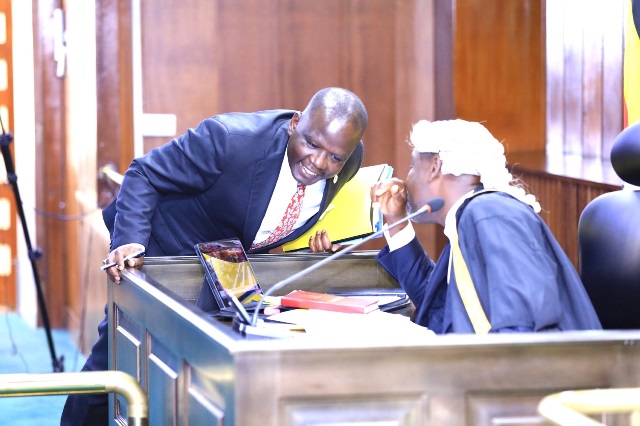
Deputy Speaker Thomas Tayebwa directed the Minister of Energy and Mineral Development to meet with the Attorney General, Hon. Ariko, and Hon. Kanyike before the Bill returns for the second reading.
“The member has raised salient issues, saying the proposed law is redundant. We must ask: can these issues be solved with regulations, or do we need a law? Because of that, I say we stand over this,” Tayebwa ruled.
Several MPs echoed the concerns. Hon. Jonathan Odur (UPC, Erute County) noted that the Bill narrowly focuses on electricity, cooking, and road transport, yet Uganda has multiple energy sectors, including rail, water, and air transport, which remain unaddressed.
Hon. Peter Okeyoh (NRM, Bukooli Island County) and Hon. Jane Pacuto Avur (NRM, Pakwach Woman MP) questioned the relevance of passing a law on electricity efficiency when many rural areas still lack access to power.
Shadow Attorney General Hon. Wilfred Niwagaba also criticised the Bill, saying its provisions could be handled through regulations rather than a standalone Act.
“When you look at the definitions in the Bill, these are matters that can be addressed under statutory instruments. We do not need to legislate on this,” Niwagaba argued.
Lawmakers further expressed concern that if enacted, the Bill could increase electricity tariffs, placing additional burdens on households and businesses.