KAMPALA: The Government of Uganda, through the Ministry of Health, has received over 1,000 liters of Biolarvicides from the United Republic of Tanzania to help in the fight against malaria and other vector-borne diseases in the country.
The donation follows a sideline meeting between Dr. Hussein Ali Mwinyi, President of Zanzibar, and Uganda’s Vice President, Maj. (Rtd) Jessica Alupo, during the G77 + China Summit of Heads of State in Cuba. During this meeting, Alupo, who was representing President Yoweri Museveni at the 2023 summit, requested that Uganda join Zanzibar and Tanzania in the use of Biolarvicides as part of efforts to eliminate malaria and other vector-borne diseases.
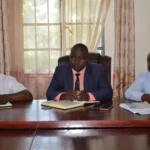
On Tuesday, April 8, 2025, Vice President Alupo, while receiving the donation at the Ministry of Health headquarters, expressed her gratitude to Dr. Hussein Ali Mwinyi and the Government of Tanzania for their selfless contribution and the enduring cordial relations between the two countries.
“This consignment will significantly contribute to reducing the burden of vector-borne diseases, especially malaria, in Uganda,” Alupo remarked.
She acknowledged the leadership of President Museveni in championing the fight against diseases in Uganda, recognizing the efforts of the Ministry of Health and its partners in combating various health challenges.

However, Alupo emphasized that health-related challenges continue to place a heavy burden on Uganda’s citizens, affecting household incomes due to medical expenses, long periods spent battling illnesses, and the physical and mental disabilities resulting from poor health. These factors, she said, have adverse effects on Uganda’s socio-economic development.

She also pointed out that malaria remains a significant threat, with children under 5 years old and pregnant women being the most vulnerable.
The Vice President commended the Government of Uganda for recently introducing a malaria vaccine into the routine immunization schedule, aimed at protecting children under five from severe malaria and death. Alupo encouraged all Ugandans to embrace the malaria vaccination campaign.
The Vice President was informed by experts that mosquitoes do not only transmit malaria but also other dangerous diseases such as lymphatic filariasis (elephantiasis), yellow fever, Zika virus, and more.
She stressed that controlling mosquitoes would not only reduce malaria but also mitigate the spread of these other public health threats.
Alupo expressed her satisfaction that the Ministry of Health had incorporated Larval Source Management (LSM), including larviciding, as part of the country’s vector control efforts.
“This initiative should continue to be supported and popularized in the communities,” she said. She further encouraged Ministry officials to train and support district local governments in managing more complex malaria breeding sites using modern methods.
In her speech, Alupo thanked President Museveni and the National Resistance Movement (NRM) government for leading efforts to fight vector-borne diseases and ensuring universal health coverage for all Ugandans. She also extended her gratitude to the Ministry of Health team, led by Dr. Jane Ruth Aceng, for their tireless work in delivering quality healthcare services while embracing science and technology.
She concluded by expressing her appreciation to the people of the United Republic of Tanzania for their ongoing bilateral support to Uganda. She assured Tanzania that Uganda stands with them and will continue to support their efforts.
Dr. Jane Ruth Aceng, Uganda’s Minister of Health, also thanked Vice President Alupo for her role in securing the donation from President Mwinyi.
“This act reflects your unwavering commitment to disease prevention and public health. We remain grateful for the government’s continued support of the health sector and the invaluable guidance you provide,” Dr. Aceng stated.
She further acknowledged that Uganda’s rich natural resources, such as lush vegetation, a warm and humid climate, and abundant water bodies, also create favorable conditions for disease-transmitting vectors.
According to the World Health Organization, Uganda bears a significant burden from malaria and neglected tropical diseases, including bilharzia, filariasis, onchocerciasis, trachoma, and sleeping sickness. These diseases cause illness, disability, and reduced productivity across the population.
Aceng stressed that Uganda remains committed to combating malaria and neglected tropical diseases, with a clear target to eliminate them by 2030, in line with Vision 2040 and the country’s aspirations for socio-economic transformation.
She expressed confidence that with the deployment of the malaria vaccine and other proven interventions such as larviciding, insecticide-treated mosquito nets, indoor residual spraying, and timely diagnosis and treatment, Uganda will accelerate its progress towards malaria elimination and save countless lives.
Aceng also lauded the collaboration established between Uganda and Tanzania through President Mwinyi’s support, recognizing it as a significant step forward in Uganda’s efforts to eliminate malaria and other vector-borne diseases.
Maj. Gen. Paul Kisesa Simuli, Tanzania’s Ambassador to Uganda, spoke about Tanzania’s long journey in the fight against malaria. He shared that Tanzania’s persistent efforts, including the distribution of mosquito nets and indoor residual spraying, have led to a significant reduction in malaria incidents.
“The strong bonds of friendship and collaboration between Tanzania and Uganda are rooted in our shared geography, culture, and vision for prosperity,” Gen. Simuli emphasized, noting that the two nations are not just neighbors but partners in development.
Dr. Charles Olaro, Director of Health Services at the Ministry of Health, explained that the Ministry is continuously strengthening integrated service delivery to ensure efficient use of resources.
He noted that Larval Source Management (LSM) presents a strategic opportunity to eliminate disease vectors before they mature and transmit diseases. This approach is being implemented through community participation, which helps build local capacity and is also cost-effective.
Currently, the Ministry is conducting larviciding in 11 districts: Namutumba, Kibuku, Pallisa, Otuke, Kabale, Alebtong, Lira, Lira City, Mitooma, Rubanda, and Kisoro. These efforts are targeting areas with a high malaria burden, using SAFE larvicide.
Where larvicides have been deployed, there has been a complementary impact alongside other malaria control interventions, resulting in a reduced disease burden, lower healthcare costs, improved productivity, and better sleep among communities.
The Ministry plans to expand the larviciding program in response to these positive outcomes. According to the latest World Malaria Report, there were 263 million malaria cases in 2023, compared to 252 million in 2022, with an estimated 597,000 deaths in 2023, slightly down from 600,000 the previous year.