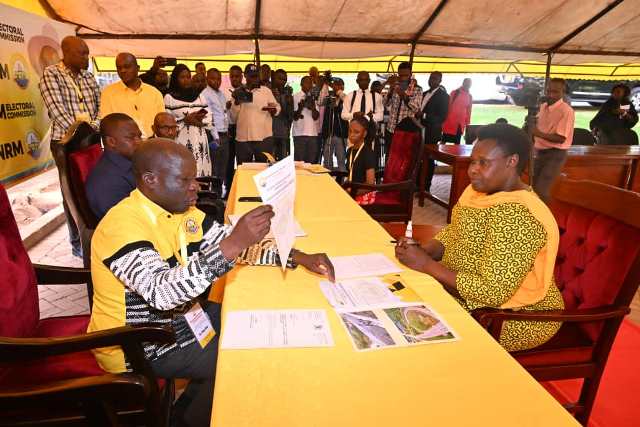

The Vice President of Uganda, Retired Major Jessica Rose Alupo Epel has officially expressed her interest to contest as Woman Member of Parliament for Katakwi District, a seat she seeks to retain in the forthcoming 2026 general election.
The brief ceremony took place at the NRM Electoral Commission headquarters on Kyadondo Road in Kampala. With this move, Vice President Alupo becomes the first candidate to express interest in the seat for the 2026–2031 parliamentary term in Katakwi District.
“I have officially expressed my intention to contest as Woman MP for Katakwi District in the NRM Primaries,” Alupo told journalists shortly after being cleared by the NRM Electoral Commission Chairperson, Dr. Tanga Odoi.
She was accompanied by NRM Secretary General Richard Todwong and other party officials.
The NRM party began registering candidates on Monday for various parliamentary constituencies ahead of the 2026 general elections.

Vice President Alupo commended the party’s electoral body and Secretariat for conducting the exercise in an orderly manner.

“I’m very hopeful that the NRM primaries will be free and fair. The early preparations by the NRM EC and Secretariat ensure that candidates have enough time to engage with voters and campaign effectively,” she said.
Reaffirming her commitment to the party’s core principles—nationalism, pan-Africanism, socio-economic transformation, and democracy—Alupo emphasized the importance of these values in shaping the future of both the NRM and the country.
She encouraged other NRM members with political aspirations to freely express their interest, describing the nomination process as “clear, simple, and fast.”
To maintain peace throughout the process, the Vice President urged the NRM leadership, particularly the EC and Secretariat, to remain vigilant and ready to resolve any disputes or tensions that may arise during the primaries.
She also called on all candidates and their supporters to strictly adhere to the party’s rules and regulations, cautioning against any interference with the established legal framework.
“The laws governing this process are clear and comprehensive. There is no need for unnecessary alterations,” she added.