
Summary:
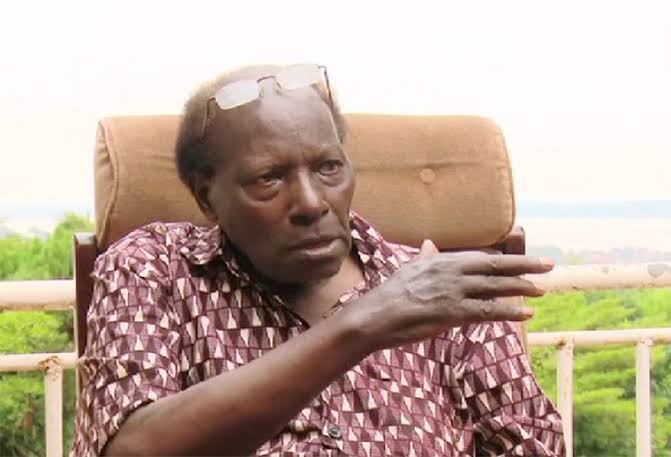
- Prof. Kanyeihamba described the decision as reprehensible, accusing Justice Irene Mulyagonja and the entire council of prioritizing politics over the law.
KAMPALA: Prof. George Kanyeihamba, the former Minister of Justice and Constitutional Affairs and Attorney General in the ruling National Resistance Movement (NRM), has condemned the Uganda Law Council’s decision to deny Kenyan Advocate Martha Karua a temporary practicing certificate.
Karua, leader of the Narc Kenya Party, was among the lead lawyers representing Dr. Kizza Besigye and Hajji Obed Kamulegeya.
Through his X (formerly Twitter) handle, Prof. Kanyeihamba described the decision as reprehensible, accusing Justice Irene Mulyagonja and the entire council of prioritizing politics over the law.

“It is shocking that an individual who struggles with basic decision-making can be entrusted with rendering impartial judgments in politically sensitive matters,” Kanyeihamba stated.

He added that respect in the legal profession requires courage to make impartial decisions rather than yielding to political influence.
Meanwhile, Isaac Ssemakadde, President of the Uganda Law Society (ULS), also criticized the Law Council’s decision. In a statement, he described the council’s December 6, 2024, ruling as per incuriam (legally erroneous).
Ssemakadde pointed out that the council disregarded Article 19 of the International Bar Association (IBA) Standards for the Independence of the Legal Profession, which emphasizes cooperation in enabling foreign lawyers to practice. The article states:
“Where a person involved in litigation wishes to engage a lawyer from another country to act with a local lawyer, the appropriate association of lawyers shall cooperate in assisting the foreign lawyer to obtain the necessary right of audience, provided they have the qualifications and meet the required conditions.”
Ssemakadde further revealed that, as a member of the Law Council under Section 2(1)(d) of the Uganda Advocates Act, he was deliberately excluded from the special sitting where Karua’s application was considered.
“Had I been present, I would have highlighted Article 19,” he asserted.
He expressed hope for Karua’s case, urging her to reapply through his office while invoking the IBA standards.
“The Uganda Law Society is empowered to fight for Ms. Karua’s right to audience. I am committed to ensuring her professional right to practice law in Uganda without discrimination,” Ssemakadde affirmed.
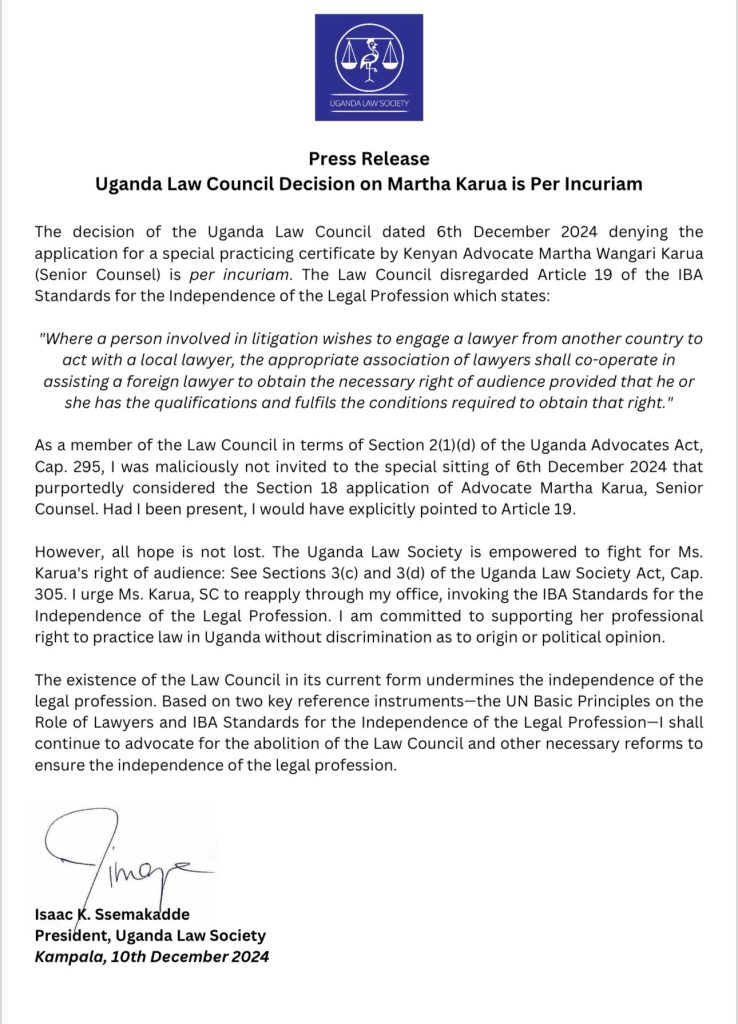
Ssemakadde also criticized the structure of the current Law Council, claiming it undermines the independence of the legal profession.
Citing international frameworks like the UN Basic Principles on the Role of Lawyers, he pledged to advocate for reforms, including the council’s abolition.
Eron Kiiza, another member of Besigye’s legal team, also took to X to decry the Law Council’s decision. Kiiza argued that the ruling contravenes multiple constitutional provisions, including Articles 20, 28, 42, 43, 44(c), and 45, as well as the Treaty for the Establishment of the East African Community.
He noted that the decision violates international law, including the African Charter, and dismissed Karua’s political affiliations as irrelevant to her eligibility to practice law in Uganda.