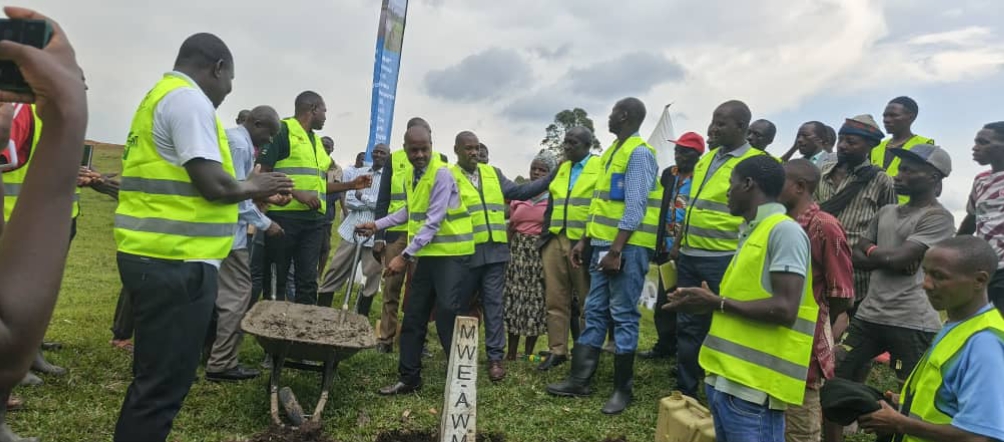

Kanungu District Local Government has launched the demarcation of the Nyamahundu wetland in Kirima Sub County, marking a new phase in Uganda’s fight against wetland degradation, a crisis that continues to fuel climate change, food insecurity, and local conflicts.
At the heart of the launch, district and ministry officials acknowledged that unchecked human activity, especially eucalyptus planting, farming, and settlement in wetlands,vhas placed fragile ecosystems at risk.
The Ministry of Water and Environment, working with the Irrigation for Climate Resilience Project (ICRP), has stepped in to draw clear boundaries to protect the wetland, a move intended to restore its ecological function while easing community tensions.
Assistant RDC Emmy Magezi noted that while wetlands are vital for water regulation and food production, many residents rely on them for short-term survival. To balance this, government pledged alternative livelihood options such as beekeeping and fish farming.
He warned those with eucalyptus trees inside the wetland to voluntarily remove them within three months or face eviction.

The District’s Chief Administrative Officer, Birungi Sam, stressed that long-term sustainability depends on local ownership.

“These wetlands are not government property alone, they serve the community. Protecting them protects us all,” he said.
But the issue remains sensitive. For many villagers, wetlands represent fertile land and livelihood opportunities, making government enforcement appear like displacement.
Magara Deus, speaking on behalf of the district chairperson, clarified that the initiative is not about chasing people away but ensuring proper use.
Gerald, from the Ministry’s Albertine Water Management Zone, explained that demarcation pillars are meant to safeguard wetlands for future generations.
He urged communities not to tamper with them but instead to embrace supported projects such as bamboo planting and grass harvesting.
Natural Resource Officer Agaba George outlined ongoing challenges, illegal encroachment, weak enforcement, and limited awareness, that require continuous monitoring and sensitization.
Security officials, including DISO Adamson Muhoozi, added that conservation must also be tied to peacebuilding, as disputes often arise over access to shrinking natural resources.
Local leaders like Kirima LC3 Chairperson, Kamahanga, welcomed the initiative, pointing out that clear boundaries will reduce community wrangles while promoting coexistence between conservation and livelihoods.
The launch, symbolized by the planting of a demarcation pillar in the presence of residents, underscored a wider national dilemma: how to save wetlands without undermining the survival of the communities that depend on them.