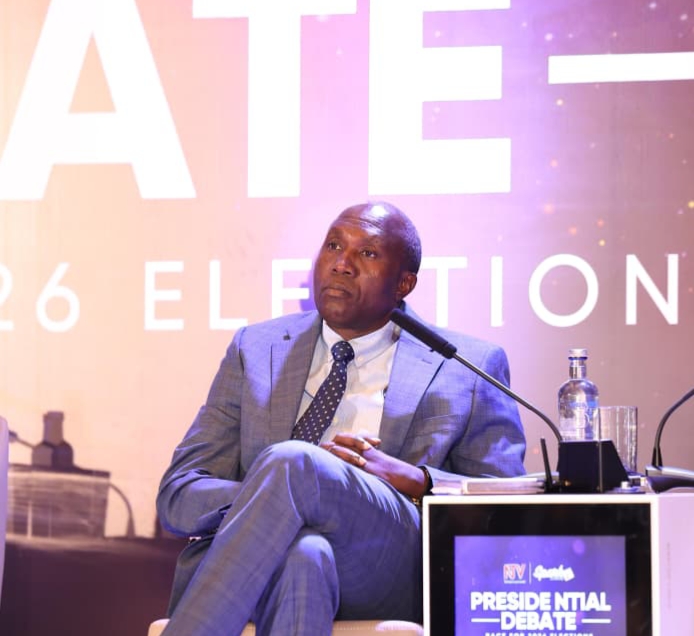

The Forum For Democratic Change (FDC) Party Secretary General, Nandala Nathan Mafabi, has accused the NRM government of presiding over a wasteful and exploitative economic system that has left Ugandan’s poorer despite a massive growth in the national budget since 1986.
Speaking during a presidential debate organized by Nation Media Group at Serena Hotel in Kampala on Sunday night while responding to questions on the economy and taxation, Mafabi recalled that in 1986, Uganda’s national budget stood at about Shs 777 billion.
He explained that even after “removing two zeros” from that figure, the country still managed to fund key services, including free university education, at a time when the country had only one public university.
“Today, when you remove two zeros from the current budget of Shs 72.3 trillion, you get about Shs 7.7 billion,” Mafabi said, noting that the budget has increased more than 10,000 times since 1986. “But what have we really got in return?” he asked.
Mafabi blamed the lack of visible transformation on wastage and corruption, which he described as one of Uganda’s biggest problems. He claimed that every year, over Shs 10 trillion is stolen through corrupt schemes.

“When that money is stolen, the government still has to run. So who pays? The taxpayer,” he argued. “People are not just paying taxes for services; they are paying taxes to cover theft.”

He added that a lot of money in Uganda is “in houses” instead of circulating in the formal economy. While it may be counted statistically, he said, it is not being productively used to create jobs and wealth.
Turning to the current national budget, Mafabi highlighted that out of the Shs 72.3 trillion planned for spending, government only expects to collect Shs 37.2 trillion in domestic revenue, leaving a deficit of Shs 35.1 trillion.
“That gap means only one thing: borrowing,” he said. “Government will run to commercial banks, and in reality even to money lenders, just like our local people do when they are desperate.”
Mafabi warned that heavy government borrowing from commercial banks leads to what economists call “crowding out” of the private sector. Because government is seen as a safer client, banks prefer lending to it rather than to businesses and entrepreneurs.
“If I want to borrow money to build a factory or invest in a serious project, the cost of money is too high,” he explained. “I walk away, and that investment never happens.”
Without investment, Mafabi noted, there can be no meaningful job creation. And if people remain unemployed, they have no purchasing power to buy goods and services, which also hurts government’s ability to collect consumption taxes like VAT and excise duty. As a result, he said, the tax base remains narrow, and the same small group of taxpayers is overburdened with new taxes.
Mafabi also raised concern over the growing exploitation of ordinary Ugandan’s by money lenders, who are now present in almost every village.
“These money lenders are giving people Shs 100,000 and charging 50% interest per month,” he said. “You cannot escape poverty under those conditions. You are tied to debt forever.”
He painted a worrying picture of an economy where a small minority is carrying the majority.
“Right now, about 14% of Ugandan’s are economically active and supporting the remaining 86%,” he said. “That is dangerous. A country full of dependants and beggars is unstable.”
Mafabi argued that the solution lies in releasing credit to the private sector, cutting corruption, and investing heavily in productive areas such as agriculture.
“If the government reduces its appetite for local borrowing, banks will have room to lend to the private sector at lower interest rates,” he said. “If we stop the theft of the Shs 9.9–10 trillion that disappears every year and invest it in agriculture and industry, we will create jobs and expand the tax base.”
He emphasised the need to revive cooperatives, especially in agriculture, to help farmers produce at scale, add value, and negotiate better prices.
“Insecurity in this country is largely driven by unemployment and poverty,” Mafabi said. “If people have jobs and incomes, insecurity will go down and tax revenue will go up without squeezing the same few people.”
Mafabi concluded by urging Ugandan’s to study the Forum for Democratic Change (FDC) Manifesto, which he said contains detailed proposals on how to tackle corruption, expand the tax base, and build an economy that works for the majority, not just a few at the top.
Mafabi also pledged sweeping governance and justice reforms, arguing that Uganda’s insecurity crisis is rooted more in poverty, inequality, and injustice than in the absence of armed protection.
He criticized the government’s heavy spending on security, saying the country’s current budget allocates 9.7 trillion shillings to the security sector largely to protect “an individual” rather than addressing the daily struggles of ordinary citizens.
“Security is a cost,” he said. “If people have what to eat, they will not be on the streets. The insecurity you meet today is not from lack of guards, it is from hungry citizens looking for survival.”
He argued that genuine peace and stability can only be achieved by tackling three fundamental issues: poverty, inequality, and injustice. He noted that while the Constitution provides for equitable development and special attention to less developed areas, government practice has fallen short, creating deep regional and social disparities.
Nandala Mafabi further accused the state of undermining the rule of law, saying many court decisions have become “political judgments” rather than judgments based on justice. He blamed this on excessive concentration of power in the presidency.
“In Uganda, the Head of State is also the Head of Government and interferes in all arms—the Executive, the Legislature, and the Judiciary,” he said. “The first reform we must undertake is to reduce the powers of the president and restore presidential term limits and age limits.”
He insisted that a functional democracy requires an independent Parliament, an independent Judiciary, and professional security organs. He said the police and the army should protect citizens and uphold law and order instead of “fighting and terrorizing” them.
Responding to concerns about the backlog in prisons and limited access to justice—where 89 percent of citizens reportedly know their right to seek justice but only 17 percent can claim it in time—Nandala Mafabi outlined his top justice sector reforms.
First, he promised to strengthen and adequately fund the Uganda Human Rights Commission to effectively investigate abuses and monitor detention conditions, especially for political prisoners.
Second, he vowed to end the criminalization of political competition, saying disputes arising from elections and politics should be resolved through political and legal processes, not through arrests and detention. “If someone is your political opponent, allow them to contest. There is no need to send your colleague to prison,” he emphasized.
Third, he pledged to improve access to justice through state-funded legal aid, mass civic education, and bringing services closer to the people. He highlighted the plight of rural citizens, like “a mother in the mountains,” who must travel long distances and incur high costs just to reach a court.
“Many people don’t know their rights, and for those who know, justice is too expensive,” he said. “The state should provide lawyers where citizens cannot afford one, and civic education should be on radio every day—explaining where to go, what to do, and how to seek justice.”
Nandala Mafabi also promised to overhaul the process of appointing judicial officers. He said judges and magistrates must be professionals, not political cadres, and proposed public vetting of senior judicial appointments, similar to practices in Kenya, to prevent “criminals and merchants” from presiding over justice.
He called on the Judicial Service Commission to audit judgments from lower courts upwards, to ensure that decisions meet standards of fairness and legality.
According to Nandala Mafabi, these reforms—reducing presidential powers, restoring term limits, professionalizing the security and justice sectors, and prioritizing equity and human rights—are essential to building a Uganda where security serves citizens and justice is timely, fair, and accessible to all.