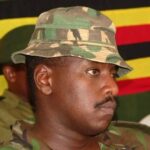
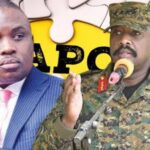



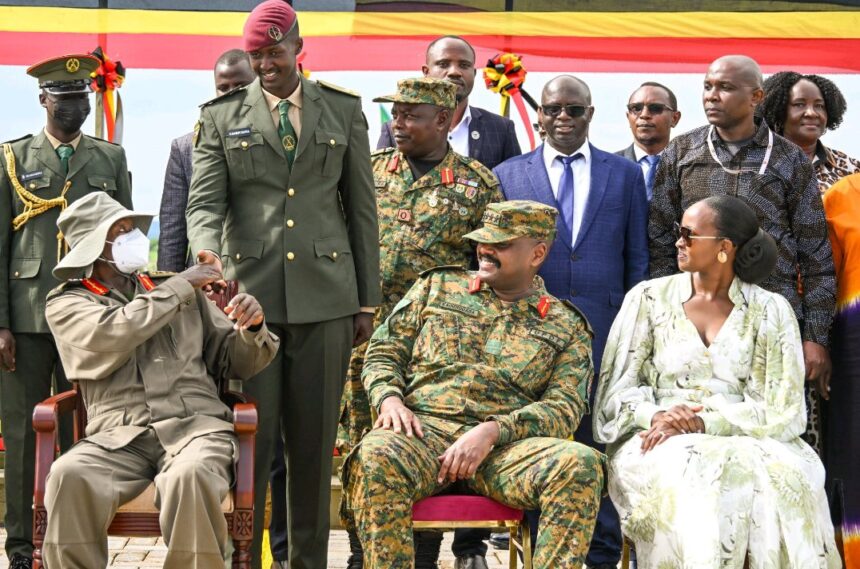

Uganda’s military establishment is at the centre of renewed political debate following the commissioning at Kabamba of Officer Cadet Ruhamya Kainerugaba, an event that has drawn attention to the presence of three generations of President Yoweri Museveni’s family within the Uganda People’s Defence Forces (UPDF).
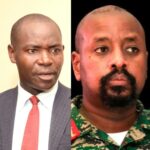
The development has triggered fresh questions about the intersection of family, military service and political succession in a country where discussions about the future leadership of the state have increasingly focused on Chief of Defence Forces Gen. Muhoozi Kainerugaba, the President’s son.
Ruhamya’s entry into the military, following reported training at the Royal Military Academy Sandhurst in the United Kingdom, has prompted commentators to describe the development as the beginning of what they call the “Ruhamya Project” — a label that has gained traction among those debating whether the Museveni family’s influence could extend into another generation.

President Museveni represents the oldest generation in the discussion, while Gen. Muhoozi currently heads the UPDF.
Ruhamya’s commissioning now adds another generation to the family’s military profile, creating a politically significant picture that has attracted attention both online and within political circles.

However, the emergence of the three-generation narrative has also revived a difficult question: where does the family’s military tradition end, and where do concerns about the concentration of influence in a single family begin?

Supporters of the First Family’s military background argue that its members have a longstanding connection to Uganda’s security establishment and that military service should not automatically become controversial because of family relationships.
From this perspective, individual qualifications, training and performance should determine a military officer’s suitability for service.Critics, however, argue that the development deserves scrutiny because of the UPDF’s central role in Uganda’s political history and the continuing public debate surrounding Muhoozi’s potential political future.
They question whether the appearance of another generation of the presidential family in the military could further strengthen perceptions that national institutions are becoming closely associated with one political lineage.
The commissioning itself does not establish that Ruhamya has been selected for a political role, nor does it demonstrate that a future presidential succession plan has been formally drawn up.
Nevertheless, the timing has fuelled speculation among commentators who see the development within the broader context of Uganda’s unresolved succession debate.The distinction is important. Military training and service are not, by themselves, proof of a political project.
Equally, the presence of several generations of one family in an influential state institution is a legitimate subject of public scrutiny, particularly in a country where citizens continue to debate accountability, institutional independence and the future distribution of political power.
The controversy also raises questions about transparency and equal opportunity. Ugandans are entitled to ask whether recruitment, training, promotion and command appointments within the armed forces follow clear professional standards that apply equally to all officers, regardless of their family connections.
For the UPDF, the challenge is to maintain public confidence that professional merit, discipline and institutional rules remain paramount. For the political establishment, the wider question is whether concerns about succession and family influence can be addressed through transparent institutions rather than left to speculation on social media.
As the debate over the “Muhoozi Project” continues, Ruhamya’s entry into military service has introduced a new generation into the conversation. Whether this amounts to nothing more than a family tradition of military service or becomes a lasting symbol in Uganda’s succession debate remains an open question.
For now, the commissioning has placed one issue firmly before the public: how can Uganda guarantee that its national institutions serve the country as a whole, rather than create the perception that access to influence and power follows family lines?