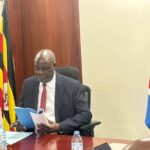





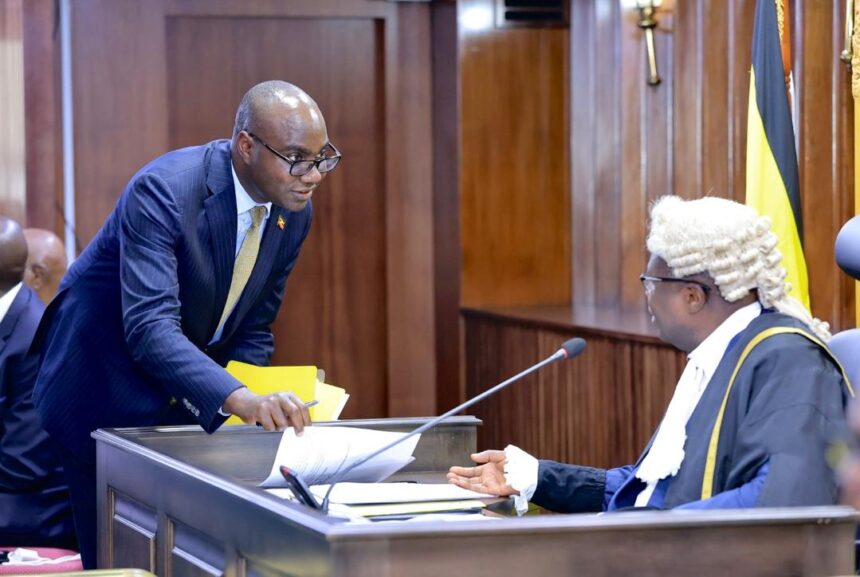

The Minister of Finance, Planning and Economic Development, Henry Musasizi, has said public servants working at district headquarters, cities and town councils are not entitled to hardship allowances, even when their duty stations are located in areas designated as hard-to-reach.
Minister Musasizi said the allowance is specifically intended for public officers deployed in remote and underserved areas where government has persistently struggled to attract and retain skilled personnel.
“Payment of hardship allowances excludes civil servants working at district headquarters, in cities and town councils of the designated local governments,” Musasizi said.
In a statement presented to Parliament on Tuesday, November 10, 2026, he clarified that the allowance is calculated at 30 per cent of the approved salary structure for the 2017/2018 financial year, rather than the beneficiary’s current salary.
Government introduced the hardship allowance under the Public Service Reform Programme to address staffing shortages in areas affected by geographical isolation, insecurity, poor infrastructure and limited access to essential social services.

The programme took effect on July 1, 2010, initially covering 24 designated local governments.

However, Members of Parliament questioned the criteria used to determine areas eligible for the allowance, arguing that some communities face difficult living and working conditions despite being located in districts not classified as hard-to-reach.
Rubanda West MP Bruce Balaba cited Kabale District, which is not on the list of designated hard-to-reach areas, despite some communities facing significant accessibility challenges.

“Even though Kabale is a modern district, it has areas where students and teachers must use canoes across Lake Bunyonyi to access schools, and many of them end up dying,” Balaba said.
Bushenyi District Woman MP Annet Katusiime raised similar concerns about Ruhumuro Sub-county, where she said poor accessibility had discouraged public servants from accepting deployments.
Kaberamaido County MP Alfred Edakasi also said communities located on peninsulas in Kaberamaido have teachers who travel by boat to reach schools but do not benefit from the allowance.
In response, Musasizi undertook to present the legislators’ concerns to Cabinet for consideration.
The minister also addressed concerns raised by Kole North MP Samuel Opio over the taxation of allowances paid to local government councillors.
Opio said the Uganda Revenue Authority (URA) imposes a 30 per cent Pay As You Earn (PAYE) tax on councillors, including those whose only source of income is the allowances.
He argued that many councillors depend entirely on the payments for their livelihood and should therefore be exempted from the tax.
Opio also questioned the practice of leaving chief administrative officers to determine which councillors should be taxed, saying it had resulted in inconsistent deductions across local governments.
Minister Musasizi clarified that councillors whose only source of income is their allowances should not be subjected to PAYE, describing the reported blanket deductions as an error.
“The law requires that a councillor who has no other source of income and receives only allowances should be exempted. If one has other sources of income, such as rental income or earnings from other businesses, that is considered secondary employment and is charged,” Musasizi said.
He assured Parliament that the ministry would engage URA and local governments to address the inconsistencies and ensure the tax provisions are properly understood and implemented.