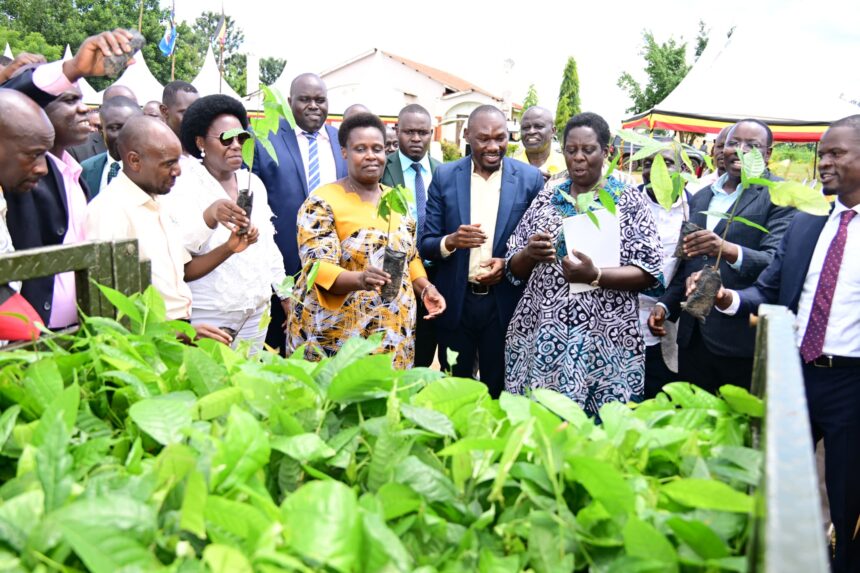

The Vice President Jessica Alupo, together with leaders from the Bukedi Sub-region, has launched a national campaign aimed at increasing Coffee and Cocoa production as part of efforts to fight poverty and drive economic transformation.
The initiative, dubbed the “National Kibaalo Concepts Awareness Campaign,” seeks to produce and distribute about 80 million Coffee and Cocoa seedlings to farmers across the region through large-scale multiplication centres.
“When you produce millions of bags of coffee and cocoa, it means we shall need factories and industries here to process them for export markets. This will create thousands of jobs that will benefit our people,” Alupo said while representing President Museveni at the launch in Budaka District.
She commended the initiative and urged the Ministry of Agriculture to strengthen farmer support systems from planting to harvest.
“Be helpful to us as we introduce crops of high value to our economy. They should be preserved from the time of planting up to harvest,” she said.

Alupo expressed optimism that the programme would accelerate industrialisation, create employment opportunities, and increase household incomes across Bukedi.

The campaign comes at a time when the Ministry of Agriculture has confirmed that Bukedi soils are highly fertile and well-suited for coffee production.
Historical and economic context
The Vice President noted that African societies have long been economically productive, citing early European explorers who documented the region’s wealth.
“When you read books written by early European travelers like Henry Morton Stanley, you will find they wrote about the huge wealth they found here,” she said.
She explained that pre-colonial economies operated largely through barter trade, locally known as okuchurika, and that early forms of currency such as cowrie shells (ensiimbi) existed before the introduction of the modern money economy under colonial rule.
Alupo further noted that by 1962, Uganda had developed a limited “enclave economy” dominated by a few export commodities such as coffee, cotton, copper, tea, tobacco, and tourism.
“At independence, the economy was a small island of money economy surrounded by a sea of underdevelopment,” she said, adding that post-independence disruptions weakened key sectors, leaving coffee and tobacco as the surviving export pillars.
Economic transformation agenda
She said Uganda’s long-term goal has been to transform into a modern, industrialised society driven by four key sectors: commercial agriculture, manufacturing, services, and ICT.
“Our strategic goal is to ensure every working-age Ugandan participates in one of these sectors, either as an owner or employee,” she said.
Alupo added that since 1986, the NRM government has guided Uganda through four economic phases, including recovery of the 3Cs and 3Ts, expansion and diversification of exports, and gradual transition towards a knowledge-based economy.
She noted that infrastructure development in roads, electricity, and ICT has been central to this progress, with the economy growing from USD 1.5 billion in 1986 to about USD 61 billion today.
“This is why I insist that Uganda will reach USD 500 billion by adding value to our raw materials—agriculture, minerals, forests, and fresh-water products,” she said.
Regional mobilisation
To support the campaign, leaders also launched the annual Bukedi Coffee Run, aimed at mobilising funds for seedling production and distribution.
Tororo County North MP-elect Nicholas Owino described the initiative as a major economic turning point for Bukedi.
“It means Bukedi is finally returning to the money economy,” he said.
Bukedi Leaders Forum Coordinator Jona Oboth said the run will be held annually for the next ten years to sustain seedling production and farmer participation.
Coffee currently contributes nearly 20 percent of Uganda’s export earnings, and leaders believe that with sustained investment and farmer engagement, Bukedi could emerge as a leading agricultural production hub in the country.