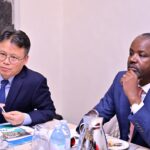
The Bank of Uganda has revealed that it was never consulted during the drafting of the Protection of Sovereignty Bill, 2026, a disclosure that has drawn sharp criticism from Members of Parliament over the handling of the proposed law.
Governor Michael Atingi-Ego made the admission while appearing before a joint sitting of the Committee on Defence and Internal Affairs and the Legal and Parliamentary Affairs Committee, where he presented the central bank’s position on the controversial Bill.
His remarks came in response to concerns raised by MPs Jonathan Odur (Erute South) and Abdu Katuntu (Bugweri County), who questioned whether the central bank had been given an opportunity to advise government on the Bill’s potential monetary implications.
Odur sought clarity on the Bank’s engagement with the Executive, asking whether it had provided input on the economic consequences of the proposed legislation and what feedback, if any, had been received.
Katuntu criticised what he described as a failure by government to conduct adequate consultations before tabling the Bill in Parliament. He noted that the scrutiny currently being undertaken by legislators should have been done earlier by the Executive through engagement with key stakeholders.

“What we are doing today is what should have been done by government,” Katuntu said. “Institutions like the central bank, the Financial Intelligence Authority, Makerere University, and commercial banks should have been consulted. Instead, stakeholders appearing before the committee seem uncertain about the origins of this legislation. That is a serious problem.”

He further urged the Bank of Uganda to engage the Ministry of Finance to ensure such lapses do not recur, stressing that government agencies should present a unified position before submitting legislation to Parliament.
“It is quite concerning that government institutions appear not to agree. By the time a Bill comes to Parliament, there should have been sufficient consultation and consensus among all relevant agencies,” Katuntu added.
Atingi-Ego cautioned Parliament against passing the Bill in its current form, warning that it could have far-reaching economic consequences.
He said the proposed law risks weakening the Ugandan shilling, reducing financial inflows, and undermining the country’s ability to service its public debt.
“We are likely to see significant currency depreciation, as imports become more expensive in an attempt to balance trade. This is a major risk,” he said. “Reduced financial inflows would also limit our ability to build foreign exchange reserves, yet a country without reserves cannot claim true sovereignty.”
The Governor emphasised that while protecting national interests is a legitimate objective, the Bill, as drafted, could reverse decades of financial sector progress achieved through liberalisation.
“True national sovereignty is built on economic strength and financial independence,” Atingi-Ego said. “If refined appropriately, the Bill can safeguard national interests without undermining the robust financial architecture that has supported Uganda’s economic growth and its long-term goal of becoming a 500-billion-dollar economy.”
In a rare move, the Governor appeared alongside his deputy, Augustus Nuwagaba, underscoring the central bank’s concern over the potential impact of the legislation.