
The Chief Justice, Dr. Flavian Zeija, has announced a significant increase in the pecuniary jurisdiction of lower courts, a move aimed at improving access to justice and easing the burden on higher courts.
Under the new reforms, the jurisdiction of Magistrates Grade I has been raised from Shs 20 million to Shs 100 million, while that of Chief Magistrates has increased from Shs 50 million to Shs 200 million.
Justice Zeija explained that the changes are intended to reduce the distance litigants travel to access justice and enhance efficiency at lower courts, in line with recent amendments to the Magistrates Courts Act.
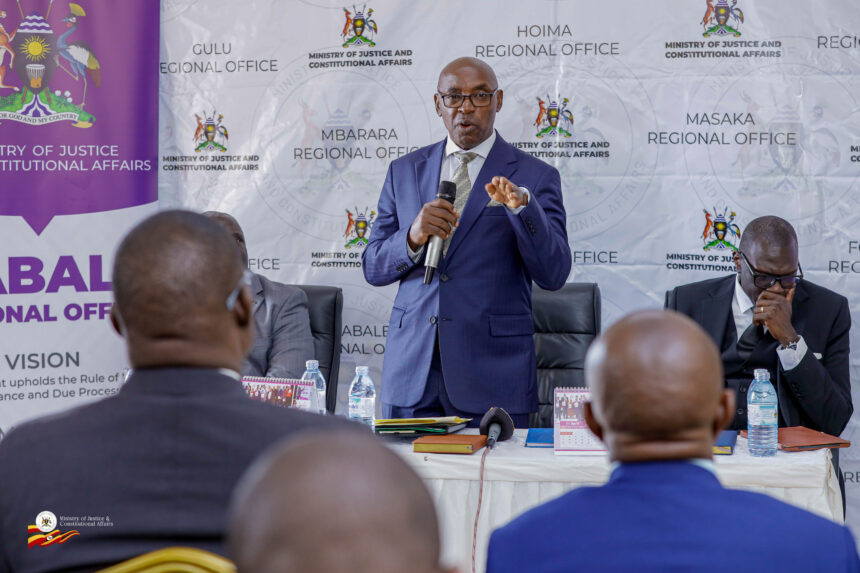
The Chief Justice revealed this on Tuesday during a visit to Rukiga Magistrate’s Court in Rukiga District, where he met judicial officers and justice sector stakeholders to assess service delivery and gather feedback on access to justice.
He was accompanied by Karoli Lwanga Ssemogerere, the Kabale High Court Judge; the Permanent Secretary/Secretary to the Judiciary, Dr. Pius Bigirimana; and the Acting Chief Registrar, Lamunu Pamella Ocaya.

The engagement brought together a wide range of stakeholders, including judicial officers, representatives from the Uganda Police Force, Uganda Prisons Service, the Office of the Director of Public Prosecutions, the Ministry of Justice and Constitutional Affairs, as well as advocates, district leaders, and religious leaders.

Justice Zeija outlined key initiatives under the Judiciary’s transformation agenda, including the decentralization of the Inspectorate of Courts and the Court of Appeal, the rollout of mobile courts to serve hard-to-reach communities, and ongoing infrastructure development across the country.
He also emphasized the promotion of Alternative Dispute Resolution (ADR), particularly mediation, citing the recently issued Judicature (Court Annexed Mediation) Rules, 2026.
He noted that mediation fosters amicable settlement of disputes, reduces appeals, and contributes to timely justice delivery.
He added that the Judiciary is training local, cultural, and religious leaders in mediation to strengthen dispute resolution at the community level.
The Chief Justice commended Rukiga District for offering land for the construction of a court and reiterated the Judiciary’s policy of establishing at least one Grade I Magistrate’s Court per constituency, with additional courts based on need.
While acknowledging staffing gaps, he assured stakeholders that more judicial officers will be recruited when resources allow.
On the absence of a State Attorney in Rukiga, Justice Zeija pledged to engage the Office of the Director of Public Prosecutions to explore deployment options, noting that the gap contributes to delays in criminal case disposal.
He also advised the Chief Magistrate to utilize operational funds to address basic challenges such as water and electricity connections at the court.
Regarding transport, he said priority has been given to hard-to-reach areas such as Rukiga, Kisoro, and Kabale, with plans to provide additional vehicles over time.
Addressing concerns about the lack of a female prison facility in the district, the Chief Justice acknowledged the logistical challenges involved and committed to engaging the Uganda Prisons Service on the matter.
Justice Ssemogerere noted that Rukiga had gone for years without an operational court following the phasing out of Grade II Courts, describing the establishment of the current court as a major milestone.
However, he raised concerns about the distance between some newly established courts within the district, including Kamwezi and Rwamucucu.
In his remarks, Dr. Bigirimana urged the district to provide at least 1.5 acres of land for court construction, warning that inadequate space could hinder development.
He pledged to provide a motorcycle and a computer to the court before the end of June and assured stakeholders that furniture, signage, and fencing would also be addressed.
He further emphasized his role in mobilizing resources for the Judiciary, including infrastructure, transport, and human resources, to support efficient service delivery across the country.