
Summary:
- Daniel Emadu, Senior Environmental Health Officer at the Rural Water and Sanitation Regional Center II, Ministry of Water and Environment, explained that due to the rampant corrosion of galvanized iron pipes, the ministry issued a directive in the 2017/18 financial year for all districts to use stainless steel pipes.
KATAKWI: Following the widespread distribution of galvanized iron (GI) pipes for water systems in Katakwi District by politicians, the Ministry of Water and Environment has issued a warning to local lawmakers to stop providing substandard materials for borehole rehabilitation.
The warning comes after some politicians replaced durable stainless steel pipes with galvanized iron pipes, which corrode after 2 to 3 years, whereas stainless steel pipes last for over six years.
Daniel Emadu, Senior Environmental Health Officer at the Rural Water and Sanitation Regional Center II, Ministry of Water and Environment, explained that due to the rampant corrosion of galvanized iron pipes, the ministry issued a directive in the 2017/18 financial year for all districts to use stainless steel pipes. This directive aimed to prevent water sources from becoming more acidic and hazardous to public health.
“In 2016, Uganda had 35,896 boreholes, with 5,700 of them utilizing galvanized iron pipes,” Emadu said. He urged all stakeholders to adhere to water and environmental sector regulations to avoid causing harm.

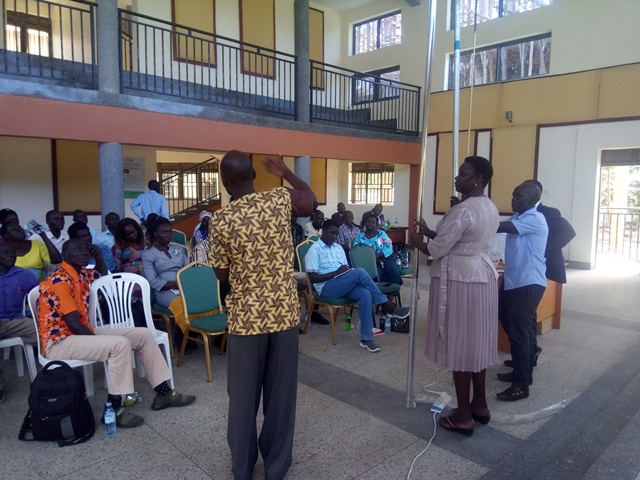
Emadu made these remarks during a stakeholders’ meeting held on Wednesday, September 25, 2024, at the Katakwi council hall.

Ezasa Lydia Apio, the District Water Officer, said Katakwi has about 600 boreholes, with 360 equipped with stainless steel pipes and 340 with galvanized iron. Apio criticized politicians for replacing the longer-lasting stainless steel pipes with short-term galvanized iron pipes during borehole rehabilitation, describing it as a disservice to the community and a violation of ministry guidelines.
She clarified that while the district welcomes political support for community water services, politicians must work with the district water office and comply with ministry regulations.
Geoffrey Omolo, the LC5 chairman of Katakwi, echoed this sentiment, stating that all stakeholders are welcome to contribute to water services, but they must adhere to the guidelines. He accused some political figures of spreading misinformation and propaganda, emphasizing that no one is prohibited from contributing to water projects, as long as they cooperate with the water office.
“We don’t reject anyone who wants to help address water issues, but they must remain in touch with the water office to ensure proper service delivery to the community,” Omolo said.
Clare Okiror, personal assistant to Hon. Andrew Joseph Koluo of Toroma, noted that while members of parliament have faced challenges using galvanized pipes, they have often been pressured by constituents to act quickly, which has sometimes led them to overlook the policy. She urged the district water office to profile both galvanized and stainless steel boreholes to address the problem.
Joseph Isadat, the district councilor for Katakwi Town Council, called on political assistants to work closely with the district water office in implementing the proper rehabilitation materials.
Moses Oluka, a health inspector for Usuk Town Council, urged the government to support its policy by stopping the production of galvanized iron pipes and rods to ensure full compliance.
Rtd. Maj. Godfrey Katamba, the Resident District Commissioner of Katakwi, highlighted that water is a key issue in the National Resistance Movement (NRM) manifesto, second only to education, stressing the importance of delivering on promises to the electorate.
Several stakeholders, including Clare Okiror, Gabriel Ogele (representing Daniel Mulalu, a parliamentary aspirant for Ngariam County), and Richard Ongoro (aspirant for Usuk County), attended the Wash advocacy meeting organized by the Ministry of Water and Environment at the district chambers.
Many politicians have been involved in borehole restoration projects, but the stainless steel pipe policy may create challenges for some, as stainless steel pipes cost 200,000 UGX and rods 101,000 UGX, while galvanized pipes in the open market range from 60,000 to 70,000 UGX.